Homeworlds Booster Buying Guide: Standard Packs, Carbonite, and What to Buy
Affiliate disclosure: As an Amazon Associate, B3 earns from qualifying purchases.
Homeworlds gives Star Wars: Unlimited players new ways to care about the base they brought and the world printed on it. It also creates a familiar buying question: do you want a complete deck, a pool of cards to build with, or premium versions to collect? Those goals point toward different products even when every box carries the same set logo.
My recommendation is to choose the game you want to play before choosing the amount of sealed product to open. A Spotlight Deck is the predictable starting point for learning one leader. Standard boosters make more sense for limited play and an opening experience. Carbonite is a collecting purchase whose premium presentation does not make its cards necessary for ordinary gameplay.
What is Homeworlds?
Homeworlds is the ninth Star Wars: Unlimited set. Its theme centers on alien worlds, their inhabitants, and the armies invading them. The official overview describes more than 260 new cards, the Fortify keyword, Beast tokens, and Weakness tokens. That is enough to create new deckbuilding questions, but the theme alone does not tell you which cards improve a particular list.
The two supplied Spotlight leaders are Chewbacca — Relentless Rebel and Grand Moff Tarkin — Architect of the Tarkin Doctrine, whose deployed side is the Death Star. They are separate fixed decks. A standard booster does not supply one of those complete lists just because its wrapper belongs to Homeworlds.
Standard boosters: what the official description actually says
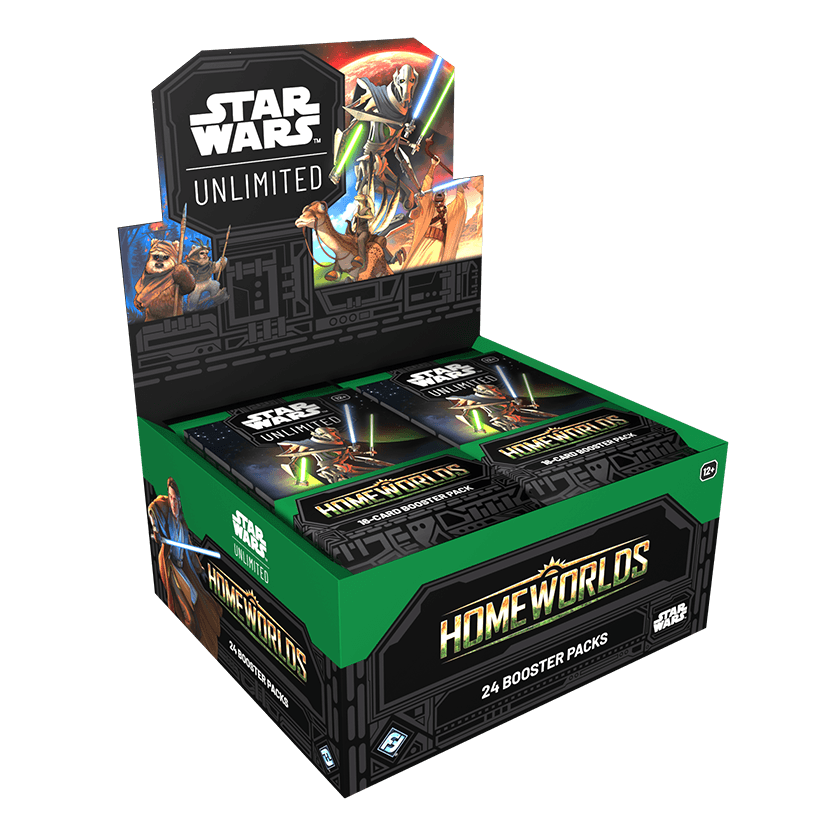
The Homeworlds product page describes a standard pack as 16 cards: approximately nine commons, three uncommons, one rare or legendary, one leader, one base/token, and one Hyperspace-foil card. Preserve the word “approximately” when describing the distribution. Do not substitute an earlier set's generic foil wording or assume every slot guarantees a particular gameplay card.
A display contains 24 standard packs. At 16 cards per pack, that is 384 cards, including the leader and base/token slots, not 384 main-deck cards and certainly not 384 distinct cards. Repeated commons are expected in a randomized product. A display is not advertised here as a full set, a complete playset, or a guaranteed collection of specific leaders and legendaries.
The distinction matters when comparing listings. Some retail descriptions can mix generic text from other sets or use a different card-count shorthand. Match the exact product, language, quantity, and edition to the official contents instead of treating a short marketplace bullet as the final rules authority.
Decide whether you want certainty or randomness
If your goal is to learn Chewbacca this weekend, a complete Chewbacca deck answers the question directly. If your goal is a particular Fortify upgrade for a Tarkin list, compare buying that exact card with the sealed product you would otherwise open. If your goal is drafting with friends, the experience requires packs, so singles do not replace it.
I would write the objective in one sentence before buying. “I want to explore the new set by opening six packs and building” is a coherent entertainment purchase. “I need a specific pair of cards” is a different task. Confusing the two makes it easy to keep opening because the deck is always one lucky pull away from finished.
The same distinction applies to gifts. A booster display can be exciting for an existing player. For somebody with no deck, no damage tracking, and nobody to teach them, a fixed deck or learning product may make the first game much easier to arrange.
Fortify: the base becomes part of the engine
Fortify lets the relevant upgrade attach to your base instead of a unit. That changes which part of the board you invest in. A unit upgrade is exposed to the fate of its host; a base upgrade can support a longer plan while the base remains the objective your opponent is trying to defeat. Its printed ability and cost still determine whether it is worth the action.
Tarkin's leader ability ignores aspect penalties on Fortify upgrades. It does not make those upgrades free, does not remove every aspect penalty in his deck, and does not turn a nine-resource deployment threshold into a payment of nine ready resources. If you are buying cards for that leader, distinguish the exceptional permission from the ordinary costs that remain.
I would evaluate a Fortify card by asking what happens on the turn you play it. Does it immediately reduce pressure or improve a subsequent play? Or are you spending an action and resources while the opponent's existing units continue attacking? An impressive long-game payoff may still arrive too late when the base race is already lost.
Beast and Weakness tokens: calculate what changes
Beast tokens are 3-power, 3-HP token units. They add board presence, but the card creating them determines the cost, timing, and conditions. Do not count a token as an immediate ordinary attack just because it was created during the action phase. Follow the normal exhausted-entry procedure and any specific exception on the effect.
A Weakness token gives its attached unit -1 power and -1 HP. Reducing HP can be as important as reducing future attacks. In an invented example, a unit with 4 HP and three existing damage survives normally. Attach a Weakness and its HP becomes three; that can defeat it immediately through the damage check. This is not the same as dealing another point of damage, and a Shield is not a blanket answer to a stat reduction.
These mechanics make visible counters and accurate current stats important. A player evaluating only the printed numbers may miss a lethal threshold or a newly favorable exchange. When considering purchases, ask whether the actual card creates that useful situation at a reasonable cost instead of valuing every token-making card equally.
Planet traits are a reason to read the base
Homeworlds includes cards that refer to base traits such as Endor. A base can therefore support more than an aspect and HP total. Before replacing a base just to change an icon, inspect which cards in your list refer to its trait. A seemingly small change can switch off part of the plan you thought you were preserving.
For a first deck experiment, keep the supplied list and base together until you know why each was chosen. If you change the base, write down which synergies you gain and which you lose. That is a more useful starting point than assuming every base of the same aspect is interchangeable.
Prerelease boxes: six packs with a purpose
The official Prerelease Box contains six boosters plus supporting materials. Its natural use is a sealed learning or event experience. Do not compare its price with six loose packs while ignoring whether you want the included materials or event participation. Equally, a retail box purchased after release does not automatically include entry into a store event.
For an organized session, confirm the store's format and product requirements before ordering. If you are arranging casual limited play at home, agree on the rules and what supplies everyone needs. A pack-opening evening is much easier to enjoy when nobody discovers halfway through that they expected a constructed match instead.
Carbonite: pay for the treatment because you want it
Homeworlds follows the later pack configuration introduced with A Lawless Time. Non-foil Prestige can appear in standard packs; foil and serialized Prestige remain exclusive to Carbonite. See our full Carbonite explainer for the earlier and later contents, treatment names, and buying comparisons.
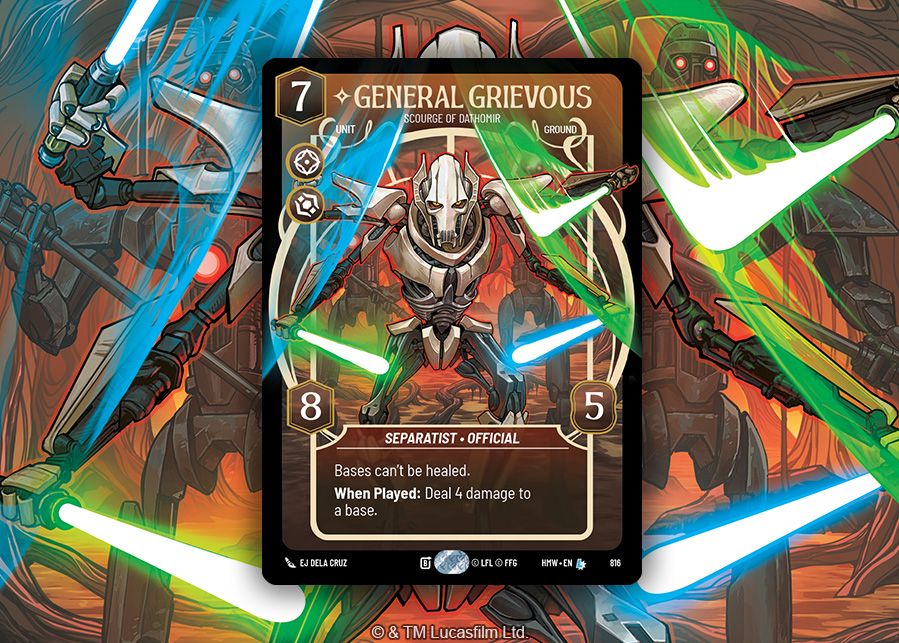
Carbonite Edition packs emphasize special visual treatments, including Prestige variants, and the official product description says the edition is limited and will not be reprinted. That is a product fact, not a forecast of resale value. Limited supply does not guarantee appreciation or make an expensive pack the best way to obtain a playable card.
I would treat Carbonite as a discretionary collecting budget. Decide what the opening experience and premium treatments are worth to you without counting on a valuable result. If your actual need is an affordable functional deck, ordinary copies can serve that purpose without a premium finish.
Never compare a standard display and a Carbonite display by the word “box” alone. Check the pack count and the exact edition. A lower headline price may belong to one pack, a different product, or a listing whose photograph shows more than the selected offer includes.
Release dates do not prove stock availability
The headline release date was October 9, 2026, but Fantasy Flight Games issued a regional product-delay update. Carbonite supply was affected globally, and additional products were delayed in some regions. Australia and New Zealand received revised October 15 prerelease and October 16 release dates. For the United States, the update directs players to check local availability.
That notice does not establish the stock position of a particular seller today. Read the actual delivery estimate and compare several legitimate offers before paying a scarcity premium. A listing being visible is different from a retailer having sealed product ready to dispatch.
Compare delivered prices with a simple calculation
Here is a hypothetical example, not a live quotation. A 24-pack display priced at $96 delivered works out to $4 per pack. Six equivalent loose packs at $5 each cost $30. If you only want six packs, the larger purchase still requires an extra $66 even though its unit price is lower. A discount per pack is not a saving when it persuades you to buy far beyond your intended experience.
If two exact cards would cost $12 delivered as singles, compare that certainty with the randomized purchase honestly. You may still prefer opening packs, but the reason is entertainment and discovery. Do not describe the full display cost as a necessary deckbuilding expense when you already know the small number of cards you need.
Check the Amazon offer carefully
I could confirm Homeworlds product mentions on Amazon, but not a dependable exact standard-display listing identity. The link below is therefore labeled as a search. Check the selected result for Homeworlds, standard versus Carbonite edition, 24-pack quantity where applicable, English language if required, sealed condition, actual seller, and delivered cost. A neighboring set's listing is not a substitute just because its recommendations mention Homeworlds.
Search Amazon for a Homeworlds standard booster display (Search link; confirm the exact product before buying.)
What I would buy first
For learning a leader, start with the relevant complete Spotlight Deck and use the linked guide. For a specific upgrade, identify the exact card and compare singles. For a group limited session, buy the correct standard packs for the agreed format. For premium collecting, set a separate Carbonite budget you can enjoy without relying on resale.
Homeworlds has interesting mechanical reasons to explore it. The most useful purchase is the one that lets you engage with those decisions at the table, rather than leaving you with a larger stack of cards and the same unanswered question about what to play.
Choose a deck or learn the game
Learn Star Wars: Unlimited with B3’s first-game guide, then compare the main product types. For fixed Homeworlds decks, read the Chewbacca guide or the Tarkin guide.
Sources
Checked October 20, 2026: official Homeworlds products and pack distribution, Homeworlds first look, regional release update, and current rules. B3 is independent of Lucasfilm, Fantasy Flight Games, and Asmodee.
Considering packs for upgrades? Read the Homeworlds booster buying guide before choosing a sealed product. For premium treatments, see Carbonite packs explained.