Star Wars: Unlimited Carbonite Packs Explained: Contents, Prestige, and When to Buy
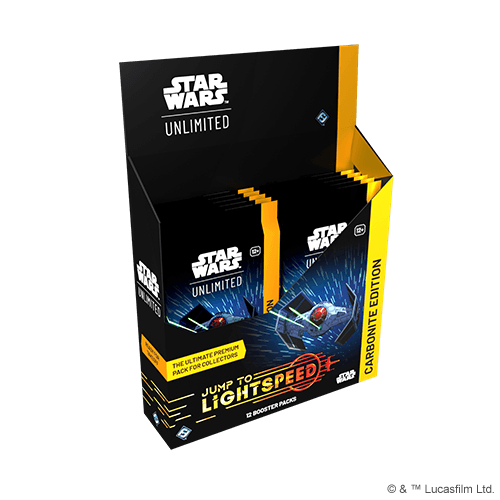
Carbonite is Star Wars: Unlimited's premium pack-opening product. I would buy it because I wanted a concentrated opening of special artwork and finishes, with a budget I could enjoy spending even if the most exciting pull never appeared. I would not buy it to make a deck playable or because a limited print run sounded like a guaranteed return.
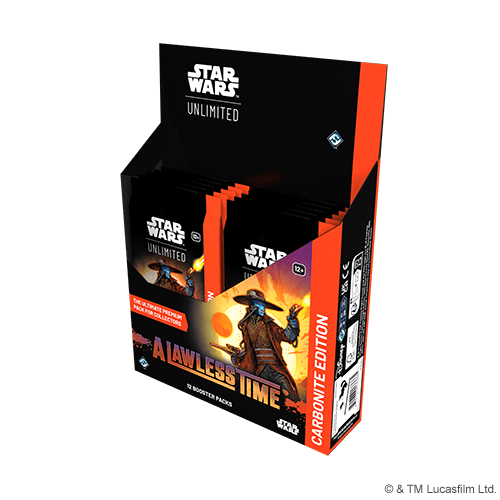
The confusing part is that Carbonite has changed. The pack introduced with Jump to Lightspeed is not the same configuration as the one introduced with A Lawless Time. Old explanations of Prestige exclusivity and serialized numbering can therefore be accurate for their original release and misleading for the box you are considering today.
In this Carbonite guide
- The quick answer: do you need Carbonite?
- Standard vs. Carbonite: identify the edition first
- Know what the treatment names mean
- The original Carbonite configuration: sets four through six
- What changed with A Lawless Time?
- Can you pull Prestige from standard packs?
- Does a rarer treatment make a card stronger or legal?
- A concrete budget comparison
- Limited print run does not mean guaranteed profit
- Before ordering: check the selected offer
- Find a specific Carbonite product
- B3’s recommendation
The quick answer: do you need Carbonite?
For gameplay, no: Carbonite does not contain mechanically unique cards unavailable in ordinary versions. A premium treatment changes presentation, not the card's rules. For a collector who enjoys the variants themselves, that presentation can be the whole point.
I would put a complete deck, sleeves, and games ahead of premium packs when starting. If the goal is one exact artwork, I would price that single before buying randomized product. Carbonite makes the most sense when the opening experience is part of what you want to purchase.
Standard vs. Carbonite: identify the edition first
Both products contain 16-card packs. A standard display has 24 packs; a Carbonite display has 12. One box of each therefore gives you 384 versus 192 cards before considering the different treatments. Compare delivered price per pack and total spending, not just a price next to the word display.
Carbonite began with Jump to Lightspeed, the fourth set. The first three releases—Spark of Rebellion, Shadows of the Galaxy, and Twilight of the Republic—did not have an original Carbonite Edition. Later products must be identified by their own set and edition rather than assuming every SWU release offers the same package.
Know what the treatment names mean
Foil describes a finish. Hyperspace is an alternate frame treatment; a Hyperspace-foil combines that presentation with foil. Showcase refers to special alternate-art leader versions. Prestige is another alternate-art and graphic treatment with multiple tiers. These names describe different things, so a listing promising foil cards is not automatically promising the Prestige card you have in mind.
For a binder target, record the full card name, set, treatment, language, and condition. Two versions can share rules text while satisfying very different collecting goals. If you mainly want the picture, paying extra for a serial number may add nothing to your enjoyment; if you want the numbered edition specifically, an unnumbered copy does not complete that target.
The original Carbonite configuration: sets four through six
| Original pack slot | Cards |
|---|---|
| Hyperspace or Showcase leader | 1 |
| Foils | 7 |
| Hyperspace cards | 5 |
| Hyperspace-foils | 2 |
| Prestige card | 1 |
| Total | 16 |
This is the original configuration described by Fantasy Flight for Jump to Lightspeed, before the later Lawless changes. It is the relevant starting point for Jump, Legends of the Force, and Secrets of Power. A guaranteed Prestige slot is not a guarantee of its foil or serialized tier, a particular character, or a valuable resale result.
The original Prestige tiers were non-foil alternate art, a special foil version, and a foil serialized version. Original serialized Prestige cards were numbered to 250. Do not turn a print-run number into a personal probability: knowing how many numbered copies exist does not tell you how many packs were printed or how they are distributed among sellers.
What changed with A Lawless Time?
From A Lawless Time, normal black-border foils were removed. Carbonite increased its Hyperspace content, including six Hyperspace-foils per pack instead of two. Non-foil Prestige also became possible in standard packs; foil and serialized Prestige remained Carbonite-exclusive. Some serialized cards now have print runs of 100 or 50 alongside the usual 250.
That is the essential correction when reading an older guide: Prestige is no longer an entirely Carbonite-exclusive category in later sets. The set-specific packaging and the official change announcement take precedence over generic retailer copy describing every Prestige card as exclusive.
Can you pull Prestige from standard packs?
Yes, beginning with A Lawless Time, at the publisher's approximate non-foil Prestige rate of one in eighteen standard packs. Earlier standard packs do not gain that feature retroactively. An eighteen-pack purchase is not a guarantee, and opening seventeen without one does not make the next pack due.
This is an average across production, not a sequence promised inside your order. I would never buy another pack solely because the previous opening felt unlucky. Decide the quantity beforehand and assess the opening by the entertainment you purchased, not by an imagined obligation for the next pack to compensate you.
Does a rarer treatment make a card stronger or legal?
No. Use the underlying card identity and current format rules. A premium version does not bypass rotation, copy limits, errata, or suspension. A character can also have several different leader and unit cards, so compare the exact subtitle and set identity before copying a list.
For play, I would buy the least expensive suitable version I liked handling. For collecting, I might choose an artwork or finish for its own sake. Keeping those two reasons separate prevents the price of a beautiful card from becoming an invented gameplay requirement.
A concrete budget comparison
Here is hypothetical arithmetic, not a live price quote. A $240 Carbonite display costs $20 per pack across twelve packs. A $96 standard display costs $4 per pack across twenty-four. Carbonite costs $144 more while supplying half as many cards; its case must rest on the treatments and opening experience, not bulk volume.
Now suppose the particular premium single you want costs $45 delivered. Buying it spends $45 with certainty about the target. Buying a $240 randomized display spends $240 on a broader experience with no guarantee of that card. You may prefer the display, but it is a different purchase. Do not label all $240 a necessary cost of obtaining the $45 target.
If you would be disappointed with a display containing only treatments you did not personally want, consider a smaller opening budget or singles. A collector's purchase should still feel acceptable when the result is ordinary for the product.
Limited print run does not mean guaranteed profit
Fantasy Flight describes Carbonite as a one-wave, non-reprinted product. That tells you about the announced supply policy. It does not determine future demand, seller fees, condition sensitivity, shipping costs, or how long a buyer might take to appear.
I would avoid treating an unopened box as a substitute for money you need for bills. Buy a quantity you can enjoy as a hobby purchase. If you later sell cards, use actual completed transactions and net proceeds when assessing the result, rather than the highest asking price you can find.
Before ordering: check the selected offer
Confirm the set, Carbonite Edition label, language, pack count, sealed condition, and whether the selected variation is one pack, one display, or a case. Compare the actual product image with the description; an image of a whole display can accompany an offer for a single pack.
Read seller and return information before paying, and keep the order details. Packaging concerns need evidence and seller support; one disappointing pull is not proof of tampering. For an expensive collectible order, clarity about the item is worth more than rushing because a listing uses the word limited.
Find a specific Carbonite product
As an Amazon Associate, B3 earns from qualifying purchases.
View the Jump to Lightspeed Carbonite 12-pack display on Amazon. This is the earlier configuration shown above.
View the Secrets of Power Carbonite 12-pack display on Amazon. Check the selected offer and language.
Neither link is a live stock, price, or pull-value promise. For set-by-set buying advice, use the SWU guide hub. For a first playable setup, start with the general buying guide.
B3’s recommendation
Choose Carbonite when special treatments and the act of opening them are the reason you want the product. Choose standard packs for a conventional limited pool or a lower-cost opening experience. Choose singles when your goal can be written as an exact card and version.
I would set that goal before browsing the chase-card photographs. It makes the purchase much easier to judge afterward: did it provide the experience or item you actually wanted, at a cost you had already accepted?
Checked October 22, 2026. Sources: the original Carbonite breakdown; A Lawless Time pack changes; Jump to Lightspeed products; A Lawless Time products; current rules. Historical configuration and current collecting advice are distinguished above. Examples are hypothetical; this is not a pull-value forecast.