The Great Hunny Rescue Guide: Encounters, Team Roles, and Buying the Right Box
Affiliate disclosure: As an Amazon Associate, B3 earns from qualifying purchases.
The Great Hunny Rescue is the Illumineer’s Quest I would investigate for players who want a journey through changing problems. You enter the Vine to rescue Piglet, then push farther toward the source of the danger. Encounter cards make progress more specific than repeatedly collecting lore against a single unchanging backdrop.
That structure creates an interesting choice: spend another turn improving your board, or clear the current encounter before its restrictions become more expensive to tolerate. The right answer depends on the encounter in front of you. This guide focuses on reading that situation, using the featured characters, and choosing the complete cooperative box rather than a similarly named booster product.
Buy the adventure, not just Attack of the Vine! packs
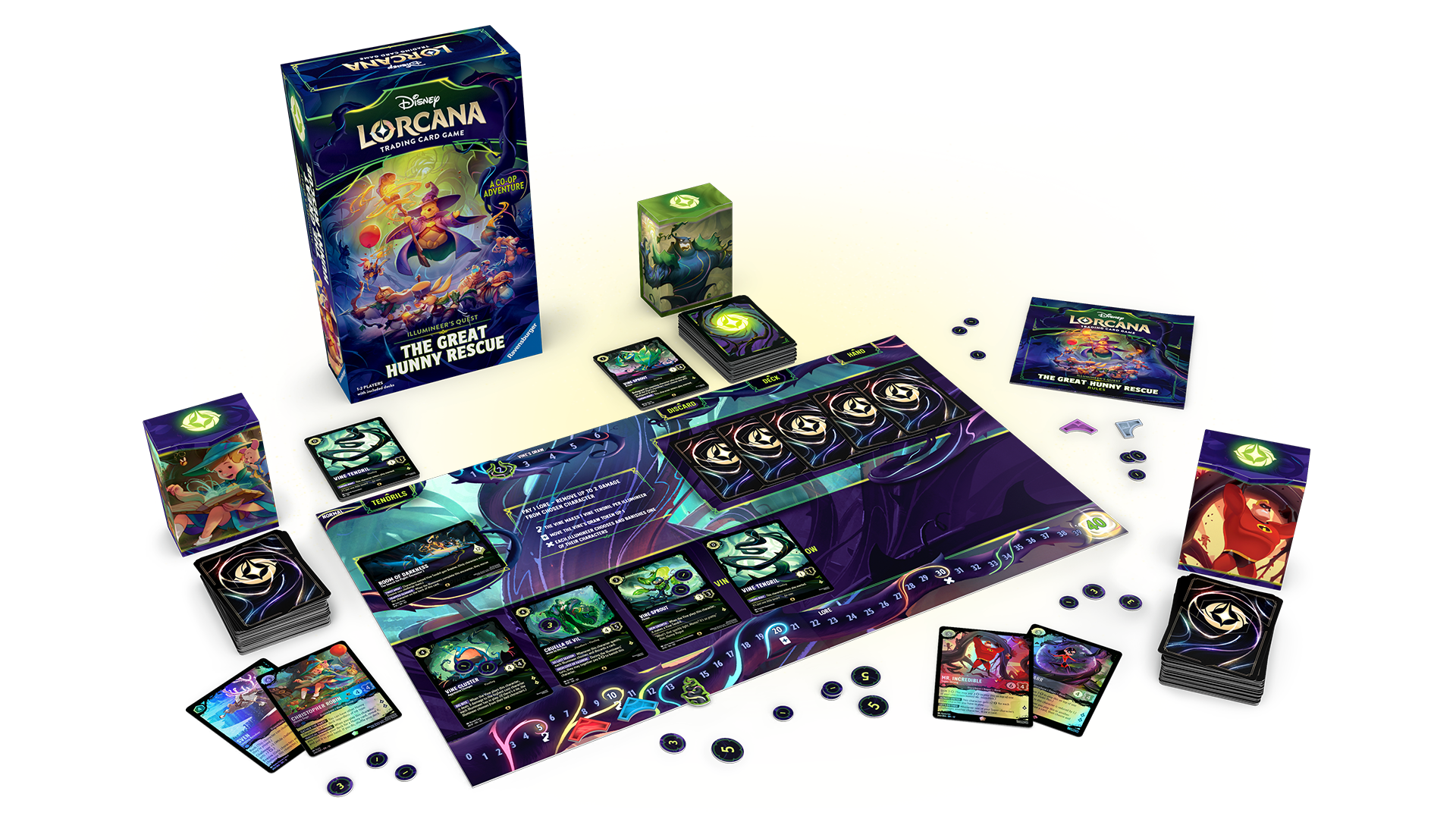
The official contents are a fifty-card Vine scenario deck, ten Vine Tendril cards, two sixty-card player decks with storage boxes, six encounter cards, two prize packs containing two cards each, thirty tokens, a game board, and scenario rules. These are the contents of the cooperative box, not a claim that ordinary booster packs contain the scenario.
Attack of the Vine! is a related expansion whose cards can support customization. It is not a prerequisite for using the supplied decks. The prize packs are also different from twelve-card randomized booster packs; compare actual contents when evaluating a listing.
For one or two people who want to try the cooperative experience, I would start with the complete box and leave upgrades for later. A first session can tell you much more about what your group needs than a shopping basket built from theme alone.
Read the encounter as a temporary rules environment
Encounters specify conditions and a lore threshold for progress. Clearing one can rescue a friend and change the problem ahead; the adventure also includes boss confrontations. Follow the chosen scenario’s sequence and printed objectives instead of importing Deep Trouble’s race as a universal rule.
Before a round of player actions, read the current encounter aloud. Identify what it prevents, what it makes more dangerous, and what completing it will require from each player. A strategy that was sensible in the previous room may now be too slow.
I would keep a small reminder beside the board with the current objective. It helps separate a play that improves your collection of characters from a play that actually advances the adventure. A huge board is not the objective if a harmful encounter remains active indefinitely.
Pooh turns a group into a better quest
Winnie the Pooh — Hunny Archmage rewards other Hunny characters with additional lore. That makes the printed classification relevant: an illustration of an animal or a Hundred Acre Wood character is not, by itself, enough to qualify.
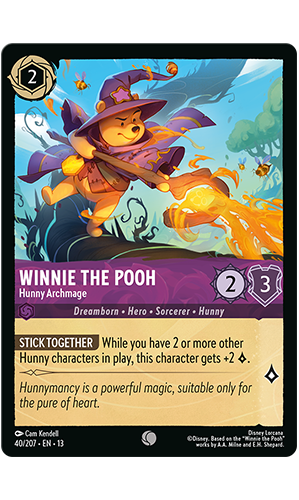
Before making challenges, count which allies would benefit from keeping the group intact. A challenge that sacrifices a useful Hunny character can cost more than the character’s own quest value if it changes the way the rest of your turn works. Likewise, questing with an important character before resolving a useful support play can miss the reward you meant to obtain.
I would practice a turn twice with the same visible board. First choose the challenges you instinctively want to make. Then reset the exercise and plan the lore needed to clear the encounter before choosing attacks. Compare what survives and whether the current restriction remains for another enemy turn.
Survival and progress need different jobs
Tigger — Hunny Barbarian brings a protective role, while Violet Parr — Super Resilient combines damage mitigation with finding useful cards. Boo — Energetic Child offers another way to deal with certain Vinelings. Read each printed condition rather than treating every protective or removal effect as interchangeable.
A protection effect can preserve a questing engine, but only if the relevant damage or target qualifies. A search effect can improve consistency, but it may require a particular type of card. Before spending resources, identify the exact result you need: protect a specific character, remove a blocker, or find the next part of the plan.
The strongest cooperative turn may have one player handle the immediate threat while the other develops enough lore to move everyone onward. Repeating the same role forever is less reliable because encounters can change what the group needs.
Some Vinelings need a specific answer
The official previews highlight Vine Sprout — Buzzer as an Evasive threat and Pete — Made by the Vine as a threat that requires a challenge rather than another way of banishing it. Those examples show why a single generic removal plan is insufficient.

Check access before counting damage. A character with enough strength cannot necessarily challenge an Evasive enemy. Likewise, a powerful removal effect may fail to answer a threat whose own restriction rules that method out. Identify a legal line first; only then calculate how efficiently it works.
If the board offers no useful answer, consider whether progressing the encounter changes the problem more efficiently than trying to manufacture perfect control. That is a proposed decision method, not permission to ignore an enemy effect or advance before meeting the printed conditions.
A worked choice: clear the room or build for later?
Imagine the current encounter is making enemy threats difficult for your available characters to handle. The team can either spend its turn collecting enough lore to progress or spend the same ready characters on a few legal challenges while developing another future engine.
The questing line risks leaving enemies in play, but may remove the encounter’s ongoing restriction sooner. The development line can produce a stronger future board, yet also grants another enemy turn under the current disadvantage. Compare those actual next-turn states rather than assuming that more characters always means more safety.
I would favor progress when the current restriction is the main reason the board is deteriorating and the team can complete it legally now. I would favor stabilization when moving on leaves the team unable to survive what is already visible. The distinction is the danger you can describe, not optimism about a hidden draw.
Prepare for the boss without building only for the boss
The adventure eventually needs more than early lore collection. Preserve enough capacity to deal with a major confrontation, but avoid filling your opening hand with expensive cards that contribute nothing to reaching it.
A practical deck review asks whether you can develop on the early turns, sustain cards in hand, answer awkward enemy properties, and transition into the later objective. If one of those stages repeatedly fails, improve that stage first. An additional impressive finisher does little for a deck that never reaches its moment.
Keep scenario-only cards and the player decks separate after play. Their shared artwork and setting do not make every card interchangeable in an ordinary constructed deck. Check the current rules and card legality before moving cards into another format.
Learning with a partner
Cooperative play lets an experienced player explain a line without deliberately losing a competitive match. Preserve that advantage by allowing the newer player to make choices. Ask what they want their turn to accomplish, show one alternative, and discuss the result afterward.
During the first attempt, use the provided instructions for every encounter transition and enemy turn. A remembered rule from another Quest can quietly change the difficulty. If a result seems surprising, check the current card and scenario sheet before deciding the deck needs expensive repairs.
Which Quest would I choose?
I would choose The Great Hunny Rescue for encounter progression, the rescue theme, and the need to adapt across the adventure. Deep Trouble suits a group attracted to a direct Ursula showdown. Palace Heist suits one interested in coordinating a Crown theft alongside the lore race.
There is no need to collect all three before playing any of them. Pick the structure your group wants, play the stock decks enough to understand it, and let actual games identify the next purchase. B3’s Attack of the Vine! buying guide covers the separate booster products if you later want to expand.
Find the exact product
View this product on Amazon. Confirm the selected edition, language, seller, contents, and delivered price.
Continue with B3
All Disney Lorcana guides · Learn the core game · Choose a first purchase.
Sources and scope
Product details and printed mechanics were checked against Official Great Hunny Rescue products and previews, Encounter structure and play observations. Use the included instructions and current official rules for exact procedures. The proposed turns, practice exercises, and buying judgments are B3’s analysis; they do not imply hands-on tournament testing. Checked October 21, 2026.