How to Play Disney Lorcana: A Complete First-Game Guide

Lorcana looks like a game about assembling your favorite Disney characters. The decision that makes it interesting is what you ask those characters to do. A character that quests moves you toward winning, but usually becomes available for your opponent to challenge. A character that challenges may protect your future turns, but normally gives up its own chance to quest now. Learning that exchange is more useful than memorizing every keyword before your first game.
This guide teaches an ordinary two-player game with complete preconstructed decks. Gateway has its own staged instructions; follow those for the first scripted game. The examples below are invented teaching situations, not reports of B3 playtesting.
The goal: reach 20 lore
Each player starts at zero lore. Reach 20 or more and you win. Lore is a score, not a health total: ordinary challenges do not subtract it. Your characters usually earn lore by questing, while some abilities and locations provide other routes.
That changes how you judge a board. A large character is not automatically the most urgent threat. Two smaller characters that can quest for the opponent's last four lore may be more dangerous than a big fighter with little lore value. Before making a complicated play, count the lore already available to each player.
What you need on the table
Each player needs their own playable deck, a lore tracker, and damage counters. Paper and dice can do the tracking; special accessories are optional. Keep a draw pile, a faceup discard pile, a character area, and a separate inkwell. Standard constructed decks contain at least 60 cards, use no more than two ink types, and normally allow up to four copies of a card with the same full name and version. Event formats also impose eligibility and banned-card rules.
Different subtitles mean different cards. Mulan — Considerate Diplomat and Mulan — Free Spirit are not interchangeable rules text just because both say Mulan. Read the version line whenever a guide recommends a particular card. There is also no general one-copy-in-play restriction simply because a character is famous.
Read a card in the order you will use it
Start at the upper-left cost. The surrounding inkwell swirl, if present, tells you whether you can normally turn that card into ink. The colored band identifies its ink type; it does not demand a matching color of resource during play. For characters, check Strength, Willpower, lore symbols, and then the ability text. Classifications such as Princess matter only when a rule or ability refers to them.
Strength is damage dealt in a normal challenge. Willpower is the damage threshold for banishment. Lore symbols show the score gained from an ordinary quest. A character with Strength 3, Willpower 5, and two lore is therefore doing three different jobs with three different numbers. Damage does not reduce its Strength or erase its lore symbols by itself.
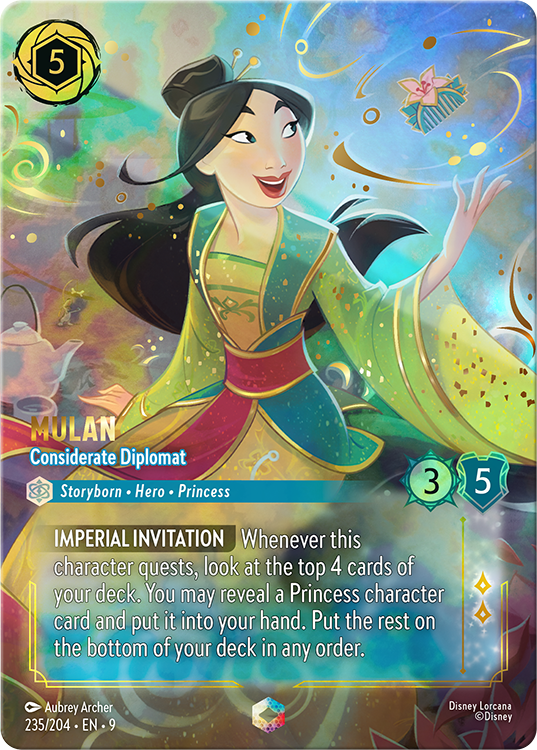
Mulan — Considerate Diplomat illustrates the distinction. She costs five, has 3 Strength and 5 Willpower, and normally quests for two lore. Her quest ability can also find a Princess among the top four cards. That ability does not turn the quest into a challenge, and finding a card does not play it for free. The image shows a special art treatment; the named card's gameplay is what matters.
Set up and choose an opening hand
Randomly establish the starting player, shuffle, and draw seven cards each. You may alter your opening hand once: put any number of unwanted cards on the bottom, draw back to seven, and then shuffle after the hand-alteration procedure. This is a selective replacement, so keep functional early cards rather than throwing them away alongside expensive ones.
I would look for an affordable first character, a believable second turn, and cards I can spare as ink. A hand of impressive five- and six-cost cards is asking several future draws to repair it. A hand of only cheap cards may work well initially but needs a plan for continuing after the opening burst.
For example, suppose your seven contain a one-cost character, two two-cost characters, a three-cost character, two expensive inkable cards, and a situational action. Keeping the early curve and replacing the cards with the least immediate purpose is a sensible starting exercise. This is a process, not a universal mulligan chart: an uninkable card and a key synergy can change the decision.
Your turn begins: Ready, Set, Draw
Ready your exerted cards, handle the Set step, then draw a card. The starting player skips the draw on the very first turn. During Set, your characters already present become dry, locations with a lore value award their lore, and the relevant start-of-turn effects are handled. Resolve those instructions before moving into your main decisions.
Exerted means sideways; ready means upright. Your characters normally enter ready but drying. That is different from entering exerted. A drying character normally cannot quest, challenge, or exert to pay an ability or song cost. It can still have a useful enters-play ability, and another card can affect it. Being upright does not mean it is already allowed to do everything.
Use a visible second row for freshly played characters. At the next appropriate Set step, move them into your established row. This small habit prevents a remarkable number of accidental immediate quests.
Build your inkwell without sacrificing your whole hand
Normally once during your main phase, reveal an inkable card from hand and put it facedown into your inkwell, ready. It supplies one ink, regardless of its printed cost or color. A six-cost card becomes one ink, not six. Once there, its character abilities do not operate; under the normal rules, you cannot inspect its face again just to reconsider your choice.
To pay three ink, exert three ready cards in your inkwell. They stay there and will normally ready next turn. If you have five ink and pay three, you have two ready ink left. You may take other legal actions before or after your once-per-turn ink placement. Special card effects can add ink in other ways; they are not permission to ignore the ordinary limit whenever convenient.
Before inking, lay out a two-turn plan. Which card can you play now? What do you want to afford next turn? Which card loses the least practical value by becoming a resource? Early on, an expensive duplicate can be a better sacrifice than your only affordable play. Later, when your inkwell already supports your hand, preserving another useful card can be better than growing automatically.
Main phase: take the actions your board can support
You can play cards, quest, challenge, use appropriate abilities, and move characters to locations in an order that suits your plan. Lorcana does not use Star Wars: Unlimited's alternating single actions. You complete your turn before the opponent takes theirs, although abilities triggered during your turn still matter.
Pay a character's cost and place it ready in your drying row. Resolve an action's instructions, then discard it. Items stay in play until removed and can supply ongoing or activated effects. An item does not have character drying restrictions merely because you just played it; read its payment requirements. Locations stay in play and have their own movement cost, Willpower, and possible lore value.
Don't announce six actions at once. Resolve one, update damage and lore, and then choose the next. An ability that finds a card may change what you should do with your remaining ink.
Questing: score now, accept exposure
Choose a legal ready, dry character, exert it, and gain its lore value. You do not normally pay ink to quest. Several characters can quest in one turn, one at a time. Without another effect readying it, a character you used this way cannot then also exert to challenge or sing.
Imagine you have a dry two-lore character and the opponent has no way on board to threaten it. Questing is an obvious use of that opportunity. Now give the opponent an established fighter that can banish it on the next turn. The two immediate lore may still be worth taking, but you should compare them with the future quests you are risking. Leaving it ready may make ordinary challenges unavailable to the opponent, though actions and abilities can still threaten it.
Challenges: do the arithmetic before turning a card
A normal challenge uses a ready, dry character against an exerted opposing character. The challenger exerts. They deal their Strength to one another simultaneously, and damage remains afterward. A character with damage at least equal to its Willpower is banished to the discard pile. An exerted defender still deals its damage.
Consider an ability-free 3-Strength, 4-Willpower character challenging an exerted 2-Strength, 3-Willpower character. The defender is banished; the challenger survives with two damage. It does not heal automatically at the end of the turn. If the challenger already had two damage, both characters would be banished instead.
Challenge a location to damage it without taking normal Strength damage back. You do not have to move a character to an opposing location first. Locations do not need an exerted state to be challenged. A location quietly earning lore every turn deserves attention even when its artwork makes it look like background scenery.
Songs: save ink by spending a character's opportunity
Songs are actions you can normally pay for with ink. Alternatively, an eligible ready, dry character can exert to sing a song within its singing capacity. Singer changes that capacity. Powerline — Taking the Stage costs two ink but has Singer 4, so once dry he can sing an appropriate four-cost song. That does not make him a four-cost character for every other effect.
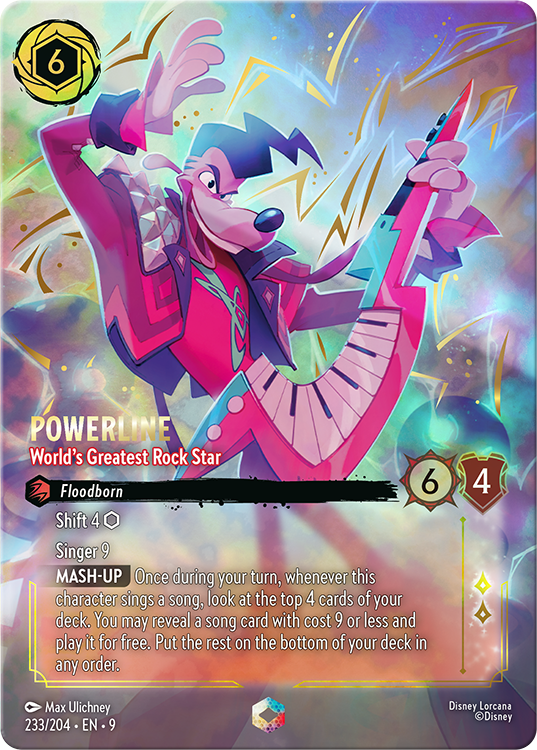
The trade is practical: singing preserves ink for another play, but usually gives up that character's quest or challenge. If a song would accomplish nothing useful, playing it merely because singing is available wastes both a card and an action opportunity. Sing Together is a separate keyword that lets eligible characters combine their singing values as instructed. You cannot combine arbitrary small characters to sing every ordinary song.
Keywords you can learn as they appear
Evasive restricts who can challenge a character; it does not prevent all actions or abilities from affecting it. Ward restricts opponents' choices for effects, rather than supplying universal immunity. Rush permits an early challenge, not an immediate quest. Bodyguard can redirect ordinary challenge choices while its condition applies. Shift provides an alternative way to play a character onto an appropriate character already in play; check the full rule and the stack's readiness, damage, and drying state.
Do not teach all of these before dealing the first hand. Put a finger on the actual card when a keyword first changes a decision. A remembered example is more useful than a list recited before the player has any reason to care.
A three-turn practice sequence
This invented sequence uses generic characters without abilities. Both players have inkable cards to spare. On turn one, Alex inks a card and plays a one-cost character with one lore. It is ready but drying and cannot quest. Bea takes a similar first turn, drawing because Bea is not the starting player.
On Alex's second turn, the first character becomes dry. Alex draws, adds a second ink, and plays a two-cost character. The original character can quest for one lore; the new one cannot. Bea can now decide whether to spend an established character challenging Alex's exerted quester or pursue lore instead.
On turn three, Alex's second character is dry too. If it can challenge a dangerous exerted enemy profitably, that may protect repeated future quests. If Alex can simply score enough to win, the challenge is unnecessary. Separate the question “can I banish that?” from “does banishing that improve my chance to reach 20 first?”
Watch the turn structure, then a real game
Ravensburger's short official lesson below demonstrates the flow of a turn. It is an introductory video, not a current tournament-rules update. Watch for when cards turn sideways and when ink becomes available again.
Watch How to Play Disney Lorcana — On Your Turn, by Ravensburger on YouTube if the embedded player is unavailable.
For a longer tabletop example, Before You Play's New Disney Lorcana Starter Sets — Playthrough uses the two-player starter product. The embedded player keeps the game on this page when playback is available. It is not a demonstration of the Fabled deck lists.
Watch New Disney Lorcana Starter Sets — Playthrough, by Before You Play on YouTube if the embedded player is unavailable.
Pause before a quest and ask what opposing challenge it enables. Pause before a song and identify which character is giving up another task. Those two questions turn a video from background entertainment into a lesson you can use in your next game.
Common mistakes and one current rule to know
Do not draw for the starting player's first turn, ink cards without the swirl as a normal action, treat ink as color-specific, or use a drying character to sing. Do not erase damage when cards ready. Do not subtract lore after an ordinary challenge. Most importantly, count whether you can win before using your best quester for something else.
The October 2026 comprehensive rules specify that a player ending their turn with no cards in their deck loses. Older printed material and videos can describe running out of cards differently. Use the current official rules for standard play; Gateway's staged teaching procedure has its own instructions. Reaching 20 lore is still the main goal to practice.
For a productive first evening, play the decks unchanged, swap sides for a later game, and discuss one ink choice and one quest-versus-challenge decision. Buying cards will not fix a rules misunderstanding. Once those choices make sense, it becomes much easier to choose a deck or upgrade with a purpose.
Choose your first Lorcana purchase
B3’s Lorcana buying guide compares learning sets, complete decks, boosters, and collection products so you can choose a useful first purchase.
Sources and further reading
Checked October 20, 2026: official rules and release notes, including the October 8 comprehensive rules; official teaching lessons; Gateway contents; Fabled products and official art; two-player set contents; and formats.
B3 is an independent publication and is not affiliated with or endorsed by Disney or Ravensburger. Official card art and product images remain the property of their respective rights holders. Images are shown for product identification and discussion; depicted premium treatments are identified where applicable.