Disney Lorcana Buying Guide: What to Buy First and What Can Wait
Affiliate disclosure: As an Amazon Associate, B3 earns from qualifying purchases.
The easiest way to overspend on Disney Lorcana is to buy something called a starter product that does not give you the game you expected. A ready-to-play deck supplies one player's deck. A two-player set supplies both sides. A collection starter set can be aimed at opening packs and storing cards instead. Those are sensible products for different people, but their names do not tell the whole story.
My starting recommendation is simple: buy a complete way for your actual group to play, learn the cards you own, and then decide whether you want deckbuilding, collecting, or both. You do not need to fund all three hobbies on the first order.
Choose the evening before choosing the box
Are two complete beginners going to learn together? Will one experienced player teach another? Are you buying for someone who already plays at a store? A product that works well for the first situation can be redundant in the third. The best deal is the one you will use, not necessarily the largest markdown.
For a gift, ask one concrete question: “Do you already have a deck you play?” If the answer is yes, a second introductory course may be less welcome than a specific requested deck or a small collecting gift. If the answer is no, a pile of random boosters leaves the recipient with another decision before they can play.
Compare the main product types
| Product | What it gives you | Best starting use |
|---|---|---|
| Gateway | Two small starting decks plus fixed staged additions and teaching materials | Two newcomers learning gradually |
| Two-player starter set | Two complete 60-card decks and tracking supplies | Two people wanting full decks immediately |
| Single-player starter deck | One fixed 60-card deck; check the particular package extras | One player choosing a strategy; opponent needs a deck |
| Booster packs/display | Random cards; a display is a larger pack purchase | Opening fun or the appropriate limited format |
| Illumineer’s Trove | Packs, storage, and tracking components; no fixed deck | Collectors who will use the accessories |
| Collection starter set | Packs and collection accessories; check its precise contents | Starting a collection, rather than supplying a first complete match |
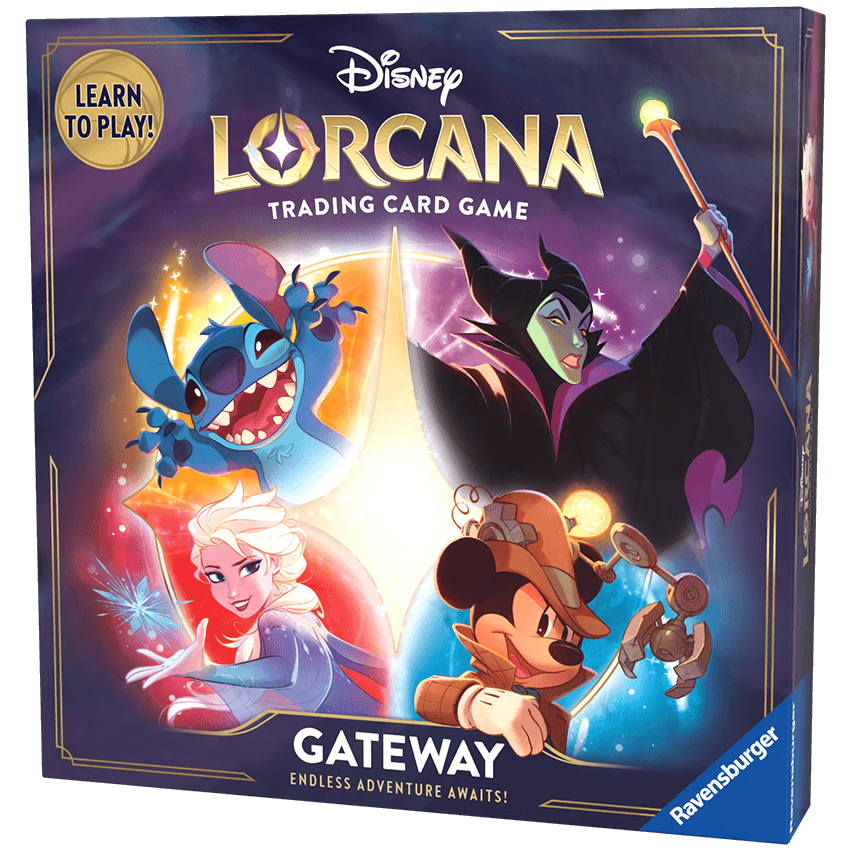
Gateway starts with two 30-card decks and unlockable additions. The newer two-player starter set instead provides two ready-to-play 60-card decks. Both can serve two people, but they offer different learning structures. The single-player wording on a deck means one person's supply for a competitive game, not a solo opponent hidden inside the package.
Gateway: choose it when the teaching matters
Gateway makes sense when you want a guided introduction shared by two people. Its board helps establish where cards belong, and the staged additions reduce how much you must understand at once. I would value that structure most for a household where nobody wants to become the rules expert before the first game.
The limitation is equally clear: the teaching package may be unnecessary for two established TCG players happy to learn from the rules. Its fixed cards are not automatically the best basis for a current competitive deck. Buy it for the learning experience and the games it supports, rather than assigning speculative value to every included card.
View Disney Lorcana Gateway on Amazon
A two-player starter set: compare it on total cost for two
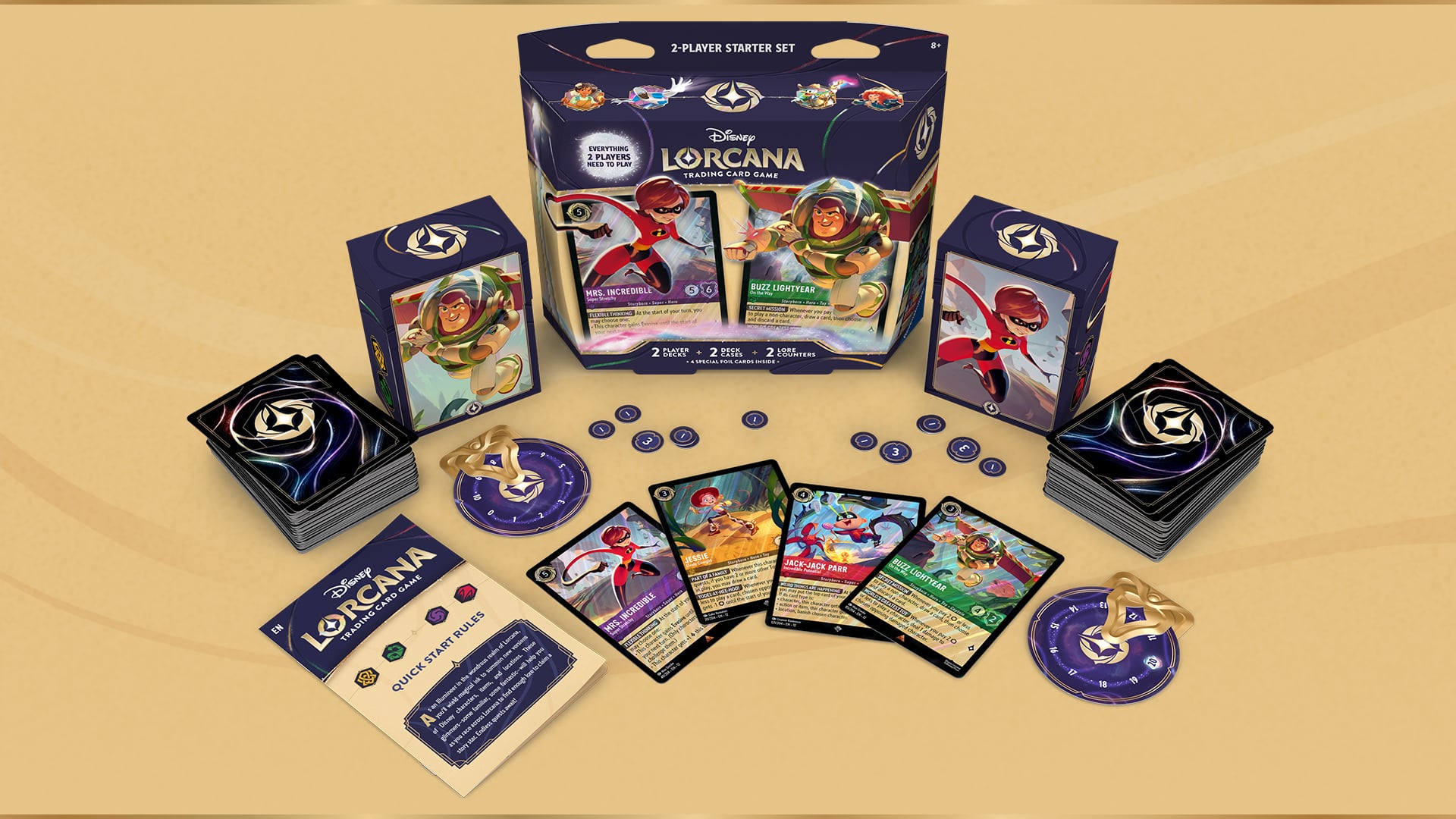
The official two-player starter set contains two 60-card decks, deck boxes, tokens, lore trackers, and a rulebook. Its themes feature The Incredibles and Toy Story characters. It is worth comparing directly with the delivered cost of two individual decks, especially if you want complete decks immediately rather than a course that expands over time.
Do not compare its box price with the price of one single-player deck and conclude it is automatically expensive. Equally, do not assume two separate decks are worse: a discounted pair with themes you prefer may be a better fit. Compare the actual contents and both players' interest. A shared learning session is much easier to arrange when both sides want to use their characters.
Search Amazon for the Disney Lorcana two-player starter set (Search link; confirm the exact product before buying.)
Individual decks: pick a strategy you want to learn
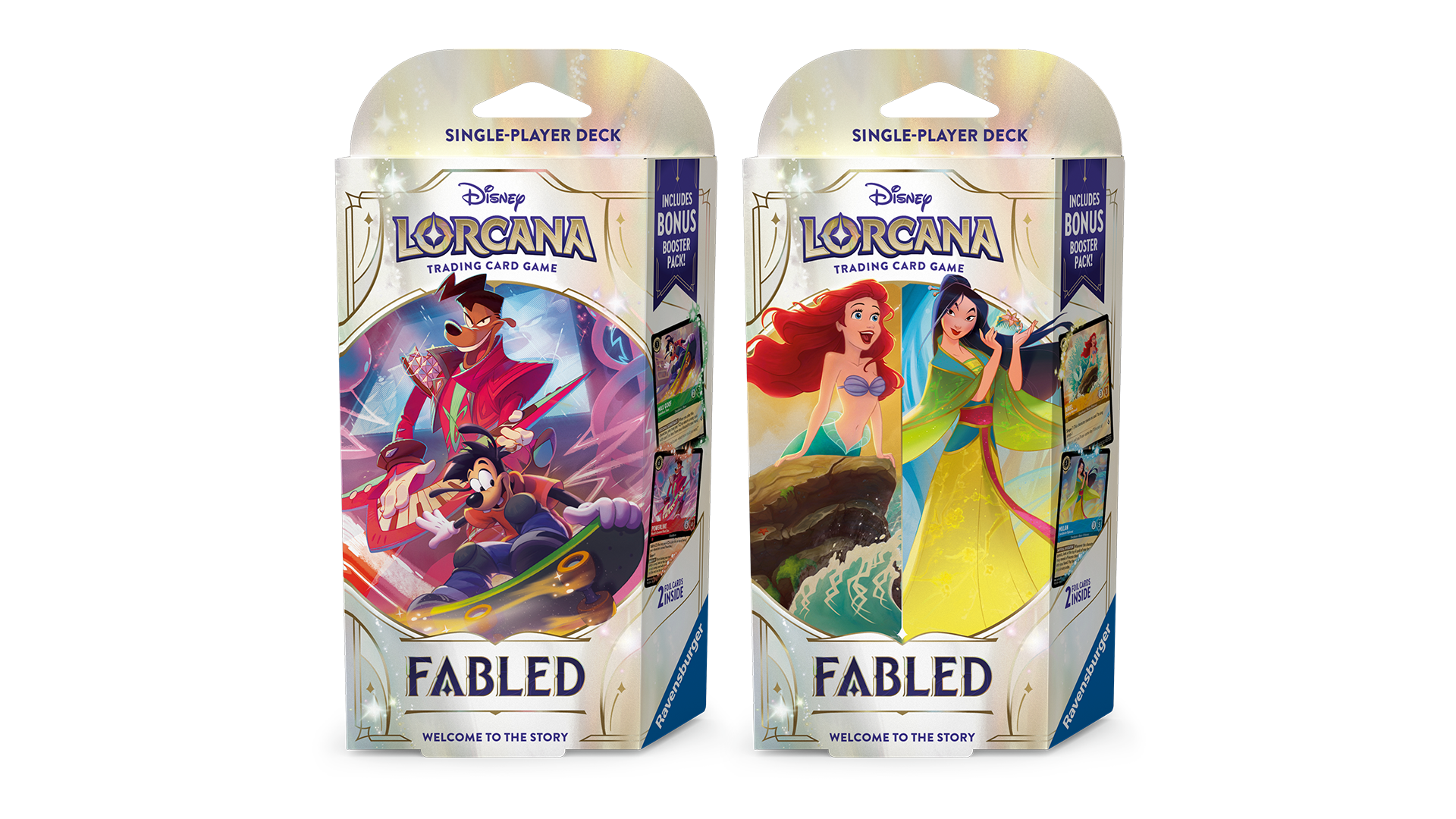
Fabled's Princess Power is Amber/Sapphire and features Ariel — Singing Mermaid and Mulan — Considerate Diplomat. Standout Headliners is Emerald/Ruby and features Max Goof — Rebellious Teen and Powerline — World's Greatest Rock Star. Each supplies a fixed 60-card deck; the product's extra booster is random and separate from that fixed list.
For choosing between them, I would start with the decisions rather than the cover. Princess Power asks you to develop characters whose classifications, healing, and quest abilities work together. Standout Headliners asks you to turn ready singers into useful song effects while keeping ink available for development. Neither box is a guarantee of tournament readiness. Both can be examined and practiced without opening more packs.
View the Fabled Amber/Sapphire Princess Power deck on Amazon
View the Fabled Emerald/Ruby Standout Headliners deck on Amazon
Boosters: buy the opening experience deliberately
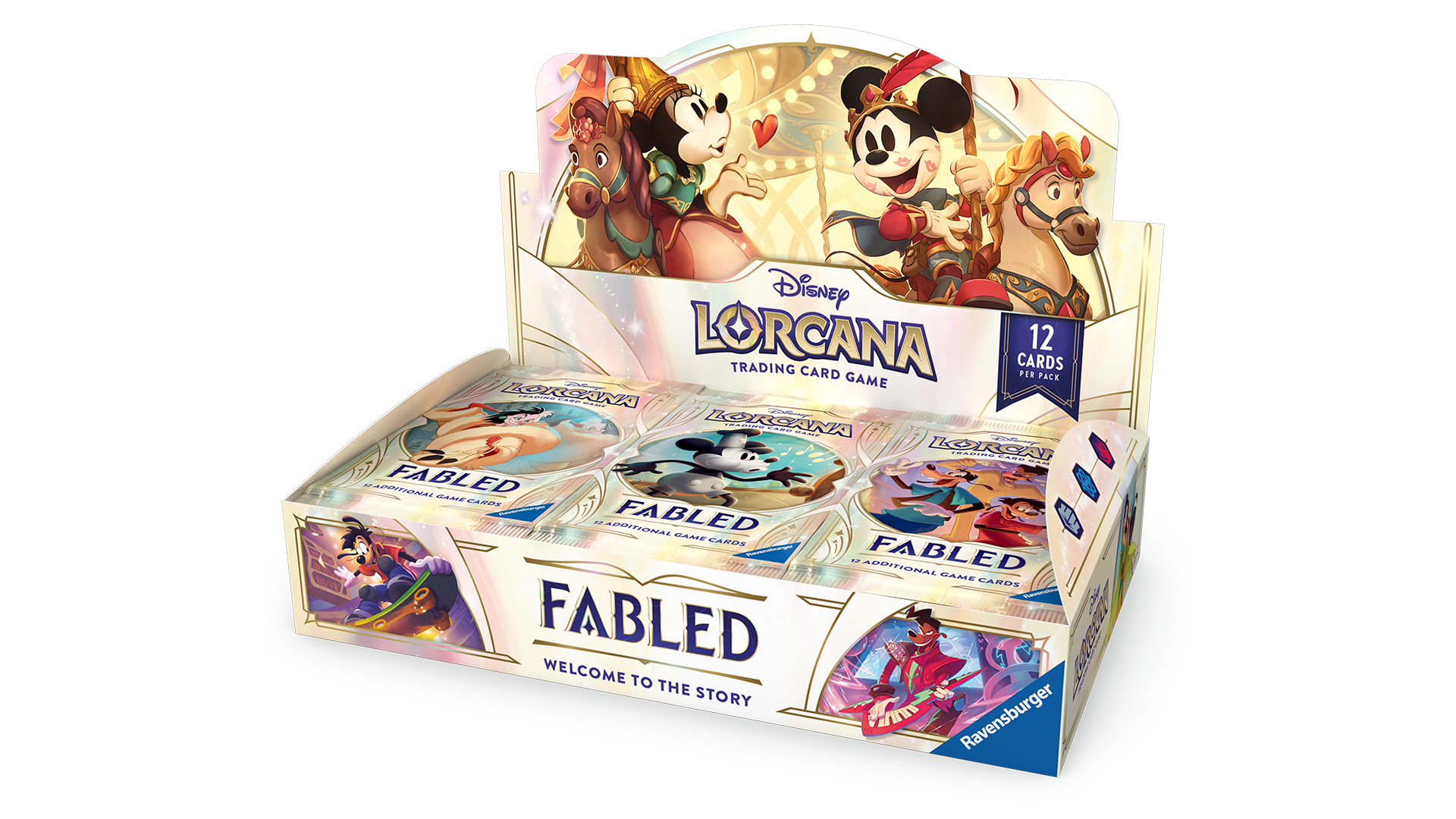
A Fabled booster display contains 24 packs of 12 random cards. That is 288 cards, but not 288 distinct cards and not a promised complete deck. Duplication is normal. An appealing character on the wrapper is not a promise that a particular version is inside.
I would buy a few packs when opening them is part of the fun, or the right number of packs for an organized limited event. I would not buy a display simply to obtain a named missing card. Once your objective can be written as “two copies of this exact card,” compare the delivered price of those singles with the money you are comfortable spending on random contents.
For a family, separate the play budget from the surprise budget. That lets a pack be an enjoyable bonus without making the next game depend on a lucky pull. It also makes disappointing contents easier to put in perspective: you bought an opening experience, not a guaranteed solution to a deck problem.
View the Fabled 24-pack booster display on Amazon
Troves and collection sets: check what the storage is costing
The Fabled Illumineer's Trove includes eight boosters, storage, dividers, damage dice, and a lore counter. A Fabled collection starter set instead pairs four boosters with a Mickey Mouse portfolio and a Tinker Bell glimmer foil. Neither description promises a fixed playable 60-card deck.
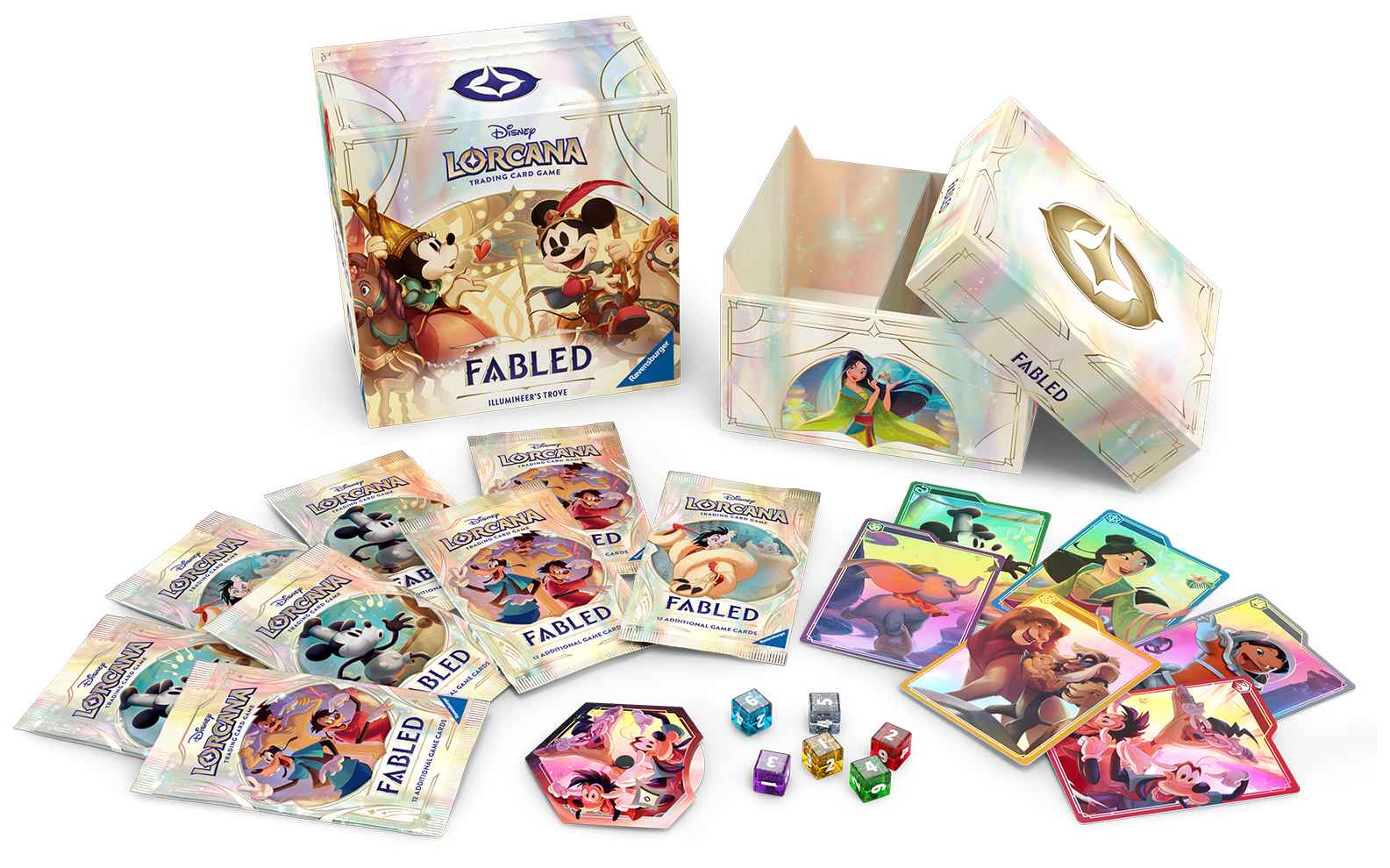
Here is a hypothetical comparison, not a current quotation. If eight packs separately cost $40 delivered and a Trove costs $48, you are paying an $8 difference for its extra components and packaging. That may be reasonable if you will use them. If you already own storage and counters, the same extras may be redundant. Compare like-for-like products from the same set and account for shipping.
The word “starter” in a collection product's title describes starting a collection. Before gifting one as somebody's first game, verify that they have a deck and an opponent. Nice packaging cannot substitute for the cards needed to take a turn.
Current legality and older boxes
Core Constructed uses a rotating card pool; Infinity is the broader constructed format. A card's latest eligible reprint can matter, so an older physical printing is not necessarily unusable. Conversely, a sealed older deck can contain cards outside the current Core pool. Check the exact full name, official card information, current bans, and your event's format before buying specifically for tournament use.
For casual games at home, you can agree to play your fixed decks together without chasing each release. Keep that separate from a claim that the same unchanged decks are eligible or well suited for a store event. Learning the game, building a competitive list, and collecting favorite characters have different purchase priorities.
Accessories: solve a real problem first
Opaque, matching sleeves can protect a frequently shuffled deck. An ordinary box can hold it. Dice or paper can track damage, and a clear shared tracker can record lore. A themed playmat, premium portfolio, or special counter is optional. Decide which makes your actual table easier to use before treating accessories as an entrance fee.
If a child struggles to shuffle, choose handling help rather than assuming a larger product bundle fixes it. If your group loses track of damage, make the counters clearer. If cards keep mixing between decks, label the storage and keep a list. Those inexpensive practical changes often do more for the next game than another decorative purchase.
Three purchase paths I would use
For two beginners who want instruction, compare Gateway with the current two-player starter set and choose the learning structure you prefer. Start with that one complete purchase. For two players comfortable learning a TCG, compare two specific fixed decks and avoid paying a premium for themes neither person wants. For an existing player, ask for the exact deck, card, set, or format they want before buying random product.
After several games, write down what is missing. “I want to open something” points toward a small pack purchase. “My deck never finds a cheap character” points toward deck analysis and specific cards. “My partner wants a different playstyle” points toward another complete deck. The more precise the need, the easier it is to spend less while improving the experience.
Check an Amazon listing before buying
Match the set, ink pair, language, and named deck. Check whether the offer is for one specified deck, an assorted deck, an empty accessory, a single card, or a larger display. Review the actual seller, condition, return terms, shipping, and total delivered cost. Product-page availability can change, so the links here make no live stock or price promise.
B3's recommendation is to start with certainty: enough fixed cards for the people who will play. Add randomness and premium packaging only when those are part of the experience you want. A smaller purchase that gets used is a better beginning than a collection built around a game nobody has learned yet.
Learn the game before your next purchase
Read B3’s complete Lorcana first-game guide, with worked turns and embedded teaching videos.
Sources and further reading
Checked October 20, 2026: official rules and release notes, including the October 8 comprehensive rules; official teaching lessons; Gateway contents; Fabled products and official art; two-player set contents; and formats.
B3 is an independent publication and is not affiliated with or endorsed by Disney or Ravensburger. Official card art and product images remain the property of their respective rights holders. Images are shown for product identification and discussion; depicted premium treatments are identified where applicable.