Reign of Jafar Guide: Songs, Combat Decks, Boosters, and Palace Heist
Affiliate disclosure: As an Amazon Associate, B3 earns from qualifying purchases.
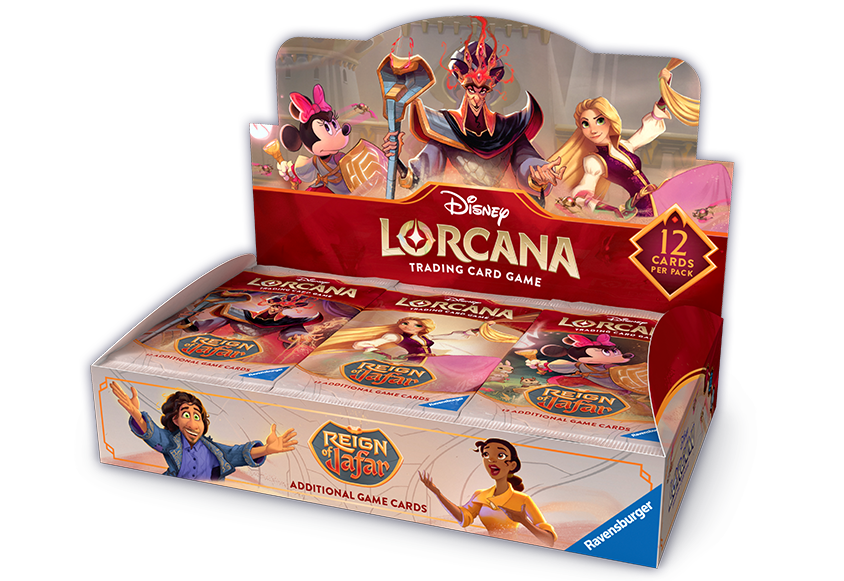
Reign of Jafar is a payoff to Lorcana’s early island-and-crown storyline, but the product choice is about the kind of game you want. The numbered set contains ordinary booster cards and two fixed decks. Palace Heist is a separate cooperative scenario box. A player looking to confront Jafar with a friend should identify that box by name rather than buy a display of the associated set and expect the scenario inside.
For head-to-head play, I would examine the starter plans first: Tiana and Bruno for songs, or Mulan and Stitch for more direct combat decisions. For collectors, the set’s dual-ink cards, Illusions, and story cast offer different projects.
Tiana reacts to playing a song; Bruno reacts to singing
Tiana — Natural Talent has Singer 6, so her printed four-ink cost does not limit her to singing only songs of four or less. Her other ability triggers when you play a song and reduces opposing strength until the start of your next turn. Paying ink for a song can still satisfy that play trigger.
Bruno Madrigal — Singing Seer uses a narrower trigger: when he sings, you may draw for each character you have in play. A song paid for entirely with ink does not become “Bruno sang it” merely because he is on the table. The difference is essential when planning a card-flow turn.
Before singing with Bruno, compare how many characters will still be present. A challenge that sacrifices a teammate can reduce the later draw. If you can safely obtain the draw first and then make the same trade, the order may improve your turn. Newly drawn options can also change which challenge you actually want.
Both featured cards are uninkable. That makes opening-hand discipline important: several appealing payoffs can leave too few cards suitable for the inkwell. When tuning the deck, preserve the early inkable plays that support the song turns instead of filling every spare slot with another exciting uninkable card.
Mulan reaches targets, but Reckless changes her job
Mulan — Charging Ahead has Reckless, gains Evasive during your turn, and can challenge ready characters. Those abilities together give her broad challenge access, but they do not grant Rush. A newly played Mulan normally still has to wait before challenging.
Reckless means she cannot quest and must challenge each turn if able. She is a combat tool rather than an ordinary future lore source. Other characters in the Mulan/Stitch deck must provide the quests that finish the race.
Her Evasive is specifically active during your turn. It helps her reach Evasive targets then, but does not remain as that ability’s protection throughout the opponent’s turn. A Mulan left exerted after an attack can be much more exposed than a quick reading of the keyword suggests.
For a worked decision, give the opponent a ready card-flow engine and an exerted small quester. Mulan can potentially reach either, but removing the engine may prevent several future cards while the small quester offers a safer trade. Calculate legal access, damage dealt, return damage, and the time remaining in the lore race before deciding.
Build different opening plans for the two sides
For Tiana/Bruno, I would look for affordable characters and a sequence that supports a useful singing turn without stranding the entire hand. For Mulan/Stitch, I would look for early development and a clear distinction between challengers and the characters expected to collect lore.
Do not use the same upgrade prescription for both decks. More songs can improve access to a trigger while worsening inkability or early turns. More dedicated fighters can improve board control while leaving too little lore output. Record the specific failure after each game, then replace the smallest group of cards that addresses it.
The useful stock matchup is a comparison between spending characters on songs and spending them on challenges. In either case, the opportunity cost is a quest you might otherwise have taken. Count the full turn’s result, not just the most spectacular effect it contains.
Card references: Tiana card reference · Bruno Madrigal card reference · Mulan card reference. Gallery illustrations may show a reprint or alternate treatment; the analysis concerns the named card’s abilities, not a promise of that treatment in the starter.
Tiana and Bruno: a song must earn the singer’s turn
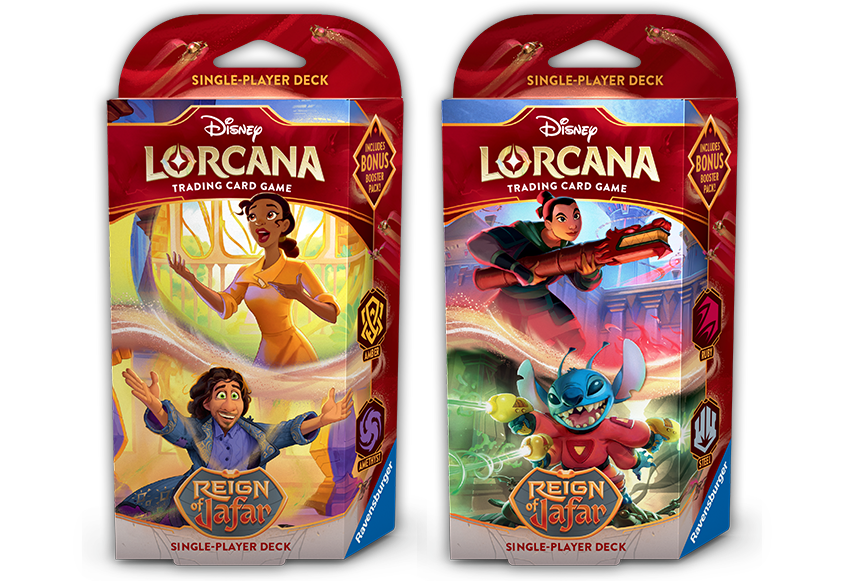
The Amber/Amethyst deck features Tiana — Natural Talent and Bruno Madrigal — Singing Seer. Its song-oriented plan offers a clear lesson in opportunity cost. Singing can preserve ink for another card, but it consumes a character that might otherwise have quested or challenged.
I would compare the complete turn, not just the cost of the song. If singing lets you develop a useful character while interacting with the opponent, the combined outcome may be much stronger than paying ink for the same song. If you sing and leave the saved ink unused, the benefit may be far smaller than it first appeared.
A good practice question is: what will the saved ink buy before this turn ends? Name the follow-up before choosing the singer. That prevents using an appealing synergy merely because all of its pieces happen to be available.
Also separate playing a song from singing it. An ability may care about one or the other. Read its exact trigger, including any once-per-turn condition. A deck containing many songs does not automatically produce unlimited cards or repeated bonuses from one supporting character.
Mulan and Stitch: challenge permissions are specific
The Ruby/Steel deck features Mulan — Charging Ahead and Stitch — Alien Troublemaker. I would inspect it for a learner who enjoys identifying useful attacks and managing damage. Its distinctive cards make ordinary challenge restrictions worth learning accurately.
If an ability permits challenging a ready character, that changes the ready-target restriction described by that ability. It does not automatically grant permission to ignore Evasive or every other condition. Conversely, an effect that gives access to Evasive targets does not by itself ready your attacker or erase its damage.
Work through one condition at a time: is the attacker eligible to act, is the target legal, what permissions or restrictions apply, and what damage will each character receive? Then consider whether the resulting trade advances the lore race. A deck built around fighting still needs a plan to collect the final lore.
I would practice against a board containing a ready engine and an exerted ordinary quester. Which removal matters more, and can your particular card legally reach it? That question turns an unusual combat permission into a concrete reason to include the card.
Dual ink and Illusions need their own checks
Reign of Jafar continues dual-ink cards. They belong in decks matching both printed inks, rather than acting as permission to splash a third color into an ordinary constructed list. Read the inkability symbol separately; two printed inks do not mean the card produces two ink.
Illusions and Vanish also return. Treat the actual choosing condition literally rather than assuming every opposing effect is equivalent. A vulnerability to an action choosing a character is not a universal rule that any damage, challenge, or ability automatically banishes every Illusion.
For a learner, I would introduce one unusual interaction at a time. Play several ordinary turns first, then pause when the exception matters. That makes the card an example of a rule, rather than a collection of exceptions someone is expected to memorize before playing.
Packs, display, or Trove?
A pack contains twelve random cards, and the display contains twenty-four packs. The Trove combines eight packs with storage, a lore counter, and damage dice. The fixed decks are curated sixty-card lists. These products solve different problems even when the same story artwork appears across them.
For a known song engine or combat package, compare the exact missing cards with the delivered sealed cost. For a collection or opening evening, choose a pack budget before buying. A Trove’s accessories have value if you use them; they do not promise better random outcomes.
If you buy two starter decks for a household matchup, keep the original lists. Upgrade in small groups and test against a stable opponent. Rebuilding one side substantially while preserving the other stock can make a fun learning pair feel unfair without either player having made a rules mistake.
Palace Heist is a separate adventure
Palace Heist supplies two player decks, a fifty-card Jafar scenario deck, a Reforged Crown tile, battlegrounds, and dedicated play components. Its keep-away objective and scenario procedure are a different experience from a normal match using Reign of Jafar cards.
I would choose it when cooperation is the purpose of the gathering. Learn the base Lorcana actions, then use the scenario rules and chosen battleground. Do not assume owning an ordinary Reign of Jafar starter supplies the Jafar deck or crown components.
Buying the older release today
Reign of Jafar is outside the current Core set pool. A specific older printing can remain eligible through a legal reprint with the same full card identity. Check the planned list against current rules before buying for a Core event. Infinity and agreed casual games offer other uses, subject to their own restrictions.
My recommendation is Tiana/Bruno for the repeated singing-versus-questing decision, Mulan/Stitch for combat permissions and damage planning, and Palace Heist for a cooperative evening. Choose boosters for discovery or a defined collecting project. The story ties these products together; your intended game should decide which one comes home.
Find the product
View Reign of Jafar booster display on Amazon. Confirm the selected quantity, language, seller, and delivered price.
Continue with B3’s Lorcana guides
Browse all Lorcana guides · Learn to play · Compare your first purchase.
Sources and scope
Checked October 21, 2026: official Reign of Jafar products and card previews, current rules and release notes, and the official rotation explanation. Product facts and printed mechanics are separated above from B3’s proposed buying and practice methods. Prices in worked examples are hypothetical; live prices, stock, event availability, and pull odds are not promised.