Palace Heist Guide: Steal the Crown, Coordinate Your Turns, and Defeat Jafar
Affiliate disclosure: As an Amazon Associate, B3 earns from qualifying purchases.
Palace Heist asks a better question than “can our Lorcana decks beat a boss?” It asks whether you can collect the lore you need while taking and keeping the source of Jafar’s power. That extra Crown objective gives the cooperative game a useful tension: an action that improves your board may still leave the team unable to complete the heist.
I would choose it for players who already understand the basic Lorcana turn and want a shared problem with more going on than a straightforward race. It is a standalone Illumineer’s Quest box. You do not need Deep Trouble or a booster display to begin.
Check the complete box
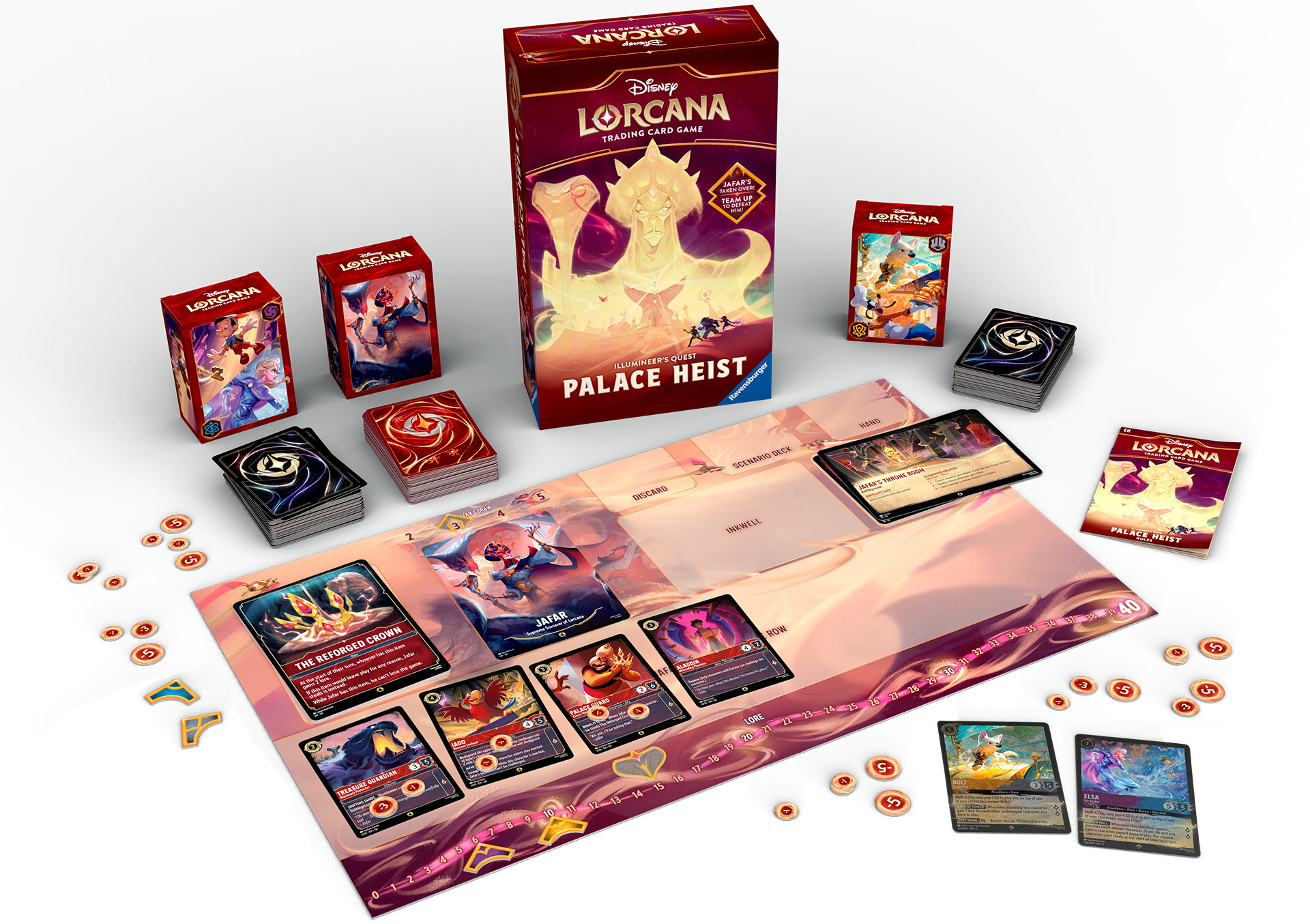
The official contents include Jafar’s fifty-card scenario deck, two sixty-card player decks and their storage boxes, an oversized Jafar card, the Reforged Crown tile, a playmat, four battlegrounds on two cards, tracking pieces, damage counters, a victory card, and scenario rules.
The Crown tile and battlegrounds are functional components, not decorative extras. A loose scenario deck can be useful for an experienced owner replacing cards, but it is not automatically equivalent to the complete adventure. When shopping secondhand, ask whether all the non-deck pieces and both player decks remain.
Two requirements need to meet at the finish
The players need to reach their individual twenty-lore goals and have a player controlling the Reforged Crown. Jafar’s forty-lore threshold is the opposing deadline. A strong lore total alone does not complete the players’ objective if the Crown remains with Jafar.
While Jafar controls the Crown and has no locations, the team can take it by having every player exert a character, choosing which player receives it. That “every player” requirement makes coordination important. If one person has already used every eligible character, another person cannot simply pay their share for them.
Read the selected battleground and Crown instructions during setup. They govern the scenario’s exact operation; do not carry over an exception from a previous difficulty or a normal competitive match.
Reserve the characters before spending the turn
The simplest mistake is to do several individually good actions and discover that the Crown action is no longer possible. Before anyone quests, name the character each player can reserve if a steal becomes available.
Suppose Jafar has one remaining location and both players have a dry character available. One player may be able to remove the location, but if that uses their only remaining character, the team still cannot satisfy the collective exertion requirement. You need a complete sequence that clears the obstacle and leaves the required contributors ready.
That is why counting damage is only part of the calculation. The number of surviving ready characters across both boards matters too. A modest character kept available can be more valuable than one extra lore collected too early.
Locations are part of the objective
In an ordinary duel, you might tolerate a location while racing past it. Here, Jafar’s locations can also prevent the team from taking the Crown. Ask two questions: what does the location do if left alone, and what does removing it make possible now?
A location that unlocks a Crown steal may deserve attention even when its printed lore output looks manageable. Conversely, destroying a location without any way to follow up may not be the best use of your whole turn if another threat is about to overwhelm the team.
Plan the turn from its desired end state backward: who holds the Crown, who still has a useful board, and whether both players can make their final progress. Then choose the challenges and effects that produce that state.
Jafar is automated, not a normal opponent
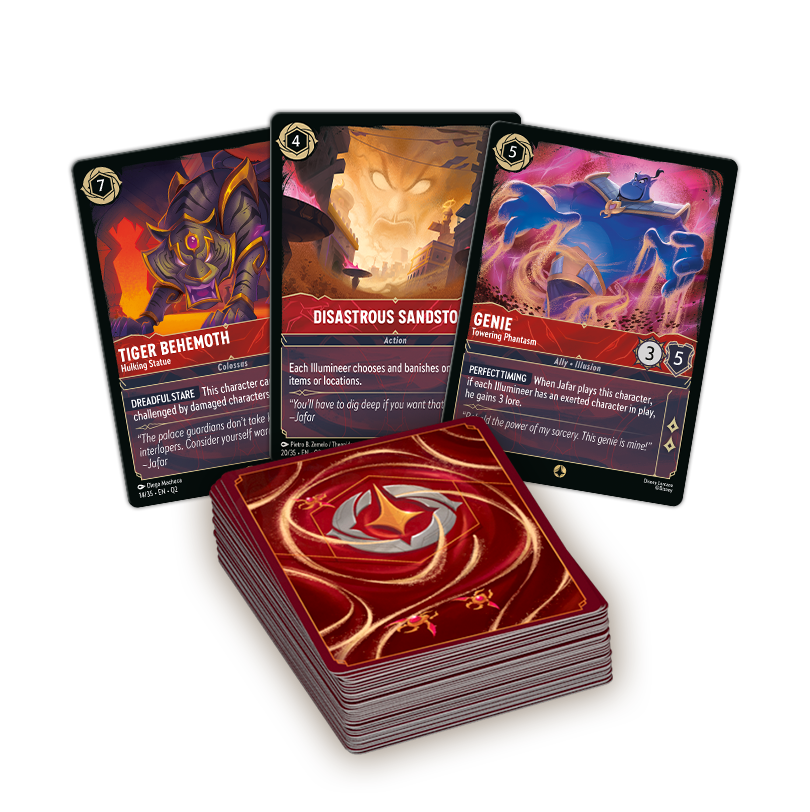
His scenario deck has special play instructions. Use its prescribed sequence instead of assuming he pays for and uses cards exactly as a human would. The official app includes a Palace Heist counter for player progress, Jafar’s captured lore, and card draw.
Assign one person to operate the scenario and let the other check the important thresholds during the first game. This is a bookkeeping role, not permission to choose a more favorable enemy action than the rules allow. Resolve uncertain interactions before continuing a long chain of plays.
The payoff is a cleaner discussion afterward. If Jafar’s turn was handled consistently, you can examine the team’s choices without wondering whether a missed rule created the result.
A Crown steal is a plan, not permanent safety
Jafar’s deck contains ways to change the situation after you take the Crown. Do not spend an entire turn assuming possession is an irreversible achievement. Look at what you can preserve for the following round and how quickly the team can complete its remaining lore.
I would prefer a steal that coincides with strong progress toward the finish over a flashy early steal that leaves both boards empty. That is a strategic preference, not a universal rule: sometimes taking the Crown earlier is necessary to interrupt the opponent’s advantage.
A useful question is “what does this steal buy us?” It might create a winning window, reduce pressure, or force another round of setup. If you cannot describe the benefit, compare it with developing enough characters to make a later steal stronger.
Divide jobs without trapping either player
One deck can spend more effort controlling threats while the other develops lore, but the players still have individual requirements. A permanent bodyguard who never quests can become the reason the team cannot finish.
Reassess jobs each turn. If one player is close to the lore target, they may be able to use more characters for interaction while their partner catches up. Keep enough ready contributors to satisfy a future Crown action. The best division of labor can change several times during a single game.
For a teaching group, ask each player what they can contribute before assigning their actions. Shared strategy works better when it preserves a decision for everyone at the table.
Upgrade for the heist you are actually losing
If locations repeatedly lock the team out, improve reliable ways to deal with locations or maintain enough challenge strength. If you clear them comfortably but cannot finish, investigate lore output, card flow, and the number of turns spent over-defending.
Test a small change against the same battleground. More expensive characters are not automatically the answer. A lower-cost card that keeps another contributor available may improve the heist more than a dramatic late threat.
Keep ordinary player cards separate from the special scenario deck when packing up. Also check the current format rules before taking an unchanged older preconstructed deck to a Core event; being useful in this adventure is a different question from current competitive eligibility.
Is Palace Heist the right first Quest?
I would choose it when the Crown problem sounds like the attraction. Deep Trouble offers a more direct Ursula race. The Great Hunny Rescue puts progression through encounters at the center. Each is a complete cooperative purchase with its own opponent and instructions.
For absolute beginners, learn questing, challenges, ink, and songs before adding the scenario layer. For existing Lorcana players, Palace Heist offers a reason to reconsider familiar cards: an ordinary ready character or location answer can become the piece that makes the whole team’s victory possible. For the associated expansion, see the Reign of Jafar set guide.
Find the exact product
View this product on Amazon. Confirm the selected edition, language, seller, contents, and delivered price.
Continue with B3
All Disney Lorcana guides · Learn the core game · Choose a first purchase.
Sources and scope
Product details and printed mechanics were checked against Official Palace Heist product and play overview, Scenario rules reference. Use the included instructions and current official rules for exact procedures. The proposed turns, practice exercises, and buying judgments are B3’s analysis; they do not imply hands-on tournament testing. Checked October 21, 2026.