Fabled Booster Buying Guide: Reprints, Rarities, Displays, and Troves
Affiliate disclosure: As an Amazon Associate, B3 earns from qualifying purchases.
Fabled is an appealing Lorcana set because it can connect a new collection with cards people already recognize from the game’s earlier years. It also makes buying advice more complicated. Reprints, new cards, premium rarities, two ready-to-play decks, and a Trove all sit under the same set name. Buying the wrong type of box can leave a newcomer with plenty to sort and nothing ready for a first match.
My starting recommendation is straightforward: choose a fixed deck if you want to play today, packs if opening and discovery are part of the entertainment, and singles if you already know the exact upgrades you need. Fabled is not a reason to abandon that distinction.
Reprints are useful for players, not just nostalgic
Fabled brings back selected cards from earlier sets alongside its new material. That lets a player encounter familiar effects without treating an old sealed box as the only route to them. The relevant comparison is the full card name and current text, not the artwork on a particular printing.
Rotation gives this a practical consequence. Older printings of a card reprinted into the current Core pool can remain usable in Core. An old card sharing only a character’s first name is not the same card. Check the complete name, including the version after the dash, against the current official gallery and format rules.
I would therefore make an inventory before shopping. You may already own usable copies in an older binder. Buying a newer-looking version of a card you already have can be a collector choice; it need not be a gameplay expense. Conversely, owning four different Ariels does not mean you own four copies of the exact Ariel an upgrade calls for.
The Fabled product choices
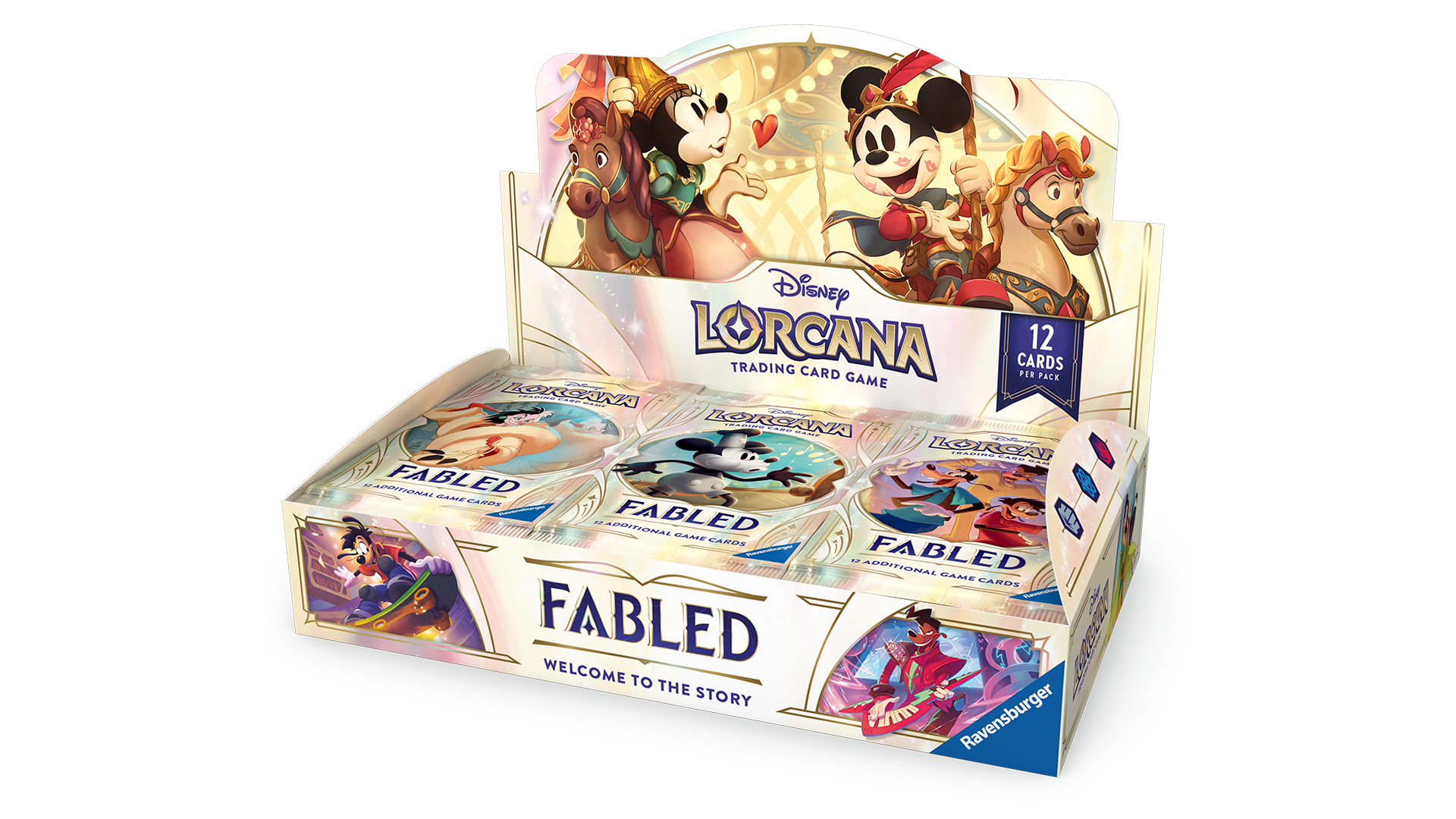
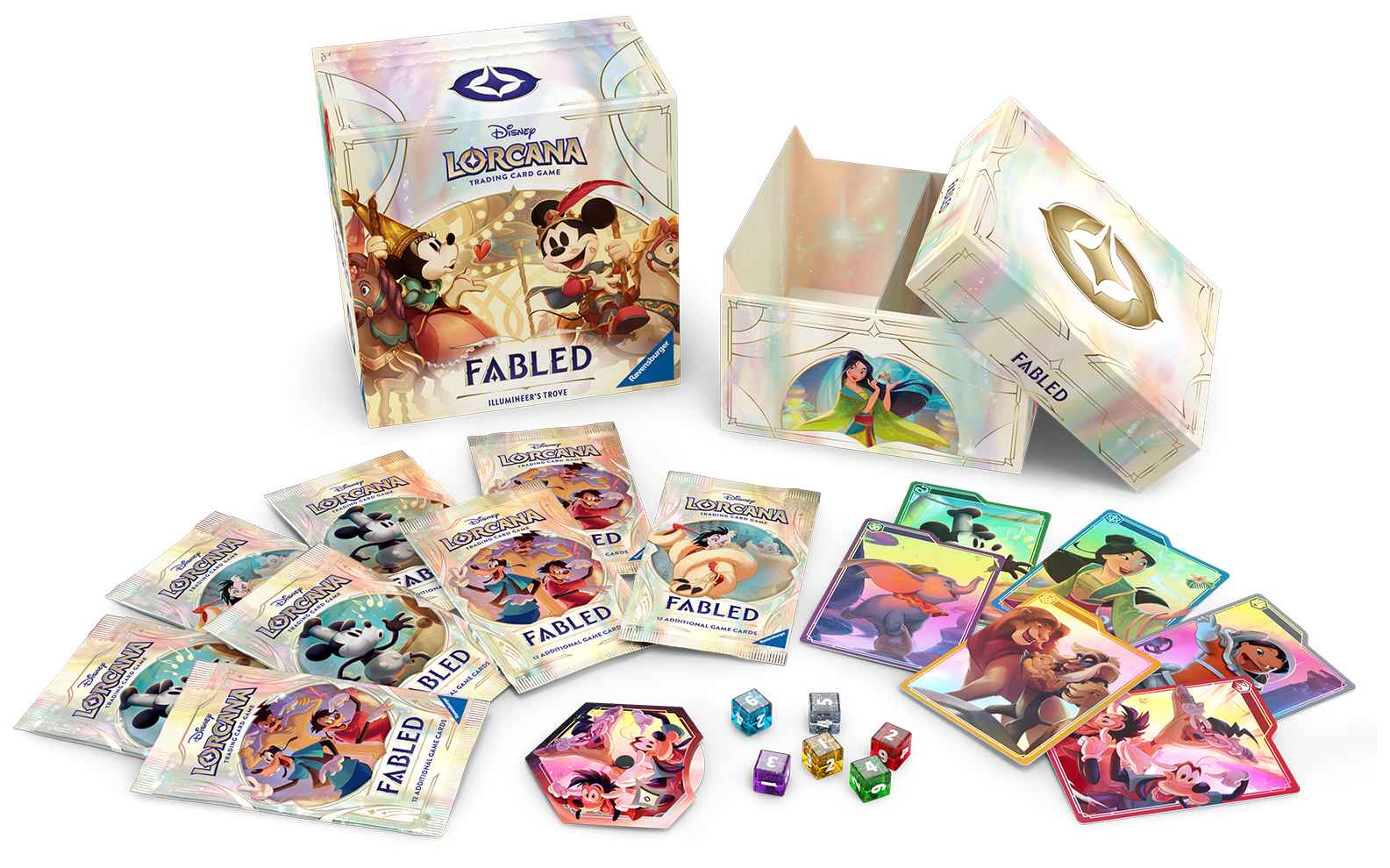
A booster display holds twenty-four twelve-card packs: 288 random cards before accounting for duplicates. A Trove includes eight packs, a storage box, six foiled dividers, damage dice, and a foiled lore counter. A single-player deck supplies sixty curated cards. Those counts describe different experiences, rather than three sizes of the same purchase.
I would compare a display with twenty-four equivalent individual packs. I would compare a Trove with eight packs plus accessories I will actually use. I would compare a deck with another playable deck, considering its plan and contents rather than dividing its price by sixty and treating it as random bulk.
For two people starting together, two different fixed decks provide an immediate matchup. A display does not guarantee two coherent, balanced decks in the desired colors. It may be a fun collection purchase afterward, but it does not solve the same problem.
Princess Power or Standout Headliners?
The two Fabled decks teach different habits. Princess Power is the Amber/Sapphire Ariel and Mulan deck. Its useful lessons include sequencing Princess discounts, using singers, evaluating healing, and deciding whether a supporting character improves the whole board. Standout Headliners is the Emerald/Ruby Powerline and Max Goof deck, with songs, Shift choices, and recurring decisions about whether a singer should sing or quest.
Neither should be bought merely because the foil front card looks strongest. Consider which decisions you want to repeat for several games. Princess interactions reward checking classifications and planning a development turn. The Headliners deck repeatedly exposes the opportunity cost of exerting a character for a song. Our individual guides work through those choices in more detail.
If both players are new, swap decks after a few games. A matchup can feel unfair when one person has learned their deck’s key sequence and the other is still reading. Swapping provides a useful check without immediately spending more money on upgrades. It also reveals which play style someone actually enjoys.
Epic, Enchanted, and Iconic: separate beauty from function
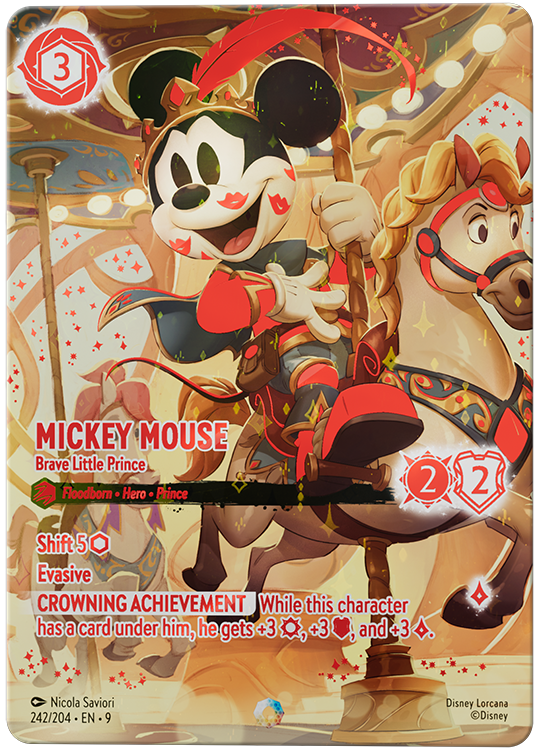
Fabled introduced Epic and Iconic treatments and updated the presentation of Enchanted cards. The collector appeal is legitimate: special artwork and finishes can make a favorite character feel like a display piece. The buying error is treating the premium treatment as additional gameplay strength.
When the full card name is the same, compare its gameplay text rather than assuming the rarer version has a stronger ability. If your aim is to play a deck, the least expensive suitable printing is often the practical choice. If your aim is to own a particular illustration, compare the exact single with the amount you were planning to spend hoping to open it.
There is no reliable personal guarantee that the next box will contain the chase you missed in the last one. I would set an opening budget independently of resale hopes. Enjoying packs is a sufficient reason to buy packs; describing them as a dependable way to obtain one premium card is not.
A useful way to open a small collection
Sort first by ink and card function, not rarity alone. Put affordable characters together, then interaction, draw or selection, songs, items, and locations. Note which cards can become ink. This makes it easier to see whether your pile can support ordinary early turns before you become attached to its flashiest payoff.
Next choose one project. It might be an Amber/Sapphire upgrade, a collection page for A Goofy Movie, or a pair of casual decks kept at comparable strength. A single goal creates a useful wants list. Trying to finish a set, build three decks, and chase every premium version at once makes each purchase difficult to judge.
For a constructed deck, test changes in small groups. If a song repeatedly sits unused, ask whether you lack singers, legal targets, or a reason to spend a character’s action on it. Those are different problems. Adding a more expensive singer may solve none of them if your real issue is a song that does not affect your usual matchup.
Worked buying comparison
Imagine a hypothetical display costs $120, while a Trove costs $48 and a single pack costs $5. The display is $5 per pack, the Trove is $6 per pack before valuing accessories, and buying twenty-four single packs also costs $120. Those invented prices show that the word “display” does not itself create a discount.
If you value the Trove’s box and trackers at $8 for your own use, its effective pack allocation would be $40 divided by eight, or $5 per pack. That is a personal budgeting model, not a claim about an accessory’s resale value. Use actual delivered prices when shopping and avoid counting accessories you already own as fresh savings.
My recommendation
Fabled is a sensible place to explore Lorcana’s mix of familiar cards and new collector treatments. I would begin with one of its fixed decks when the goal is play, then add a deliberately limited opening if discovering cards sounds enjoyable. Once a concrete upgrade list exists, I would move to exact cards rather than keep buying random ones to finish it.
The strongest reason to buy this set is a project you can describe clearly. If you can say what you will play, collect, or do with the purchase the evening it arrives, the product choice becomes much easier.
Find the product
View Fabled booster display on Amazon. Confirm the selected quantity, language, seller, and delivered price.
Continue with B3’s Lorcana guides
Browse all Lorcana guides · Learn to play · Compare your first purchase.
Choose a fixed-deck guide: Princess Power: Ariel and Mulan or Standout Headliners: Powerline and Max Goof.
Sources and scope
Checked October 21, 2026: official Fabled products and card previews, current rules and release notes, and the official rotation explanation. Product facts and printed mechanics are separated above from B3’s proposed buying and practice methods. Prices in worked examples are hypothetical; live prices, stock, event availability, and pull odds are not promised.