Fabled Standout Headliners Deck Guide: Powerline, Max Goof, and Songs

Affiliate disclosure: As an Amazon Associate, B3 earns from qualifying purchases.
Standout Headliners is the Fabled Emerald/Ruby starter deck featuring Max Goof — Rebellious Teen and Powerline — World's Greatest Rock Star. The attractive idea is to sing a useful song, keep your ink available, and use that ink to strengthen your board. The difficult decision is deciding when the singer would have done more by questing or challenging instead.
I like that as the center of a learning deck because it makes opportunity cost visible. Your character turns sideways, your song resolves, and you can see what the saved ink bought. But a card with Song printed on it is not automatically worth playing. The stock deck needs useful effects at the right time, not simply the highest possible number of musical triggers. This guide analyzes printed cards and the fixed list; the proposed practice and upgrades are not claimed B3 playtest results.
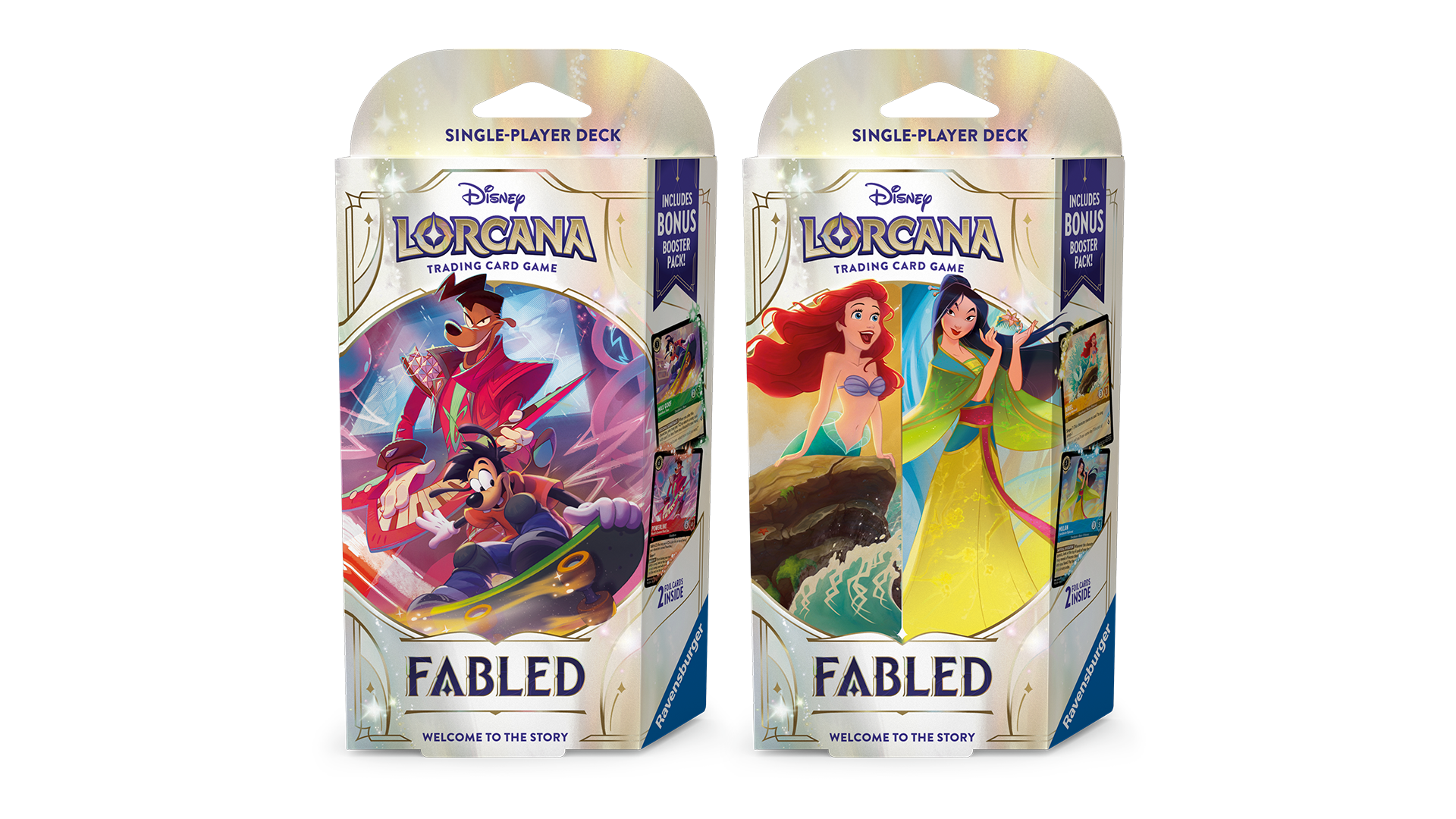
Identify the right box
This is the Emerald/Ruby 60-card Fabled deck called Standout Headliners, the Powerline-and-Max option in the official paired photograph. It is one player's deck, not a solo game. Its extra booster contains random cards and is excluded from the fixed list below.
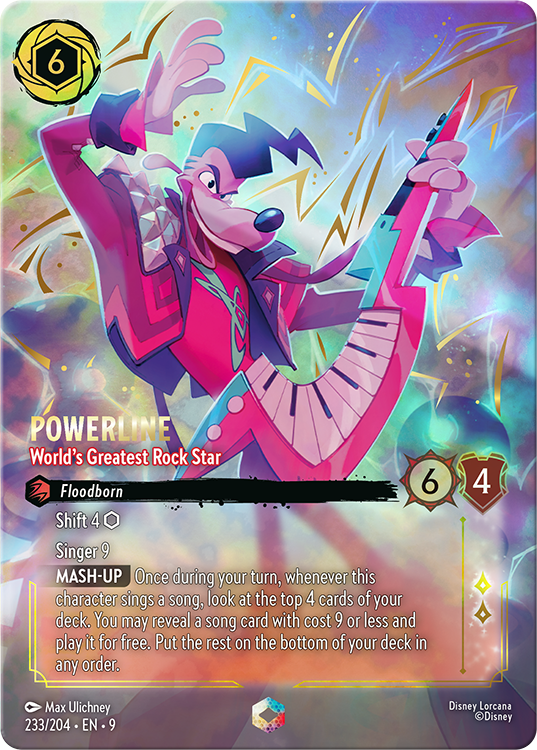
There are three Powerline versions in the list. Taking the Stage is the two-cost Singer 4. Musical Superstar is a separate three-cost card. World's Greatest Rock Star is the six-cost Shift 4, Singer 9 payoff. Do not transfer the large version's abilities to every card named Powerline.
The early singer creates choices, not automatic value
Taking the Stage has 3 Strength, 2 Willpower, one lore, and Singer 4. Once dry, he can sing an appropriate song costing up to four. That makes a two-cost character a way to use an effect such as Be King Undisputed while leaving your ink ready. His low Willpower also means that exposing him can be costly.
Suppose, in an invented turn, you have a dry Taking the Stage and four ready ink. You could sing a useful three-cost song and spend all four ink on development. Or you could pay three ink for the song and use Powerline to challenge or quest. The first line offers more purchasing power; the second preserves the character's action. Compare what each line actually accomplishes before calling the singing option better.
The song still has to come from somewhere, meet its requirements, and resolve correctly. Singer 4 does not change Powerline's printed cost to four for unrelated effects, does not draw a song, and does not let a newly played drying character sing immediately.
Mulligan for a board and a useful follow-up
The fixed deck has eight one-cost cards and a substantial two- and three-cost band. Look for an opening character, a believable second turn, and inkable cards you can afford to give up. A singer without a song may still be a functional character. Several expensive or situational songs without bodies can be a much worse opening.
I would usually send back I2I when the hand needs help developing rather than keep it because it is the most dramatic effect. Preserve a clean early curve before chasing the one-copy large Powerline. With only one copy of that headline card, many games must function without seeing it on schedule.
Think of your first ink choices as protecting a line, not a favorite illustration. If your only way to play on turn two is Taking the Stage, inking him to save a later payoff can be self-defeating. If you have redundant cheap characters and an important near-term song, the balance may reverse.
Stand Out: a combat tool with a defensive duration
Stand Out gives a chosen character +3 Strength and Evasive until the start of your next turn. Its duration crosses the opponent's turn. The Strength boost can change a challenge now, while Evasive can limit ordinary challengers afterward. Neither part is universal protection from opposing actions or abilities.
In an invented example, you have two dry characters: a singer and an ability-free 2-Strength, 4-Willpower character. An exerted enemy has 4 Strength and 5 Willpower. Sing Stand Out with the first character, then challenge using the second. Your challenger now deals five and can banish that enemy, but still receives four damage and is banished itself. The song's power bonus did not add Willpower.
Change the defender's Strength to three and the boosted challenger survives with three damage. That is a different outcome worth calculating before playing the song. An attractive animation of a large attack is not the same as a favorable exchange.
Evasive also does not let you challenge a ready enemy. You still need a legal target. Its defensive value comes from restricting who can challenge the affected character, and other removal can remain available.
Max recovers a song at a precise moment
Max Goof — Rebellious Teen costs three. When played, he offers an additional one-ink payment to return a song costing three or less from your discard to your hand. That makes four available ink a useful threshold if you want both the character and the recovery. Play him with only three ink and you cannot simply promise to pay the extra point next turn.
I would plan the target before spending the three. A recovered Mother Knows Best or Stand Out can be useful if it solves the board in front of you. Returning an irrelevant song merely because the ability is available can spend ink you needed elsewhere. The recovered song goes to hand, not straight into play for free.
Because his ability happens when played, Max does not need dry ink to trigger it. Singing the recovered song with Max himself is a different matter: he is a newly played character and normally cannot exert for that purpose yet. An already dry eligible singer can potentially use it that turn.
The Shift turn: preserve the state of the character underneath
World's Greatest Rock Star normally costs six but can be played with Shift 4 onto an appropriate character named Powerline. Shift does not erase the underlying character's damage, readiness, or drying condition. If the existing Powerline is dry and ready, the shifted character can potentially sing that turn. If it is exerted, Shift does not supply a free ready. If it is still drying, the bigger card does not magically bypass that restriction.
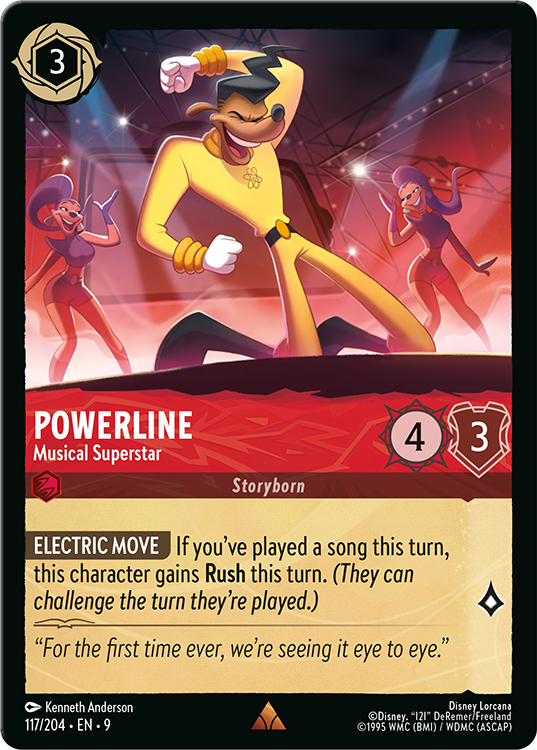
An invented clean sequence begins with a dry, ready Taking the Stage already in play and four ready ink. Pay four to Shift World's Greatest Rock Star onto him. The stack remains ready and dry, so you can then sing a suitable song with its Singer 9 capacity. This uses the state you preserved earlier. Singing with the small Powerline first would normally leave the stack exerted after shifting.
The six-cost version has 6 Strength and 4 Willpower. That is not an invitation to ignore existing damage on the stack. Check survival before choosing a challenge, especially when the smaller card has already been involved in combat.
Mash-Up is a bonus song, not another singing action
Once during your turn, when World's Greatest Rock Star sings, Mash-Up looks at the top four and can play a song costing nine or less for free. A song played by that effect was played, not sung by the character again. That distinction prevents an imagined chain of endless Mash-Up triggers.
The ability can miss if the four cards contain no eligible song, and a found song may have an effect you would rather not use. Do not evaluate the Shift play as though a perfect second song is guaranteed. Check what the first song accomplishes and whether the resulting board is acceptable even if the look produces nothing useful.
With multiple choices available, resolve instructions carefully and put the remaining cards on the bottom as directed. Do not add extra cards to your hand merely because you saw them. This is one of the places where stating each resolved effect aloud helps both players follow the turn.
I2I requires counting both players' score
I2I is a nine-cost Sing Together song. Each player draws two cards and gains two lore. If two or more characters sang it, those singers ready but cannot quest for the rest of the turn. Singer 9 can let the large Powerline handle the song alone, but one singer does not satisfy the two-character ready condition.
This is a dangerous card to treat as an automatic finisher. If the opponent is on 18 lore and you are well behind, giving each player two lore can hand them the win. If both players can reach the winning threshold from the effect, use the current simultaneous-win procedures rather than improvising a favorable order. Count before committing.
There is another distinction with Mash-Up. If it plays I2I for free, no characters sang that copy merely because a different song triggered Mash-Up. You do not ready a group of imagined singers. The card can still provide its other effects, including the benefits to the opponent.
The ready clause can enable other legal work, such as challenges or another eligible singing action, subject to state and restrictions. It explicitly forbids questing for that turn. Do not calculate a winning line by counting quests those characters are no longer allowed to take.
Use locations and recovery without losing the main plan
The stock list includes three Agrabah — Marketplace locations. A location can apply continuing lore pressure without a character questing, but playing it still costs ink and the opponent can challenge it. Check the printed movement cost and abilities before paying to move characters; simply owning a location does not make relocation free or universally valuable.
Other supplied cards fill ordinary development, interaction, and card-access roles. Not every one needs a music combo to be useful. Against pressure, putting a body down may matter more than assembling a spectacular turn. Against a slower opponent, preserving a dry singer and a useful song can make the next development turn much stronger.
What I would watch in the first five games
Record which songs were useful, which remained stranded, and how often the single large Powerline was actually required. Also record whether you ran out of cards in hand because you deployed too quickly, inked too aggressively, or simply lacked enough ways to replenish. Those are different problems with different remedies.
Do not infer that a card is weak because it appeared once in the wrong matchup. Conversely, repeated dead cards deserve attention even when they are thematically perfect. The stock list contains several small subthemes; an upgrade can make one plan more consistent by removing a peripheral package, but that also narrows the deck's range.
Small upgrades before expensive changes
A cautious experiment is to add one Taking the Stage, reaching four, and one additional useful three-cost song already in the list, while removing two cards that repeatedly fail to contribute. Choose the song from the problem you see: a return-to-hand effect and a Strength/Evasive effect solve different situations. Preserve the normal four-copy limit and the two ink types.
If I2I keeps helping the opponent more than you, temporarily replace that single slot and compare your games. If the large Powerline line is the reason you enjoy the deck, extra copies may improve access, but they also add expensive draws and monetary cost. These are proposed tests, not a validated tournament list. Verify format eligibility, reprints, and bans before purchasing for organized play.
Fixed 60-card list
- 1 each: Goofy — Set for Adventure; Max Goof — Rebellious Teen; Powerline — Musical Superstar; Kuzco — Temperamental Emperor; Powerline — World’s Greatest Rock Star; I2I.
- 2 each: Bobby Zimuruski — Spray Cheese Kid; LeFou — Instigator; Megara — Pulling the Strings; Roxanne — Powerline Fan; Wildcat — Mechanic; Donald Duck — Perfect Gentleman; Virana — Fang Chief; Signed Contract; Mother Knows Best; Stand Out; Be King Undisputed; A Pirate’s Life.
- 3 each: Sergeant Tibbs — Courageous Cat; Aladdin — Prince Ali; Powerline — Taking the Stage; Donald Duck — Sleepwalker; Max Goof — Rockin’ Teen; Mickey Mouse — Steamboat Pilot; P.J. Pete — Caught Up in the Music; Improvise; You Can Fly!; Agrabah — Marketplace.
The quantities total 60 and exclude the random booster. This factual inventory uses full character subtitles so you can check the exact versions you own.
B3's verdict
I would choose Standout Headliners for someone who enjoys sequencing and wants a recognizable musical theme with decisions beyond playing the largest available character. Its strongest lesson is that saving ink only matters when the song is useful and the saved ink improves the turn.
Learn the small singer's ordinary work first. Then add the Shift and Mash-Up lines without assuming they will appear every game. That gives the deck a practical plan as well as a dramatic ceiling.
View the Fabled Emerald/Ruby Standout Headliners deck on Amazon
Continue with B3’s Lorcana guides
Learn the rules with worked turns and example videos, or compare Gateway, decks, boosters, and other first purchases.
Sources and further reading
Checked October 20, 2026: official rules and release notes, including the October 8 comprehensive rules; official teaching lessons; Gateway contents; Fabled products and official art; two-player set contents; and formats.
The published fixed deck inventory at Lorcana Player was used to check quantities. Individual card text was checked by full name; strategic judgments and invented examples above are B3’s own analysis. The list is not a certification of current event eligibility.
B3 is an independent publication and is not affiliated with or endorsed by Disney or Ravensburger. Official card art and product images remain the property of their respective rights holders. Images are shown for product identification and discussion; depicted premium treatments are identified where applicable.