Deep Trouble Guide: Team Strategy, Ursula’s Race, and What Comes in the Box
Affiliate disclosure: As an Amazon Associate, B3 earns from qualifying purchases.
Deep Trouble is the Lorcana box I would choose for a group that wants to face the game together rather than race one another. Ursula runs from a special scenario deck, while the players use ordinary Lorcana decks. The appeal is cooperation with familiar card-game decisions: develop characters, choose what to ink, decide which threats to challenge, and still find time to collect lore.
It is a self-contained adventure purchase, not a booster expansion you must combine with an earlier Illumineer’s Quest. It also assumes you understand Lorcana’s normal turn and card rules. For a completely new pair, I would learn those basics first instead of asking a scenario sheet to teach two systems at once.
What is actually in the box?
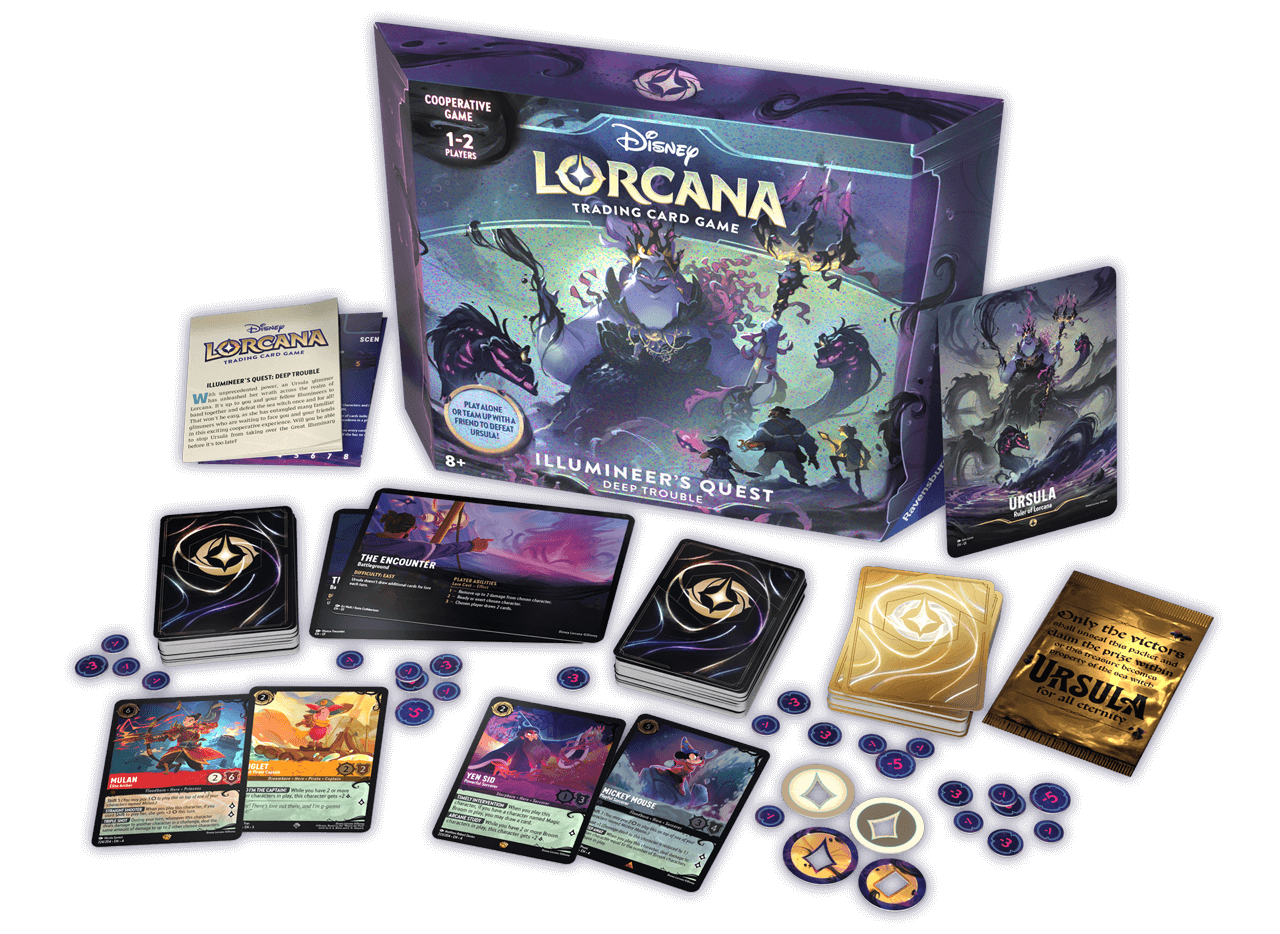
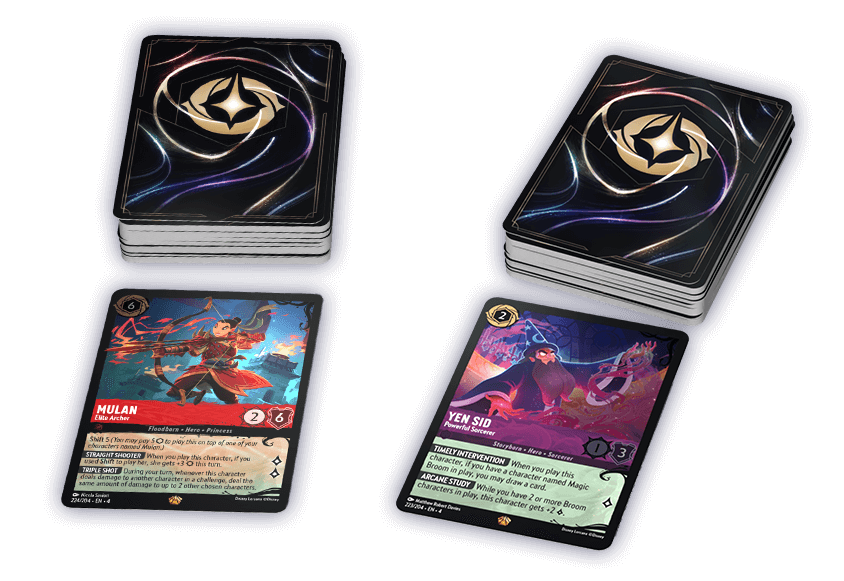
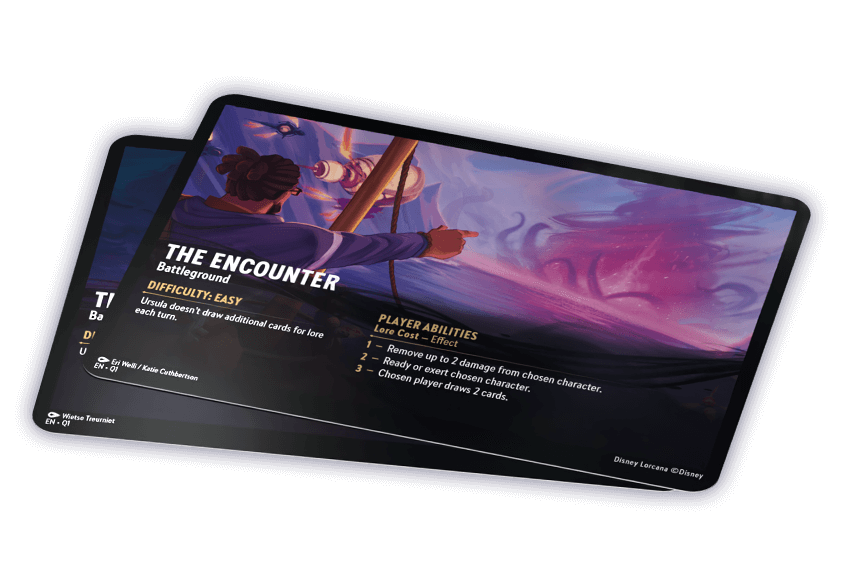
The important contents are Ursula’s fifty-card scenario deck, two sixty-card player decks featuring Yen Sid and Mulan, an oversized Ursula card, four difficulty settings across two double-sided battleground cards, a playmat, tracking pieces, damage counters, a victory card, and scenario instructions. The included player decks support one or two people; up to four can participate if the additional players bring decks.
You do not need booster packs to make the adventure function. That matters when comparing a complete sealed box with a used listing containing only the scenario deck or a selection of loose cards. Check the photographed contents and description, not just a familiar Ursula illustration.
Understand the race before choosing attacks
The players are trying to get every participating player to at least twenty lore before Ursula reaches forty. Those are individual player totals, not one shared twenty-lore target. Ursula’s automated play follows its own instructions rather than acting like another human with a normal deck.
That creates a bottleneck. If one player reaches their target while another remains far behind, the team has not finished. I would track the slower player’s plausible next two turns as carefully as Ursula’s immediate threats. Helping that player develop may be more useful than adding another impressive quester to an already comfortable side of the table.
A cooperative victory condition changes the value of support. An effect that lets your partner keep questing can advance the whole team even when it adds nothing to your own lore total. Evaluate the team’s finish, not a private scoreboard.
Plan one shared turn, then take the legal actions
Players take their turns simultaneously, which allows coordination. It does not merge their inkwells, hands, or card ownership. Each person must still pay their own costs, and an effect can only target what its wording permits.
Before acting, identify three things together: what Ursula will gain if you ignore the board, what each player can contribute to lore, and which affordable intervention improves both plans. Then carry out the sequence one card at a time so that triggers, costs, and targets remain clear.
For a teaching game, let the less experienced player state their intended play first. Offer an alternative and explain the tradeoff, then let them choose. Cooperation is much less satisfying when one person becomes the pilot of everyone else’s hand.
A useful challenge prevents future damage to the plan
Suppose a visible opposing character can quest repeatedly if left alone. Removing it may prevent several future lore, but the challenge also consumes a character that might have quested for you. Compare those outcomes over a realistic number of turns.
If removing a threat buys two extra rounds for the slower teammate, that can justify a sacrificed character. If you are already able to complete the team’s win this turn, clearing an otherwise frightening board may accomplish nothing. The current objective determines the useful action.
I would not use a blanket “always quest” or “always clear” rule. Instead, ask which threat forces an immediate response and which can be tolerated while you finish. A good cooperative turn often mixes one player’s interaction with the other player’s development.
Battleground abilities have a real price
The selected battleground determines difficulty and offers abilities that cost lore. Treat that cost as spending part of your route to victory, not as a free communal bonus. Read the specific battleground rather than importing an ability from a previous difficulty.
For a hypothetical comparison, imagine spending two lore allows a useful effect now. If it saves a character that can collect four lore over the next two turns, the investment may be worthwhile. If that character is unlikely to survive or the team was one quest away from winning, the same purchase may delay the result you needed.
The example is a way to value the trade, not a statement of a particular battleground’s printed cost. Name the actual effect and count the recovery time before spending.
Use difficulty to diagnose, not to prove a point
Start on the introductory battleground while learning the automated turn. Check draw instructions, play instructions, and difficulty-specific exceptions carefully. Do not add a harder mode’s escalation rules merely because you remember reading them on another side of the card.
After a loss, first ask whether the scenario was operated correctly. Then identify a strategic failure: no early board, too little interaction, a teammate who could not progress, or a promising engine that arrived too late. Those are more actionable observations than “the deck is bad.”
Change one thing for the next attempt. Replaying the same difficulty with a better division of roles teaches more than changing both decks and the battleground at once.
What should you upgrade first?
For cooperative play, tune toward the threats in the scenario. A card intended to disrupt a human opponent’s hand may have a very different practical value against an automated deck. Check scenario-specific interactions before importing a competitive list and assuming it solves the adventure.
I would preserve early development, dependable card flow, and enough useful ways to answer the threats that repeatedly defeat the team. Avoid building one deck that does nothing but defend unless the other deck can actually bring both players to their required lore totals.
If the box remains a family game, keep its original lists together. You can experiment with borrowed cards and return to the supplied experience without having to reconstruct it from memory. There is no need to start by purchasing a large pile of upgrades.
Solo play and the purchase decision
Solo play removes negotiation and makes every quest-versus-challenge decision your responsibility. It does not mean the easiest battleground will automatically be easy for every stock-deck draw. Expect to learn the scenario’s pacing rather than treating a first loss as evidence you bought the wrong box.
I would choose Deep Trouble for the Ursula confrontation, straightforward shared lore race, and the option to include more players with their own decks. Palace Heist adds a Crown objective, while The Great Hunny Rescue uses encounters and a different progression structure. You can start with the adventure that interests your group; they are not chapters that must all be purchased in order.
For the surrounding expansion, use the Ursula’s Return set guide. Its starter decks and booster packs are separate products from this cooperative box.
Find the exact product
View this product on Amazon. Confirm the selected edition, language, seller, contents, and delivered price.
Continue with B3
All Disney Lorcana guides · Learn the core game · Choose a first purchase.
Sources and scope
Product details and printed mechanics were checked against Official Deep Trouble product and play overview, Scenario rules reference. Use the included instructions and current official rules for exact procedures. The proposed turns, practice exercises, and buying judgments are B3’s analysis; they do not imply hands-on tournament testing. Checked October 21, 2026.