Secrets of Power Padmé Amidala Spotlight Deck Guide: Disclose and Control the Board

Padmé's Secrets of Power deck turns information handling into damage. Revealing a card for disclose can help pay for an effect while also enabling her leader ability; discarding can search for a better hand while adding pressure. The interesting part is deciding which cards must remain available as information tools rather than automatically playing or resourcing them.
I would choose this deck for a player who likes a busy hand and several small advantages combining into a larger turn. It is more demanding than a straightforward unit curve because the cards in hand can be valuable for their aspects as well as for their eventual plays.
Jump to a section
- What Do You Have to Hide?: the exact leader
- Disclose pays with information rather than discarding the cards
- Your first resources can switch off later effects
- Captain Typho and repeated defensive value
- Turn a one-point ping into a complete result
- Furtive Handmaiden and Bail Organa: fixing the hand while acting
- Ahsoka and multiple attacks
- The six-resource deployment turn
- Capture and protecting the investment
- Weaknesses and useful upgrade tests
- B3's verdict
- Official fixed 50-card main deck
- Buying the deck and choosing upgrades
- Learn the rules, then test the fixed deck
What Do You Have to Hide?: the exact leader
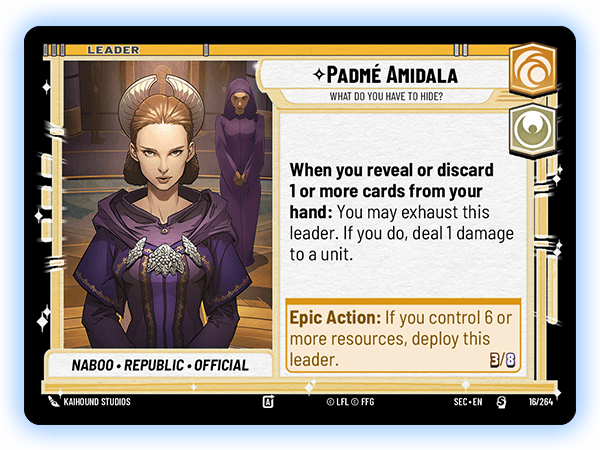
Padmé Amidala — What Do You Have to Hide? is Secrets of Power #016, Cunning/Heroism. When you reveal or discard one or more cards from your hand, her non-unit ability can exhaust her to deal one damage to a unit. Revealing three cards in one event does not automatically mean three damage: the wording refers to one or more cards, and the non-unit side exhausts.
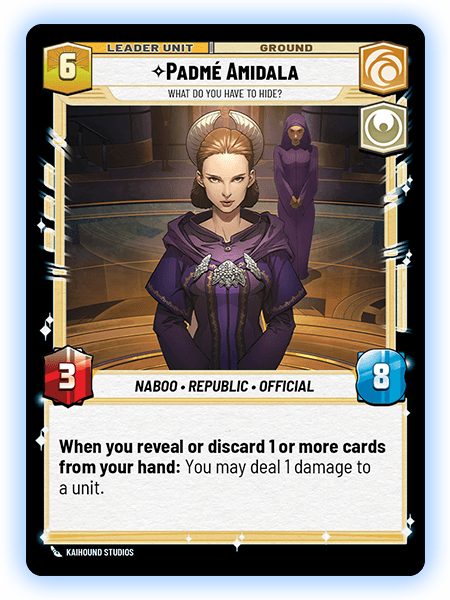
She deploys at six resources as a 3-power, 8-HP ground leader. On that side, the reveal/discard damage ability does not use the exhaust condition. Several distinct qualifying events can therefore matter in the same phase. It still deals damage to a unit, not directly to a base.
Senate Rotunda is the supplied Command base. Your normal aspect coverage comes from it and the leader, not from every icon printed on the units you control. The disclose requirement is a separate check using cards revealed from your hand.
Disclose pays with information rather than discarding the cards
If an ability asks you to disclose Command and Heroism, you reveal cards from hand whose icons satisfy the requirement. One card showing both can do the work of two cards showing one each. You do not ordinarily discard the disclosed cards merely because you showed them.
That makes a card such as the Secrets of Power C-3PO useful as both a playable card and an information tool. Keeping the right icons can let several later effects function. The same card can be disclosed for separate eligible abilities; showing it once does not permanently consume its aspects.
The opponent does learn what you hold. If you repeatedly disclose the same known card, however, you may give away less new information than revealing a surprise answer. Choosing which equivalent set of icons to show is a real decision rather than a purely mechanical payment step.
Your first resources can switch off later effects
Before keeping an opening hand, identify an affordable unit and a follow-up. Then check what aspect icons remain in hand after your two resource choices. A card that looks expendable as a future play may be the only way to satisfy the disclose requirement on another card you are keeping.
This does not mean preserving every icon indefinitely. A hand that can disclose beautifully but cannot develop a board is also weak. I would choose a functioning early curve first, then preserve the most useful disclosure combinations that curve can support.
Furtive Handmaiden, the deck's early ships, and affordable supporting units help you begin doing things while sorting the hand. Do not turn every opening into a hunt for the most elaborate later damage chain. You need units worth protecting and enemy units that your small damage effects can meaningfully change.
Captain Typho and repeated defensive value
Captain Typho's Sentinel role and disclosure-related healing make him a useful example of why hand composition matters. If you can repeatedly satisfy the required icons when he is attacked, the defensive effect can be much more useful than a one-time body with no support.
Before relying on that defense, verify which cards you must retain. If you play or resource your last matching icon, announce to yourself that the future disclosure is no longer available. Forgetting this is an easy way to plan an illegal heal and misjudge how many attacks your board survives.
Sentinel remains arena-specific. A ground defender does not ordinarily protect your base from space attacks. Naboo Security Force and B2EMO provide other defensive tools under their conditions, but you still need to read which unit and arena each effect can influence.
Turn a one-point ping into a complete result
One damage is most valuable when it defeats a unit, changes a combat breakpoint, or enables another effect. If the only result is putting a counter on a healthy threat, ask what future action converts that counter into an advantage before the opponent repairs or ignores it.
For a simplified example, an enemy has three remaining HP and your ready attacker has two power. A qualifying Padmé ping can put that defender into a range where the ordinary attack defeats it. On the non-unit side, using the exhaust now may mean forgoing a later trigger, so consider whether this particular removal is worth the opportunity.
After deployment, several distinct reveal/discard events can create several points over the phase. Keep each event separate and choose legal targets at resolution. Do not announce a fixed damage total before checking which effects actually reveal from hand, which discard from hand, and which operate on another zone entirely.
Furtive Handmaiden and Bail Organa: fixing the hand while acting
Discard-related effects are not the same as disclose. The discarded card leaves your hand, so you lose its future use as both a play and a reveal option. The upside is moving toward a better hand or gaining another immediate benefit while triggering the leader when appropriate.
If you discard a card carrying the only required icon for Typho, the short-term ping may weaken the next defensive exchange. If the card was stranded and another draw improves the curve, the same discard may be exactly right. Judge both the immediate board change and the information tools you retain.
Bail's token contribution can also support other cards that care about Officials. A Spy is a real unit with a trait line and combat role, not just a counter used to activate another card. Keep its arena and remaining HP visible when choosing whether to preserve or trade it.
Ahsoka and multiple attacks
The Secrets of Power Ahsoka Tano offers an attack-follow-up interaction tied to disclose. Before attacking with her, identify the other unit that can benefit and whether it will still be available when the relevant ability resolves. A ready eligible follow-up is more useful than a theoretical second attack involving a unit the opponent already defeated.
This is a reason to plan the hand and battlefield together. Having the right disclosed icons without an appropriate second unit can waste the opportunity. Having the perfect second unit without the disclosure payment is equally incomplete.
Naboo Royal Starship, Jar Jar, and C-3PO offer other ways to influence a meaningful combat. Combine the exact printed effects you actually hold rather than adding every possible boost from the deck to the same imaginary leader attack.
The six-resource deployment turn
Deployment improves the repeatability of Padmé's damage ability. Count which reveal/discard effects remain usable after she enters, not how many you already resolved earlier in the phase. If you spend all the hand's enabling cards first, you may leave the stronger side with no immediate work.
Some supplied cards have Plot, creating additional choices when you deploy. Plot cards must already be in your resource zone for that deployment trigger, and you still pay their costs. The resource replacement preserves the resource count, not an unlimited pool of ready purchasing power.
It can be correct to use an urgent disclosure effect before deployment if it removes a threat now. It can also be correct to deploy first when the opponent cannot disrupt the plan and several later events will benefit. Ask which response window matters instead of following a fixed “always deploy first” instruction.
Capture and protecting the investment
Moral Authority and Dismantle the Conspiracy give you reasons to develop an appropriately strong friendly unit. A captured enemy is not the same as a permanently defeated card: losing the guarding unit can change the outcome. Read the specific capture rules and choose the host with that risk in mind.
Padmé's eight HP can make her an appealing investment, but upgrades, damage, and enemy answers still matter. Hidden on the supplied Anakin is not total immunity, and a temporary boost can expire before the defense you intended it to provide next round.
With Thunderous Applause is a way to turn an established board into pressure. Do not use every action controlling small units if you already have a route to defeating the base. Your pings support the combat plan; the leader's unit-only targets mean they are not an unlimited direct-base finish by themselves.
Weaknesses and useful upgrade tests
Empty hands can undermine disclose. Awkward resources can remove the icons you need. Too many clever effects without useful bodies can leave you unable to contest either arena. The cure depends on which of those failures is happening.
The stock list already has three Furtive Handmaidens, Ahsokas, Anakins, J-Type Nubian Starships, Captain Typhos, and Sneaking Suspicions. If a support effect repeatedly matters, test an additional copy of a two-copy card such as Mina Bonteri or Bail Organa after checking the curve and disclosure icons. Do not add every singleton at once.
For the first several games, record what you could not disclose and which resource decision caused it. A better resource choice can fix that problem without changing the deck. Only buy an upgrade once you can explain what it solves and what card it replaces.
B3's verdict
Padmé rewards a player who enjoys keeping options open and extracting value from routine hand decisions. The strongest lesson is that a card can be useful before you play it, yet still be a poor keep if you cannot develop. Learn to preserve the right icons, turn small damage into completed trades, and keep enough actual attackers to finish the game those advantages are buying.
Official fixed 50-card main deck
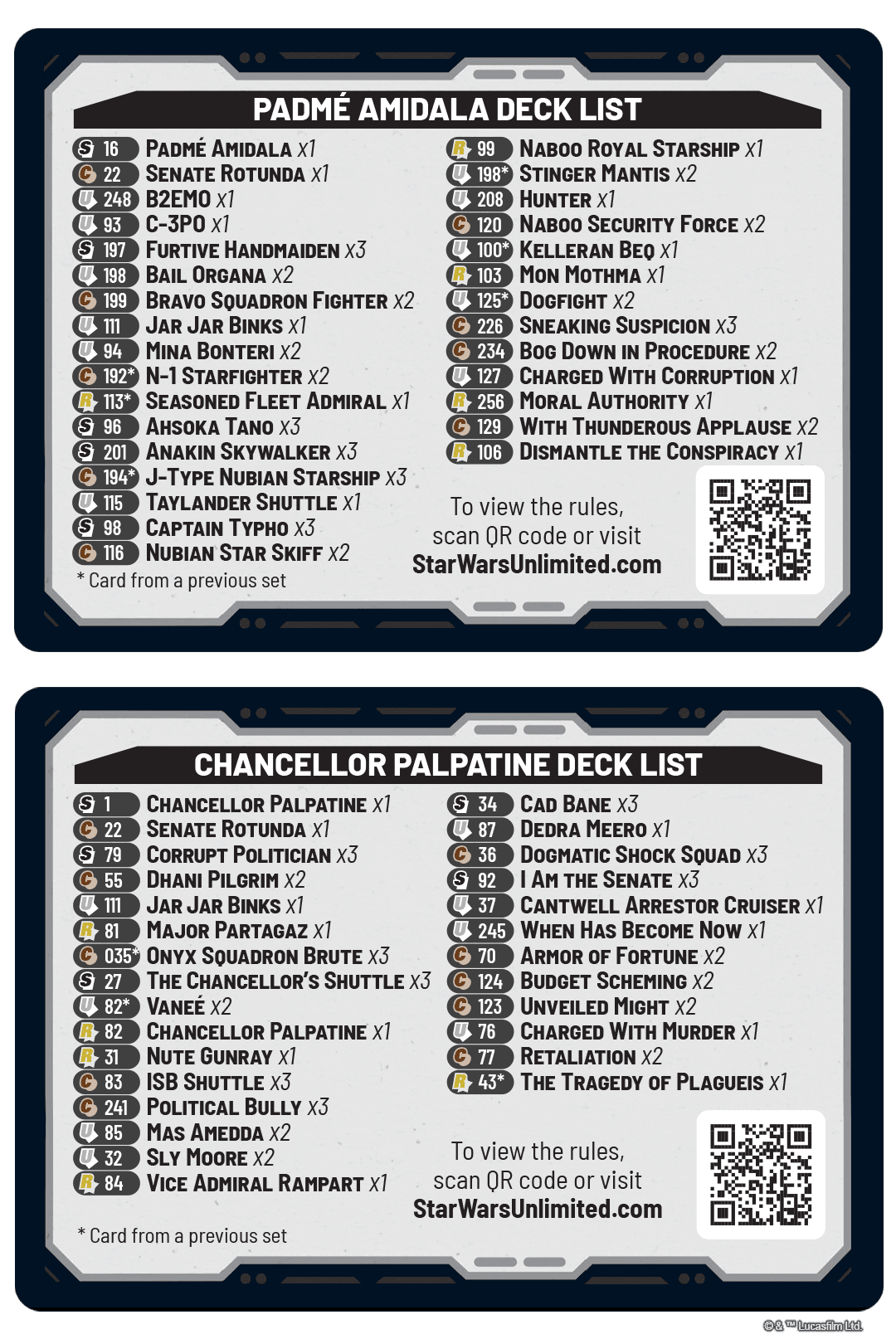
The leader and Senate Rotunda base sit outside these 50 main-deck cards. Counts below follow the official product list; earlier printings and same-name cards can have different abilities. Use the linked original for printed card numbers and previous-set markers.
- 1 each: B2EMO; C-3PO; Jar Jar Binks; Seasoned Fleet Admiral; Taylander Shuttle; Naboo Royal Starship; Hunter; Kelleran Beq; Mon Mothma; Charged with Corruption; Moral Authority; Dismantle the Conspiracy.
- 2 each: Bail Organa; Bravo Squadron Fighter; Mina Bonteri; N-1 Starfighter; Nubian Star Skiff; Stinger Mantis; Naboo Security Force; Dogfight; Bog Down in Procedure; With Thunderous Applause.
- 3 each: Furtive Handmaiden; Ahsoka Tano; Anakin Skywalker; J-Type Nubian Starship; Captain Typho; Sneaking Suspicion.
Inspect the official complete decklist image. The list includes both paired products; use the section headed Padmé Amidala.
Buying the deck and choosing upgrades
This is one player’s preconstructed deck, not a two-deck starter. An opponent needs their own playable deck. Check language, sealed condition, included accessories, and whether the listing is a single deck rather than a display or an individual leader card. Compare delivered prices; no live price or stock promise is made here.
As an Amazon Associate, B3 earns from qualifying purchases.
View the Secrets of Power Padmé Amidala Spotlight Deck on Amazon.
Learn the rules, then test the fixed deck
For a quick visual introduction, B3’s How to Play guide includes an 8:45 beginner tutorial. It explains the core action rhythm; use the worked examples here for this exact leader and fixed deck.
Keep the stock deck together for the first games. Record one resource choice, one action-order decision, and one card that felt stranded. Change a few slots only after identifying a repeated problem. For the next purchase, compare complete decks, singles, and boosters in the buying guide.
Event play: check the current format, reprint eligibility, errata, and suspended list before bringing the stock deck to an event. These products mix printings from different sets; an old printing may remain legal through an eligible reprint, but a recent package is not itself a legality certificate. Proposed upgrades here are small experiments, not a verified competitive list.
Card and inventory checks: October 20, 2026. Sources: official Spotlight Deck overview, official first look and leader images, current rules, errata, and suspended cards, and the original decklist linked above. Future rule or format changes take precedence.
Return to B3’s Star Wars: Unlimited hub.
Scope: the official Secrets of Power fixed Spotlight Deck, led by Padmé Amidala — What Do You Have to Hide?. This is rules-based analysis of the printed deck, with proposed practice and upgrade ideas; it does not claim B3 tournament results or hands-on testing.
Compare the paired deck: Secrets of Power Chancellor Palpatine Spotlight Deck Guide: Plan the Plot Turn. Browse all twelve Spotlight Deck guides and the SWU learning guides.
Considering packs for upgrades? Read the Secrets of Power booster buying guide before choosing a sealed product. For premium treatments, see Carbonite packs explained.