Secrets of Power Chancellor Palpatine Spotlight Deck Guide: Plan the Plot Turn

Chancellor Palpatine's Secrets of Power deck puts part of its future hand into the resource row on purpose. Plot lets those cards emerge when the leader deploys, and Palpatine helps find the pieces and discount the first payoff. The exciting turn is visible from a distance; your opponent's job is to make sure you never reach it comfortably.
I would choose this deck for someone who likes preparing a decisive mid-to-late-game transition. It needs patient resource management without becoming passive. A hand full of future plots is not a defense against the units already attacking your base.
Jump to a section
- How Liberty Dies: the exact Chancellor
- Plot is a deployment window, not an always-available alternate hand
- Resource decisions are part of your future turn
- Officials and Spies buy the time the plot needs
- Choose Plot payoffs by the problem they solve
- A seven-resource budget exercise
- When Has Become Now and the cost of flexibility
- Healing, disclose, and information management
- Deployment timing and the opponent's response
- Weaknesses and upgrade tests
- B3's verdict
- Official fixed 50-card main deck
- Buying the deck and choosing upgrades
- Learn the rules, then test the fixed deck
How Liberty Dies: the exact Chancellor
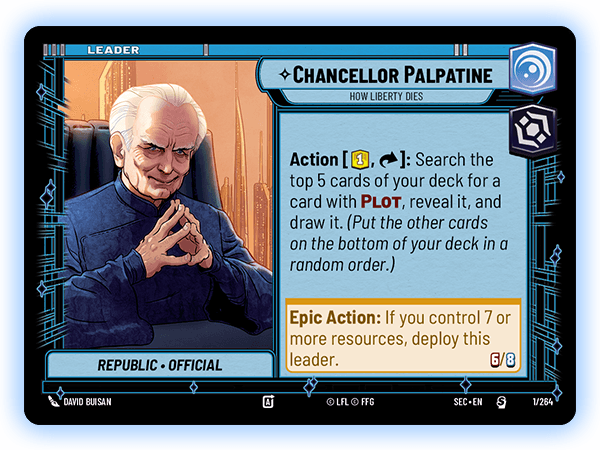
Chancellor Palpatine — How Liberty Dies is Secrets of Power #001, Vigilance/Villainy. His non-unit action costs one resource and exhausts him to search the top five cards for a Plot card, reveal it, and draw it, placing the others on the bottom in random order. It is a selection tool with a real resource and action cost, not a free extra card every time you develop.
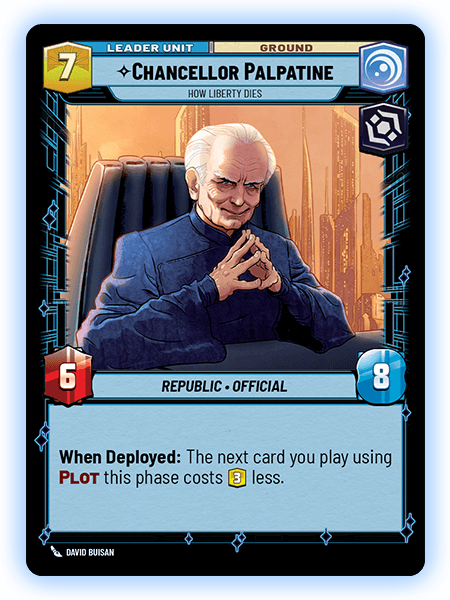
He deploys at seven resources as a 5-power, 8-HP ground leader. When deployed, the next card you play using Plot that phase costs three less. That reduction applies to the next qualifying card, not every Plot card in the resource row. Ordering the plays determines which card receives the saving.
Senate Rotunda is the supplied Command base. This is not the Ashes Emperor's Advantage deck. The character is familiar, but the leader's subtype, aspects, mechanics, and deployment plan differ.
Plot is a deployment window, not an always-available alternate hand
When you deploy a leader, Plot cards already in your resources can be played by paying their costs. You reveal the eligible cards you intend to play and resolve them in order. Their resource-zone positions are replaced from the top of your deck as the plays occur, preserving the resource count.
The replacements do not create unlimited ready resources. They replace the played cards within the resource arrangement. You still need enough spending capacity to pay the total legal costs after discounts. A new top-deck replacement that happens to have Plot was not already there when the leader deployed and does not join that same deployment's original trigger window.
That is why “I have six Plot cards resourced” is not the same as “I can play six cards when I deploy.” Plan the budget, the useful order, and the targets. The size of the reveal is less important than what the completed sequence accomplishes.
Resource decisions are part of your future turn
Ordinary decks often resource a card because they do not expect to need it soon. This deck may resource a Plot card because it specifically wants access to it later. That makes the decision more deliberate, not less costly: until the appropriate window or exception appears, the card remains unavailable as an ordinary hand play.
Before keeping your opening six, identify the two resources and an early defensive play. A useful Plot target can be one resource, but filling the row with all your playable bodies can leave no board. Decide how the hand will survive the next two rounds before admiring the seven-resource payoff.
Use the leader's one-resource search action when it fits the turn. If you have three ready resources and a three-cost unit you need to contest an attacker, paying one to search changes what you can afford. The search should improve the plan enough to justify that immediate lost option.
Officials and Spies buy the time the plot needs
Corrupt Politician, the unit version of Chancellor Palpatine, and the Spy-related cards provide a defensive and offensive framework while the resource row develops. I Am the Senate can create several Spies at once; other units benefit from their Official trait or give relevant bodies a defensive role.
A Spy's Raid makes attacking different from defending. Do not count its attacking power as though it were the same defensive combat value in every position. A token that threatens meaningful base damage can still be fragile when the opponent decides to remove it.
Major Partagaz, Nute Gunray, and the supplied support network reward using the right units in the right order. Read the exact version and timing before building a chain. The decklist's named characters are not interchangeable with cards sharing those names in other sets.
Choose Plot payoffs by the problem they solve
Cad Bane can provide an immediate answer to a low-HP enemy. Sly Moore can change the opponent's damage clock for the phase. Dogmatic Shock Squad can introduce a Sentinel role, and Armor of Fortune can change the value of the unit carrying it. Those are different responses to different boards.
If you are about to lose to several attacks, the best discounted card may be the one that reduces or redirects incoming damage, not the one with the largest independent body. If removing one specific enemy opens a winning attack, the targeted entry effect may be worth prioritizing instead.
Check targets before selecting the order. An earlier Plot play can create a useful upgrade host or change which enemy remains eligible for a later effect. Resolve relevant entry abilities fully before moving to the next card. This is a controlled sequence, not several cards entering simultaneously with all decisions postponed.
A seven-resource budget exercise
Imagine the first eligible Plot card normally costs five and another normally costs four, with all aspect requirements satisfied. The leader's three-cost reduction can make the first cost two, leaving enough of seven ready resources to pay four for the second. That uses six total and leaves one ready, assuming no other costs or effects change the example.
If you instead use the discount on a card costing two, some of the potential saving is unused. That can still be correct if its effect must happen first, but you should recognize the tradeoff. “Use the largest discount” is a useful starting idea, not a rule that overrides target setup or survival.
Now suppose you spent five resources before deploying and have only two ready. You still control seven, so deployment remains possible, but the same two-card purchasing plan is no longer affordable. Threshold and ready-resource budget must be tracked separately.
When Has Become Now and the cost of flexibility
The supplied event offers another way to access a Plot card from resources. It can matter when you need a specific effect before the leader's seven-resource turn or when you cannot fit every desired Plot play into the deployment budget.
Read its current errata as well as its printed name. The official rules page corrects this card's wording, including how the resource replacement works. An exception allowing a particular Plot play is not permission to treat every resourced Plot card as a permanent second hand for the rest of the game.
Before using the event, compare the card and resources spent with simply making an available normal play. Emergency flexibility can be worth the extra setup cost, but taking the elaborate route when an ordinary defensive unit would do can deplete the hand unnecessarily.
Healing, disclose, and information management
Dhani Pilgrim and The Chancellor's Shuttle contribute recovery while you build. Disclosure effects create another reason to preserve useful aspect icons in hand. Sometimes showing a modest already-known card is preferable to revealing the answer you were hoping to keep concealed.
Retaliation is a useful example of information affecting decisions. Revealing a potential punishment can change which enemy attacks the base, but it does not force the opponent to walk into the effect. Plan around their sensible response, not only the dramatic result if they ignore the warning.
If keeping a particular reveal option means resourcing the only early unit you can afford, reconsider the priorities. Information tools enhance a working curve; they do not replace having a battlefield.
Deployment timing and the opponent's response
Plot plays triggered by deployment resolve within the appropriate action and ability sequence. The opponent does not get unrelated normal actions between each nested Plot play just because you played several cards. They do get their action after the entire applicable sequence finishes, and triggered effects still follow their rules.
That creates a reason to preserve a meaningful deployment package. It also creates a risk: waiting one extra round for the perfect package may let the opponent win before your payoff. At seven resources, compare what deploying now accomplishes with what surviving another phase would cost.
After deployment, Palpatine's 5/8 body can contribute ordinary attacks. Do not spend the rest of the game arranging new schemes if the board you already created can pressure the base. The prepared turn should move you toward a finish, not merely demonstrate that the deck can play cards from resources.
Weaknesses and upgrade tests
Fast pressure punishes greedy searches and overly elaborate resource plans. Resource mistakes can hide the card you need before the Plot window. Too many expensive payoffs can make the deployment unaffordable even when you reach the threshold. Identify which failure appears most often.
Cad Bane, Dogmatic Shock Squad, I Am the Senate, and several early framework cards already begin at three copies. Do not buy fourth copies as a normal upgrade. If a defensive effect consistently matters, test a third Sly Moore or another relevant two-copy support card after checking the current wording and the exact slot removed.
For a hand-quality experiment, record how often the leader search finds a useful Plot and what spending that one resource prevented you from doing. If the search itself repeatedly creates the tempo loss, better timing may solve the problem without any new cards. These are proposed tests rather than a claimed tournament-optimized configuration.
B3's verdict
This Chancellor is satisfying when preparation produces a turn whose pieces genuinely solve the board. I would recommend him to a player who enjoys resource planning and can resist saving everything for one enormous reveal. Find a survivable curve, prepare a payable Plot package, and remember that the point of the scheme is the game state it leaves behind.
Official fixed 50-card main deck
The leader and Senate Rotunda base sit outside these 50 main-deck cards. Counts below follow the official product list; earlier printings and same-name cards can have different abilities. Use the linked original for printed card numbers and previous-set markers.
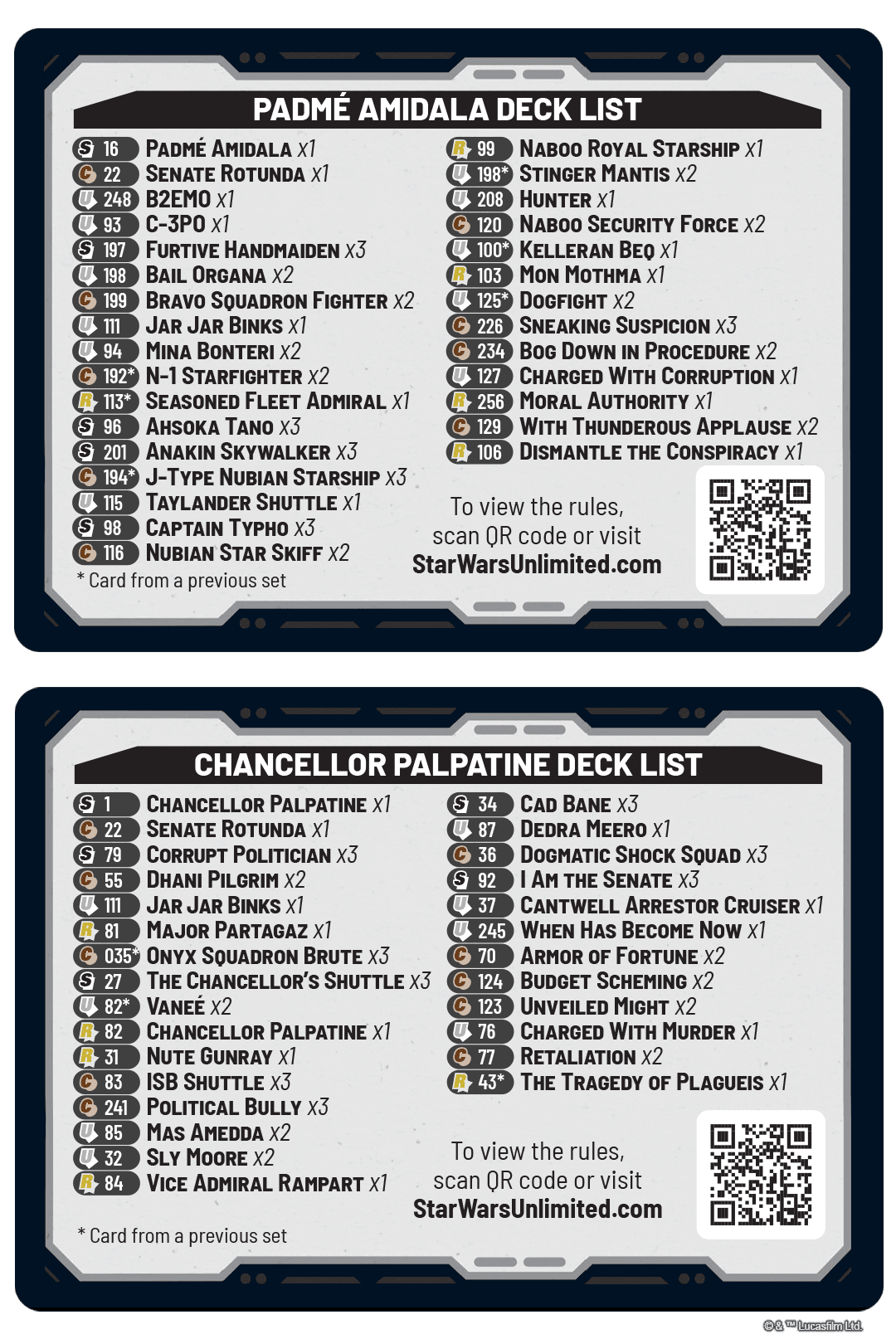
- 1 each: Jar Jar Binks; Major Partagaz; Chancellor Palpatine (unit, SOP 82); Nute Gunray; Vice Admiral Rampart; Dedra Meero; Cantwell Arrestor Cruiser; When Has Become Now; Charged with Murder; The Tragedy of Plagueis.
- 2 each: Dhani Pilgrim; Vanee; Mas Amedda; Sly Moore; Armor of Fortune; Budget Scheming; Unveiled Might; Retaliation.
- 3 each: Corrupt Politician; Onyx Squadron Brute; The Chancellor’s Shuttle; ISB Shuttle; Political Bully; Cad Bane; Dogmatic Shock Squad; I Am the Senate.
Inspect the official complete decklist image. The list includes both paired products; use the section headed Chancellor Palpatine.
Buying the deck and choosing upgrades
This is one player’s preconstructed deck, not a two-deck starter. An opponent needs their own playable deck. Check language, sealed condition, included accessories, and whether the listing is a single deck rather than a display or an individual leader card. Compare delivered prices; no live price or stock promise is made here.
As an Amazon Associate, B3 earns from qualifying purchases.
View the Secrets of Power Chancellor Palpatine Spotlight Deck on Amazon.
Learn the rules, then test the fixed deck
For a quick visual introduction, B3’s How to Play guide includes an 8:45 beginner tutorial. It explains the core action rhythm; use the worked examples here for this exact leader and fixed deck.
Keep the stock deck together for the first games. Record one resource choice, one action-order decision, and one card that felt stranded. Change a few slots only after identifying a repeated problem. For the next purchase, compare complete decks, singles, and boosters in the buying guide.
Event play: check the current format, reprint eligibility, errata, and suspended list before bringing the stock deck to an event. These products mix printings from different sets; an old printing may remain legal through an eligible reprint, but a recent package is not itself a legality certificate. Proposed upgrades here are small experiments, not a verified competitive list.
Card and inventory checks: October 20, 2026. Sources: official Spotlight Deck overview, official first look and leader images, current rules, errata, and suspended cards, and the original decklist linked above. Future rule or format changes take precedence.
Return to B3’s Star Wars: Unlimited hub.
Scope: the official Secrets of Power fixed Spotlight Deck, led by Chancellor Palpatine — How Liberty Dies. This is rules-based analysis of the printed deck, with proposed practice and upgrade ideas; it does not claim B3 tournament results or hands-on testing.
Compare the paired deck: Secrets of Power Padmé Amidala Spotlight Deck Guide: Disclose and Control the Board. Browse all twelve Spotlight Deck guides and the SWU learning guides.
Considering packs for upgrades? Read the Secrets of Power booster buying guide before choosing a sealed product. For premium treatments, see Carbonite packs explained.