A Lawless Time Jabba the Hutt Spotlight Deck Guide: Credits, Ambush, and the Sarlacc

Jabba's A Lawless Time deck asks you to turn short-term board presence into money for a later swing. Returning a unit to hand can reuse a useful entry effect and create a Credit, but it can also leave your base exposed. The deck's theme is investment; its practical challenge is knowing when you cannot afford to withdraw an ally from the battlefield.
I would choose it for someone who likes replaying characters and assembling a big midgame turn. I would not teach it as simple resource ramp. Credit tokens help pay costs, but they are not resources you control and do not make Jabba deploy earlier by themselves.
Jump to a section
- Crime Boss: the exact Jabba
- Credits are payment flexibility, not a deployment shortcut
- The Salacious Crumb opening, step by step
- Opening hands and the resource decisions they create
- Bounce units after they have earned their stay
- Deployment: spend a Credit where Ambush earns value
- Why the Sarlacc needs Malakili
- More ways to fund the plan
- Three situations to practice
- Weaknesses and small upgrade tests
- B3's verdict
- Official fixed 50-card main deck
- Buying the deck and choosing upgrades
- Learn the rules, then test the fixed deck
Crime Boss: the exact Jabba
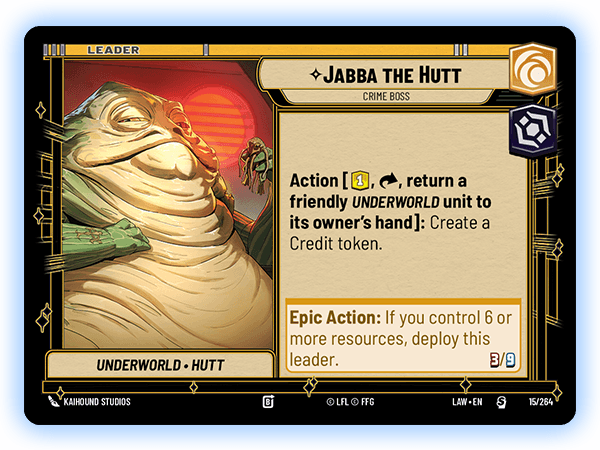
Jabba the Hutt — Crime Boss is A Lawless Time #015, Cunning/Villainy. His non-unit action costs one resource, exhausts him, and returns a friendly Underworld unit to its owner's hand to create a Credit token. The returned unit's trait matters. You cannot feed any convenient body into the ability simply because you control it.
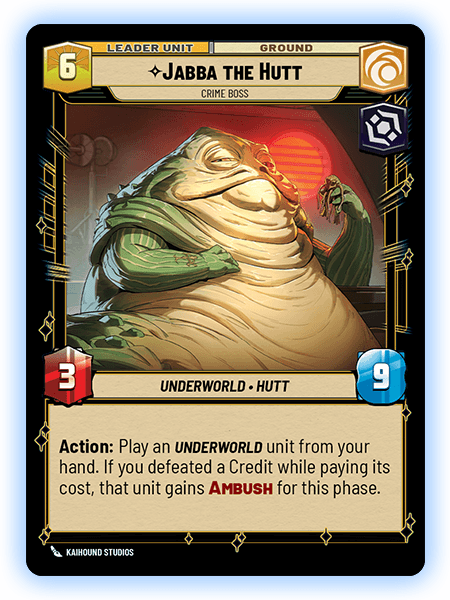
He deploys at six resources into a 3-power, 9-HP ground leader. His unit-side action plays an Underworld unit from your hand. If you defeated a Credit while paying its cost, that unit gains Ambush for the phase. Use that action to perform the play; do not assume playing an Underworld unit through an unrelated action automatically receives the same permission.
Great Pit of Carkoon is the supplied base. Its Epic Action gives access to the Sarlacc plan, but finding a card is not paying for it. Budget the resources, Credits, trait setup, and action order separately.
Credits are payment flexibility, not a deployment shortcut
A Credit can be defeated while paying resources to reduce the amount you pay by one. It can help pay for a card or an ability. It does not exhaust and come back in regroup; once used, it is gone. It does not count toward the six-resource leader threshold.
Suppose you have five resources and two Credits. You have additional spending flexibility, but still only five resources controlled. Jabba cannot deploy on the basis that five plus two equals seven. At six actual resources and two Credits, you may deploy and have a more flexible play afterward, but the threshold and purchasing budget remain different numbers.
This distinction also changes what a profitable bounce means. Spending one now and removing a unit does not permanently add one recurring resource. You are exchanging current tempo for a one-time discount, a card returned to hand, and any benefit you can obtain by replaying it later.
The Salacious Crumb opening, step by step
The Lawless Time Salacious Crumb costs one and enters ready with Jabba as your leader. On one action, play him and pay one. After the opponent's action, you can attack with him if there is a legal useful target. After another opposing action, Jabba's paid leader action can return him and create a Credit using your remaining opening resource.
That is three separate actions, not an uninterrupted opening combo. The opponent can interact between them. If they remove Crumb before the bounce, you cannot complete the same line with him. If keeping him in play is necessary to contest a threat, taking the Credit may be the wrong choice even when it is available.
At regroup you can grow to three actual resources while retaining the Credit. That improves the next round's purchasing options, but it does not erase the fact that your earlier unit left play. Compare the investment with the opponent's developed board.
Opening hands and the resource decisions they create
Look for a cheap Underworld unit and another affordable development play. A hand with Malakili, the Sarlacc, and expensive payoffs may have a story but no functioning opening. Choose two resources and name your first action before keeping it.
Syndicate Spice Runner helps find another Underworld piece, and Bib Fortuna can contribute a Credit on entry before a later bounce. Those cards let you think about future hand quality, not only this round's attack. They still need to fit a resource curve that leaves enough defense on the table.
I would avoid resourcing every cheap unit simply because the larger Underworld cards look like the finish. The small pieces are how you begin, how you feed the leader's ability, and sometimes how you replay useful effects. Conversely, keeping several copies of a late payoff can leave you unable to use the early engine at all.
Bounce units after they have earned their stay
An exhausted unit that has already attacked can be a better return candidate than a ready attacker. A damaged unit you can safely withdraw may preserve a card that would otherwise be defeated. A unit with a useful When Played ability can offer future value when replayed. Those are three different reasons to bounce, and they often point toward different targets.
Do not return a critical blocker solely to produce a token. If the opponent has a ready attacker in that arena, calculate the attack they gain access to. A Credit that saves one future resource is a poor bargain if withdrawing the unit lets the enemy defeat your base now.
Khetanna can make later Underworld plays easier to afford. Consider its cost reduction alongside Credits, not as a reason to spend the entire budget on setup. You still need suitable cards in hand and enough time to use them.
Deployment: spend a Credit where Ambush earns value
After reaching six actual resources, choose the Underworld unit whose immediate attack changes the position most. A larger body may produce a stronger Ambush fight, but an affordable removal-oriented unit can solve a more urgent threat while leaving resources for another play.
Ambush attacks a unit rather than the base. It readies the entering unit for that attack if there is an eligible target; do not convert it into an immediate direct-base swing in your damage calculation. Check the selected unit's arena, target restrictions, and survival before spending the Credit.
The deck's Boba Fett and Jabba's Rancor are attractive candidates for different combat jobs. With Boba, read the exact Lawless Time printing's entry and attack text before counting the additional damage. With the Rancor, identify what the attack removes and whether the resulting board is safer than the one you started with.
Why the Sarlacc needs Malakili
The Sarlacc of Carkoon is not naturally an Underworld unit. Jabba's action cannot give it Ambush just because the box contains both cards. Malakili supplies the trait connection that makes the proposed interaction possible.
That makes the line a small setup project: access the Sarlacc through the base when appropriate, establish Malakili, deploy Jabba, then use the eligible unit-play action while spending a Credit. Some of those steps may occur in earlier rounds. Each separate action gives the opponent an opportunity to interfere with the relevant pieces.
Before pursuing it, compare the entire investment with a simpler play. If your hand can answer the immediate board with a ready-made Underworld threat, waiting for the Sarlacc may lose a game you could stabilize. Big combinations are options, not mandatory quests printed on the deck box.
More ways to fund the plan
Unmarked Credits can provide a token without withdrawing a unit. Fett's Firespray can contribute Credits through successful unit defeats. Vermillion and Double-Cross introduce transactions whose outcomes can also benefit the opponent. Read both sides of those deals.
If an exchange gives the opponent Credits, ask what those Credits let them do before your next action. If you take a discounted or free play while funding their response, the net advantage may be much smaller than the size of your new unit suggests.
Do not treat every stored Credit as something you must preserve for the final combo. Spending one to make an important defensive play on curve can keep the game alive long enough for the later plan to matter. The best investment sometimes is simply avoiding the losing turn.
Three situations to practice
You have a ready Crumb and the leader action available. Compare attacking first with returning him immediately. Which enemy response could stop the later bounce, and what damage or board value would you give up by not attacking?
You have five resources, several Credits, and an opponent threatening a leader deployment. Count your actual threshold honestly. Decide whether a Credit-funded defensive play buys the round you need, instead of announcing an illegal early Jabba deployment.
You have six resources, Jabba deployed, one Credit, and two Underworld candidates. Calculate the complete outcome of each Ambush: target defeated, friendly unit remaining HP, other resources available, and opponent's next attack. Choose the line that changes the dangerous part of the board, not necessarily the one with the highest printed cost.
Weaknesses and small upgrade tests
Fast pressure punishes repeated withdrawals. Removal can break a Malakili-dependent Sarlacc line. An awkward hand can collect Credits without a useful card to spend them on. Those losses need different fixes.
The stock deck already has three copies of Crumb, Malakili, Black Sun Patroller, Weequay Pirate, Black Sun Cabalist, Contracted Jumpmaster, the Sarlacc, Unmarked Credits, and Haymaker. Do not solve consistency by ordering a fourth ordinary copy. Bib Fortuna is a singleton, but extra copies also change how often you draw a unique card and how your curve develops.
If early development is the problem, test a third Syndicate Spice Runner by removing a consistently stranded situational card. If immediate combat impact is the problem, test a third Jabba's Rancor only after confirming you can actually pay for and support it. If the whole issue is leaving your base exposed while bouncing, practice the stock list's timing before spending anything.
B3's verdict
Jabba is a good fit for a player who enjoys delayed rewards and replayable pieces. His strongest lessons are about tempo: a card safely returned to hand is not a unit defending the battlefield, and a Credit is not a recurring resource. Learn when to bank value and when to keep the board intact, and the deck becomes much more than a pile of large creatures waiting for discounts.
Official fixed 50-card main deck
The leader and Great Pit of Carkoon base sit outside these 50 main-deck cards. Counts below follow the official product list; earlier printings and same-name cards can have different abilities. Use the linked original for printed card numbers and previous-set markers.
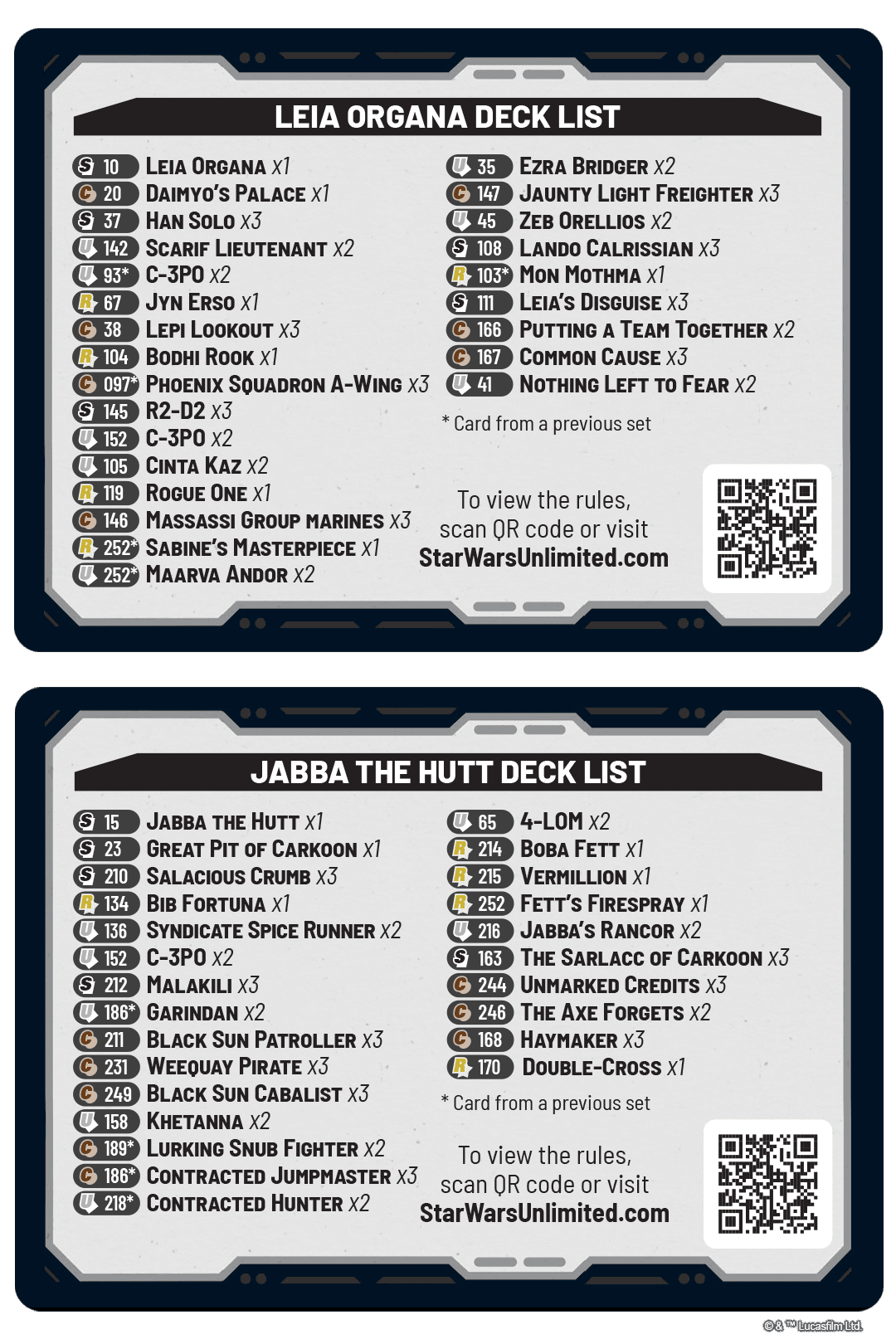
- 1 each: Bib Fortuna; Boba Fett; Vermillion; Fett’s Firespray; Double-Cross.
- 2 each: Syndicate Spice Runner; C-3PO; Garindan; Khetanna; Lurking Snub Fighter; Contracted Hunter; 4-LOM; Jabba’s Rancor; The Axe Forgets.
- 3 each: Salacious Crumb; Malakili; Black Sun Patroller; Weequay Pirate; Black Sun Cabalist; Contracted Jumpmaster; The Sarlacc of Carkoon; Unmarked Credits; Haymaker.
Inspect the official complete decklist image. The list includes both paired products; use the section headed Jabba the Hutt.
Buying the deck and choosing upgrades
This is one player’s preconstructed deck, not a two-deck starter. An opponent needs their own playable deck. Check language, sealed condition, included accessories, and whether the listing is a single deck rather than a display or an individual leader card. Compare delivered prices; no live price or stock promise is made here.
As an Amazon Associate, B3 earns from qualifying purchases.
View the A Lawless Time Jabba the Hutt Spotlight Deck on Amazon.
Learn the rules, then test the fixed deck
For a quick visual introduction, B3’s How to Play guide includes an 8:45 beginner tutorial. It explains the core action rhythm; use the worked examples here for this exact leader and fixed deck.
Keep the stock deck together for the first games. Record one resource choice, one action-order decision, and one card that felt stranded. Change a few slots only after identifying a repeated problem. For the next purchase, compare complete decks, singles, and boosters in the buying guide.
Event play: check the current format, reprint eligibility, errata, and suspended list before bringing the stock deck to an event. These products mix printings from different sets; an old printing may remain legal through an eligible reprint, but a recent package is not itself a legality certificate. Proposed upgrades here are small experiments, not a verified competitive list.
Card and inventory checks: October 20, 2026. Sources: official Spotlight Deck overview, official first look and leader images, current rules, errata, and suspended cards, and the original decklist linked above. Future rule or format changes take precedence.
Return to B3’s Star Wars: Unlimited hub.
Scope: the official A Lawless Time fixed Spotlight Deck, led by Jabba the Hutt — Crime Boss. This is rules-based analysis of the printed deck, with proposed practice and upgrade ideas; it does not claim B3 tournament results or hands-on testing.
Compare the paired deck: A Lawless Time Leia Organa Spotlight Deck Guide: Aspects, Experience, and Timing. Browse all twelve Spotlight Deck guides and the SWU learning guides.
Considering packs for upgrades? Read the A Lawless Time booster buying guide before choosing a sealed product. For premium treatments, see Carbonite packs explained.