A Lawless Time Booster Buying Guide: Credits, Multi-Aspect Cards, and the New Pack Contents
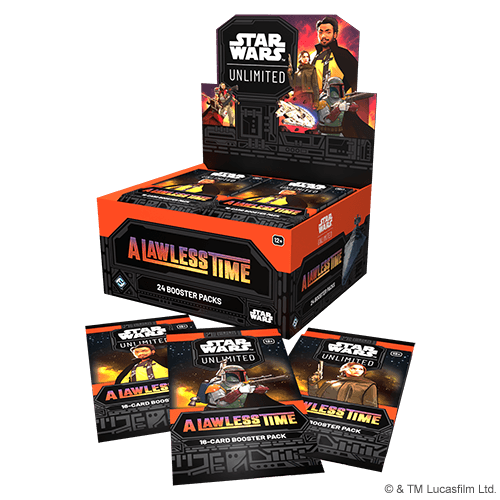
A Lawless Time changes more than the characters on the wrappers. It brings Credits and multi-aspect deckbuilding questions, and it is also the dividing line between the earlier booster configuration and the newer treatment mix. A buying guide that copies an old pack breakdown misses one of the main reasons this release needs its own page.
I would choose it for exploring the cost of a colorful deck or for a deliberate limited session built around the set. For a ready-made Leia or Jabba experience, the Spotlight products are the more predictable route. Better-looking random cards are still random cards, so a specific upgrade deserves a singles comparison.
In this buying guide
- What you get: compare the actual packages
- Multi-aspect cards make the base choice part of the purchase
- Credits create options, not permission to skip the rules
- Standard packs got a meaningful cosmetic upgrade
- Leia or Jabba before a box?
- The rotation hinge matters when comparing older deals
- How I would spend a limited budget
- Price the experience, then set a stopping point
- Find the correct product
- Keep exploring
What you get: compare the actual packages
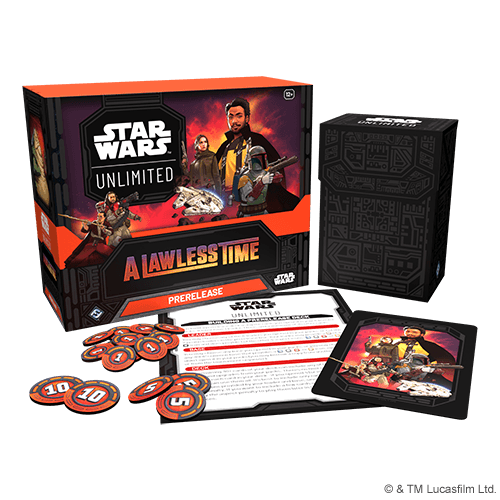
A standard display contains 24 packs. At 16 cards per pack, that is 384 cards, including leader and base/token slots; it is not 384 distinct main-deck cards. A prerelease box provides six packs and supporting materials. A retail prerelease box does not automatically include entry to a store event.
The official standard-pack description lists approximately nine commons, three uncommons, one rare or legendary, one leader, one base/token, and one Hyperspace-foil. Variant slots and substitutions mean this is not a promise of a particular rare, leader, or complete deck.
The fixed Leia Organa or Jabba the Hutt Spotlight Deck is a different product. Buy it for the supplied list; buy boosters for randomized cards. There is also a separate 12-pack Carbonite display. Compare editions and quantities before comparing a price labeled simply “box.”
Multi-aspect cards make the base choice part of the purchase
The set introduces cards combining multiple non-alignment aspects, alongside Credit tokens that help pay costs under their rules. A unit looking efficient on the card image can become awkward when your leader and base do not supply the required icons. The usual aspect penalties still deserve attention.
Before buying cards for a build, write down the icons your exact leader and base provide. Then check the intended additions one by one. A powerful multi-aspect card that consistently costs extra is a different upgrade from the one you pictured. Buying it because it matches the set's theme will not change that arithmetic.
Credits create options, not permission to skip the rules
A Credit token can help fund a play, but do not count it as another resource you control for leader deployment. The distinction matters when a turn seems to have plenty of spending power while still falling short of its deployment threshold.
For a simple exercise, separate your resource count, ready resources, and Credits into three visible totals. Ask which play each total supports. I would want a collection to support early development as well as the later purchase burst, because a hand full of expensive cards can be stranded even in a deck that expects to generate Credits.
Standard packs got a meaningful cosmetic upgrade
Beginning here, standard packs guarantee a Hyperspace card and a Hyperspace-foil card; ordinary black-border foils were removed. Non-foil Prestige variants can also appear in standard packs, at the publisher's approximate rate of one in eighteen. That is an average, not a promise that buying eighteen packs produces one.
This makes older blanket statements that Prestige requires Carbonite inaccurate for this release. Carbonite still guarantees a Prestige card per pack and retains the foil and serialized Prestige tiers. Buy the product for the treatment mix you enjoy, without treating a statistical rate as a shopping guarantee.
Leia or Jabba before a box?
The individual Spotlight Decks give you a supplied Leia multi-aspect plan or Jabba Credit-and-Underworld plan. They provide an immediate way to learn why those mechanics matter. Standard boosters instead give you a pool that may suggest several different leaders and directions.
I would recommend the fixed product when a player specifically wants one of those experiences. After a few games, identify whether the issue is aspect coverage, early units, or a payoff arriving at the wrong time. Buying two exact role players can be a more useful next step than another stack of randomized possibilities.
The rotation hinge matters when comparing older deals
A Lawless Time's release also marked the first rotation, removing the first three sets from Premier as a group. That changes the comparison with discounted Spark, Shadows, or Twilight boxes. They can still support other experiences, but their lower price does not make them equivalent purchases for a current Premier goal.
I would start with the format and decklist, then compare the missing cards across sets. Do not infer that every card in a newer package is automatically eligible in every event: exact identities, reprints, errata, and suspensions can all matter.
How I would spend a limited budget
For one leader, I would buy the chosen fixed deck and reserve money for sleeves and a first few games. For friends planning a set-specific limited evening, I would buy standard packs in the agreed quantity. For an art collector, I would compare the exact treatment singles with Carbonite before choosing the opening experience.
The wrong route is buying standard boxes solely because the new Prestige chance sounds like an investment plan. Decide what the ordinary contents and evening are worth without a premium hit. If the purchase only feels acceptable after an unusually lucky result, the quantity is too large for the goal.
Price the experience, then set a stopping point
Use delivered cost rather than the headline price. In a hypothetical comparison, a $96 display is $4 per pack; six loose packs at $5 each cost $30. The display has the lower unit price but requires $66 more spending. If you only arranged a six-pack experience, the larger order has to justify its extra quantity.
For a group, write down the format, number of players, required packs, token supplies, sleeves, and who keeps the cards before ordering. A normal draft uses three packs per person; sealed uses six. A 24-pack display therefore supplies eight draft entries or four sealed pools, before prize support or spare packs. Confirm the current procedure with your organizer.
For a deck upgrade, price the exact missing copies with shipping. Set your opening budget so the ordinary contents and the games are enough to justify it. Do not count on selling a chase card to make the purchase affordable.
Find the correct product
As an Amazon Associate, B3 earns from qualifying purchases.
View the A Lawless Time standard booster display on Amazon.
Confirm the selected edition, language, sealed condition, quantity, seller, and delivered price. This is a product-identity check, not a live stock or price promise.
Keep exploring
Learn the game · compare your first purchase · browse all SWU guides · A Lawless Time Leia Organa Spotlight Deck Guide: Aspects, Experience, and Timing · A Lawless Time Jabba the Hutt Spotlight Deck Guide: Credits, Ambush, and the Sarlacc · understand Carbonite packs and their changing contents.
Product and rules check: October 22, 2026. Official sources: set products; a lawless time; aspects and credits; a shift from what was; eternally unlimited; limited play; current rules, errata, and suspensions. B3’s buying recommendations and planning examples are editorial analysis; prices used above are hypothetical.