Whispers in the Well Buying Guide: Boost, Detectives, Decks, and Packs
Affiliate disclosure: As an Amazon Associate, B3 earns from qualifying purchases.
Whispers in the Well has one of Lorcana’s strongest invitations to build around a theme: detectives, half-formed Whisper glimmers, and Gargoyles whose hand-size restriction changes ordinary turn planning. I would buy into it for one of those interests, rather than because a dark-looking booster box must contain a competitive deck.
This is a set and product guide. It explains the choices that matter when moving from opening packs to using the cards. The strategy examples are suggestions for practice, not claims of personal event results.
Three themes with different demands
Detectives encourage you to care about which other characters are already in play. Whisper cards introduce a particular visual and narrative identity, while Boost places cards under characters or locations to support printed effects. Gargoyles can make the number of cards in your hand matter to whether they ready.
These themes are not a single package you can put together indiscriminately. A Detective payoff needs appropriate teammates. A Boost payoff needs a way to put cards underneath it and enough ink left to develop your board. A Gargoyle deck needs to consider the hand-size conditions on its actual cards. A pile containing examples of all three can still lack a reliable early turn.
I would choose one primary plan and treat anything else as supporting material. That gives you a reason to include or exclude a card beyond liking its illustration.

Boost is a spending decision
Boost has an ink cost and ordinarily lets you put the top card of your deck facedown under the card with that ability, once during your turn. The value comes from the card’s other text or the interactions you enable. A face-down card underneath is not automatically a card in hand, an additional ink card, or a new character in play.
Consider a proposed turn with four ready ink. You can pay for another affordable character, or use part of the ink to Boost a character already in play. Compare what each line produces before the opponent’s next turn. If the boosted ability matters immediately, the investment may be useful. If the opponent can simply remove the only character you developed, adding another body might have been the more resilient choice.
Ariel — Ethereal Voice illustrates why the condition matters. Her song-related draw requires a card underneath her and has a once-during-your-turn limit. That is a reason to establish the condition before the relevant song, not a reason to expect a fresh card for every song you can play. Read the complete ability rather than remembering only “Ariel draws cards.”
Stone by Day: the hand can be a restriction
Some Gargoyles have Stone by Day, preventing them from readying while you have three or more cards in hand. A large hand normally looks like a comfortable position. Here it can keep an important character exerted.
That changes sequencing. Before a ready effect resolves, look at the hand size at that moment. Playing a card can reduce the hand below the threshold; drawing can push it back up. Do not play as though every Gargoyle shares one identical ability, and do not assume a readiness restriction makes a character immune to other effects.
My practice suggestion is to count your hand aloud before readying and before resolving an effect that readies a restricted character. After a few games, the check should become a habit. It is a better solution than discovering after combat that a character should never have readied.
A Detective needs an actual partner
Judy Hopps — On the Case is a useful example of a conditional play. Her item-related ability checks whether you have another Detective. That makes the order in which you develop characters matter. Playing Judy first and hoping to play the supporting Detective later does not retroactively satisfy an on-play condition.
The lesson carries beyond this one card. Separate “when played,” “while,” and “whenever” effects when reading a new pile. A static bonus can improve after you add a teammate. An on-play ability has a particular window. A triggered ability waits for its stated event. Those distinctions tell you which combinations are real and which are just attractive cards next to each other.
Packs, display, Trove, or fixed deck?
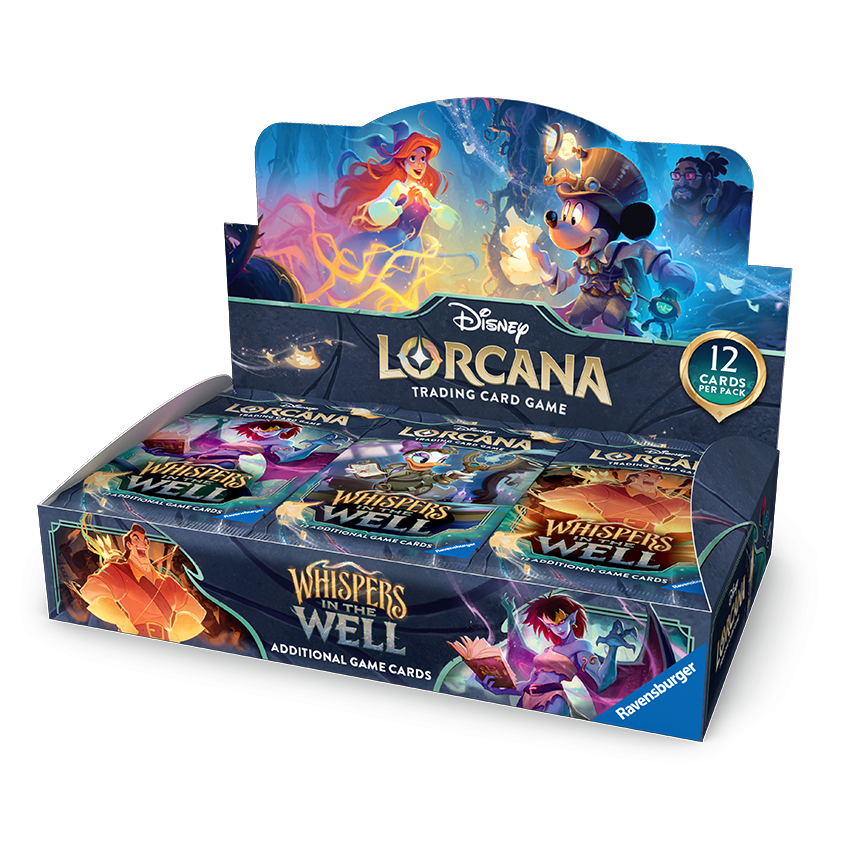
Packs and displays are random-card purchases. The Trove combines packs with storage and tracking accessories. The two single-player deck options are fixed sixty-card starting points: Amber/Emerald with Simba and Megara, and Sapphire/Steel with Judy Hopps and Robin Hood. Check that a listing lets you choose the exact deck; “one assorted deck” is a different offer from a pair.
For learning, I prefer a chosen fixed deck over hoping a handful of boosters will supply a plan. For collecting Gargoyles or Sleepy Hollow artwork, packs can provide a fun introduction, followed by exact singles for the illustrations still missing. For a specific constructed engine, start with its list and compare exact-card costs.

Compare a Trove’s delivered price with the same number of equivalent packs, and pay extra only for accessories you want. Do not interpret different exterior packaging as a guarantee of better odds. Also check the language: a low-looking price on a version you cannot comfortably read may be a poor first learning purchase.
How I would evaluate the first upgrades
Play the stock deck before modifying it. Record three things after each game: the earliest turn you could not develop, the card you repeatedly declined to play, and whether your named mechanic ever produced a meaningful benefit. Those observations identify different needs.
If Boost consumed the ink needed to establish a board, try fewer setup pieces or a lower curve. If the board was fine but you never found a payoff, examine access and redundancy. If Stone by Day locked a key attacker every turn, look at your draw pattern and spending sequence before assuming the attacker itself is weak.
Do not change ten cards after one dramatic loss. A dramatic opponent’s play is memorable, but it may not represent what usually decides the matchup. Small adjustments make it possible to learn whether you actually improved the deck.
Who I would point toward this set
Whispers suits someone who likes conditional abilities and a distinctive character lineup. Its mechanics reward reading carefully, which can be satisfying once the base game is familiar. For an entirely new player who wants the fewest possible moving pieces, I would compare its fixed decks with the current two-player set or a Fabled deck before choosing.
The set’s best feature is that its themes can become concrete deckbuilding questions. What is my second Detective? When do I pay for Boost? How many cards will I hold when this Gargoyle needs to ready? A guide, collection, or purchase becomes more useful when it helps answer one of those questions.
Find the product
View Whispers in the Well booster display on Amazon. Confirm the selected quantity, language, seller, and delivered price.
Continue with B3’s Lorcana guides
Browse all Lorcana guides · Learn to play · Compare your first purchase.
Sources and scope
Checked October 21, 2026: official Whispers in the Well products and card previews, current rules and release notes, and the official rotation explanation. Product facts and printed mechanics are separated above from B3’s proposed buying and practice methods. Prices in worked examples are hypothetical; live prices, stock, event availability, and pull odds are not promised.
Mechanics references: Whispers in the Well release notes and the official Ariel — Ethereal Voice card.