Twilight of the Republic Booster Buying Guide: Clone Wars Tokens, Exploit, and What to Buy
Twilight of the Republic makes the number of bodies on your battlefield matter. The Clone Wars theme gives that idea a natural shape: clones and droids fill the table, some cards reward maintaining a team, and others turn expendable units into a larger play. If that sounds more appealing than building around one enormous hero, this is an older set worth examining.
My first question would still be where you plan to play it. Twilight has rotated out of Premier as a set. I would buy its boosters for a deliberate Clone Wars pool or limited session, while buying exact cards for a specific legal constructed deck.
In this buying guide
- What you get: compare the actual packages
- Coordinate and Exploit ask different questions
- A practical test before buying more cards
- The starter is the reliable Ahsoka-versus-Grievous route
- Rotation is a reason to price the whole plan
- Plan enough tokens and table space
- Who I would recommend it to
- Price the experience, then set a stopping point
- Find the correct product
- Keep exploring
What you get: compare the actual packages
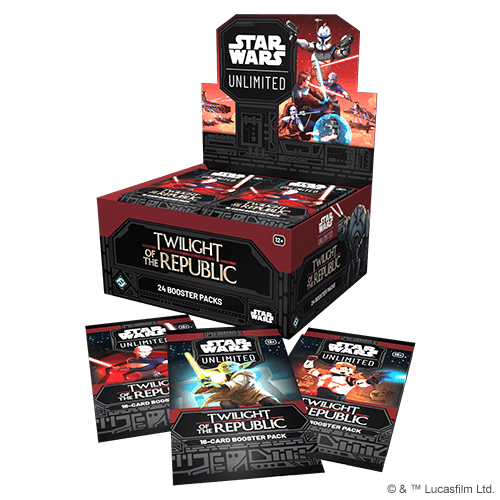
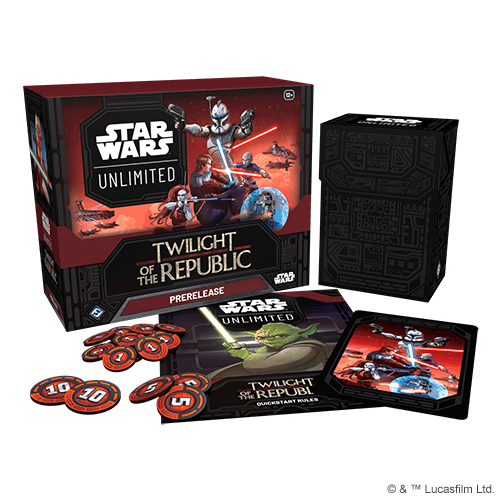
A standard display contains 24 packs. At 16 cards per pack, that is 384 cards, including leader and base/token slots; it is not 384 distinct main-deck cards. A prerelease box provides six packs and supporting materials. A retail prerelease box does not automatically include entry to a store event.
This set uses the earlier pack structure: nine commons, three uncommons, one rare or legendary, one leader, one base/token, and one foil card, with applicable variant replacements. Neither a legendary nor a particular card is guaranteed in each pack.
The fixed Ahsoka Tano and General Grievous Two-Player Starter is a different product. Buy it for the supplied list; buy boosters for randomized cards. There is no original Carbonite Edition release for this set. Carbonite began with Jump to Lightspeed.
Coordinate and Exploit ask different questions
Coordinate abilities are active while you control at least three units. Exploit lets you defeat friendly units as part of playing an Exploit card to reduce its cost according to the keyword. The set also introduces Clone Trooper and Battle Droid token units. These are reasons to count both your bodies and the jobs they perform.
A wide board can support Coordinate, but sacrificing bodies may turn those bonuses off. Conversely, keeping every small unit alive for a future bonus can delay a larger play that would stabilize the game now. I like that tension as a reason to explore the set; it gives inexpensive pieces a purpose beyond their individual power.
A practical test before buying more cards
Imagine you control three units, including one that matters mainly because it keeps Coordinate active. You are considering a cheaper Exploit play that defeats that unit. Write down which abilities stop working afterward, which future attacks disappear, and whether the new unit repairs that loss. A lower payment is not automatically a better exchange.
For a collection experiment, I would build two lists from the cards already available: one preserving a wide board, another spending expendable bodies more aggressively. Only after comparing the hands that fail would I buy extra copies. That produces a meaningful shopping list instead of a general urge for more Clone Wars cards.
The starter is the reliable Ahsoka-versus-Grievous route
The Two-Player Starter supplies fixed Ahsoka Tano and General Grievous decks. If you want that illustrated pairing to play tonight, buy the correct starter rather than assuming a display will assemble it. Boosters support exploring the broader set, not obtaining a particular fixed list with certainty.
For a gift, I would ask whether the recipient already has a deck and an opponent. A Clone Wars fan may enjoy the art in either package, but only one of those products is designed to supply two ready-made decks. The accessories and learning materials can matter more than an extra handful of randomized rares.
Rotation is a reason to price the whole plan
Twilight rotated from Premier alongside Spark and Shadows when A Lawless Time launched. Reprints may permit particular cards, so check full identities rather than relying on the old set symbol alone. Eternal and Twin Suns are separate destinations with their own requirements and current restrictions.
A cheap display can be good entertainment for a group that wants this environment. It can be poor value for a player who then has to buy a second, legal deck to attend the local event. I would add those follow-up expenses before deciding that an older box is a bargain.
Plan enough tokens and table space
For a home event, bring clear ways to represent both token types and track damage separately. A pile of identical coins can become confusing once different token units have different stats or upgrades. Agree on substitutes before the first game, and keep the current rules nearby.
When sorting the pool, do not count token-producing events as interchangeable with ordinary units. The cost, timing, and number of bodies they create determine how they fit your curve. Likewise, a hand full of Exploit payoffs needs suitable material to spend; famous expensive cards alone do not make that engine function.
Who I would recommend it to
I would consider Twilight for a Clone Wars group that enjoys tactical board management, for a deliberately preserved older draft pool, or for someone building an identified non-Premier list. I would pass if the only attraction were a headline discount and no one had committed to playing.
My preferred upgrade path would be a short list of missing role players, especially the early cards that let a plan start consistently. Buying another display because a powerful payoff failed to appear can leave you with more of everything except the specific thing the deck needed.
Price the experience, then set a stopping point
Use delivered cost rather than the headline price. In a hypothetical comparison, a $96 display is $4 per pack; six loose packs at $5 each cost $30. The display has the lower unit price but requires $66 more spending. If you only arranged a six-pack experience, the larger order has to justify its extra quantity.
For a group, write down the format, number of players, required packs, token supplies, sleeves, and who keeps the cards before ordering. A normal draft uses three packs per person; sealed uses six. A 24-pack display therefore supplies eight draft entries or four sealed pools, before prize support or spare packs. Confirm the current procedure with your organizer.
For a deck upgrade, price the exact missing copies with shipping. Set your opening budget so the ordinary contents and the games are enough to justify it. Do not count on selling a chase card to make the purchase affordable.
Find the correct product
As an Amazon Associate, B3 earns from qualifying purchases.
View the Twilight of the Republic standard booster display on Amazon.
Confirm the selected edition, language, sealed condition, quantity, seller, and delivered price. This is a product-identity check, not a live stock or price promise.
Keep exploring
Learn the game · compare your first purchase · browse all SWU guides · understand Carbonite packs and their changing contents.
Product and rules check: October 22, 2026. Official sources: set products; twilight of the republic; insights of twilight danny schaefer; eternally unlimited; limited play; current rules, errata, and suspensions. B3’s buying recommendations and planning examples are editorial analysis; prices used above are hypothetical.
Want two fixed decks instead? Read the Twilight of the Republic Two-Player Starter guide for both leaders, useful practice decisions, and the complete-box buying checks.