Twilight of the Republic Two-Player Starter Guide: Ahsoka vs. General Grievous
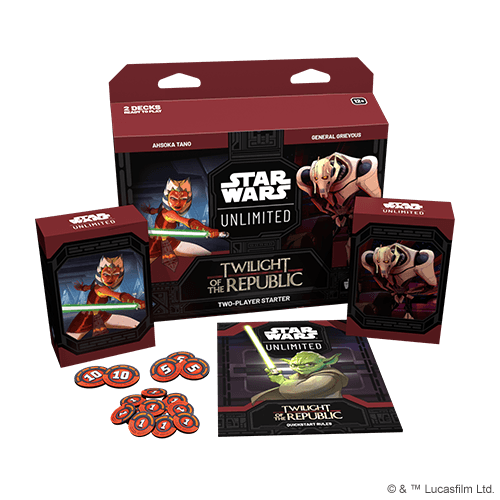
Twilight of the Republic's starter is the pairing I would choose for a Clone Wars fan who wants the battlefield to feel like a group effort. Ahsoka wants enough allies in play to bring Coordinate online. Grievous turns a supply of droids into protection, pressure, and material for larger plays. In both decks, a small unit can be worth more than its printed combat numbers.
The purchase is straightforward: one box supplies two fixed decks. The decisions at the table are less simple. Keeping a wide board, trading away a useful body, and converting expendable units into a bigger threat are all choices the pairing can help teach. I would buy it for those decisions and the theme, after comparing the actual delivered price.
In this starter guide
- What you are getting
- Ahsoka: the third unit changes the board
- Build enough of a board before buying a payoff
- Grievous: a droid can have several jobs
- Exploit: calculate the full exchange
- The matchup: disrupt the other deck’s count
- A two-session learning plan
- B3’s verdict
- Still sold does not mean automatically Premier-ready
- Buying checklist and direct product link
- Where this starter fits in the wider range
- Learn the rules, then expand deliberately
What you are getting
The Two-Player Starter supplies two complete fixed 50-card main decks led by Ahsoka Tano and General Grievous, alongside the leaders, bases, quickstart rules, counters, and paper play materials. The double-sided leaders and bases are outside the main-deck count. This is a complete pairing, not a box of random boosters.
Check the selected offer carefully if buying used. Both complete lists matter, and token representations are especially useful in this set. A pile of Clone Wars cards or two loose leaders is not the same product, even if the listing borrows the starter's title.
Ahsoka: the third unit changes the board
Coordinate abilities function while you control at least three units. Deployed Ahsoka counts toward that total. I would make the count a visible habit: before an attack, after a trade, and after an effect defeats a unit, check whether the abilities you are relying on are still active.
Imagine you have exactly three units and one attack trades a small ally for an enemy. That trade may be individually fair but turn off bonuses supporting the next attack. Compare developing another unit first, taking a different attack, or accepting the loss of Coordinate because the enemy you remove is more important.
The opponent still gets actions between your ordinary plays. A plan to add a fourth body and then attack is not protected simply because you announced it. Identify which existing unit is most likely to disappear before committing to the sequence.

Build enough of a board before buying a payoff
The supplied Ahsoka list includes inexpensive units and cards that create additional bodies. Their job is not merely to fill turns until a famous character arrives. I would evaluate them by whether they establish and preserve the board that makes later effects useful.
When considering an upgrade, count reliable early plays before adding another expensive team-wide effect. A strong payoff that sits in hand while the board stays at one unit does not solve the failure that caused it. You may need a more consistent opening or better resource choices rather than a more spectacular finisher.
Do not preserve every unit at any cost. Sometimes a trade removes the only enemy capable of threatening your base or a key attacker. The useful discipline is calculating what Coordinate changes, then choosing deliberately whether that change is acceptable.
Grievous: a droid can have several jobs
The supplied Grievous plan combines Droid units, Battle Droid token production, Sentinel-granting tools, and Exploit. I would treat each small body as a choice between an attack, a defensive role, and a potential contribution to a larger play. Spending it for one job means giving up the others.
Giving a ground Droid Sentinel can redirect ordinary ground attacks, but it does not protect the base from a ship in the other arena. Before assigning your defender, identify the actual damage clock. Winning the droid fight on the ground is not enough if space is delivering the attacks that end the game.
A token is still a unit with a location and current stats. Keep its damage and upgrades clear. When several similar tokens share the battlefield, sloppy tracking can change which ones survive or remain useful as material.
Exploit: calculate the full exchange
Exploit lets you defeat friendly units to reduce the cost of playing the relevant card under the keyword's rules. The units are a cost you are choosing to spend. A lower resource payment is therefore not the same as receiving the new unit without giving anything up.
For a useful exercise, compare two lines: keep two small units for their next attacks, or sacrifice them to bring a larger threat forward. Count the attacks lost, any defeat benefits, the new threat's immediate contribution, and the response it exposes to the opponent. If the new unit enters exhausted without a relevant exception, do not count an ordinary immediate attack from it.
The best sacrifice depends on the board. An exhausted body with little future relevance can be easier to spend than your only unit contesting an arena. I would choose the material before announcing the payoff, rather than treating all cheap units as interchangeable.
The matchup: disrupt the other deck’s count
Against Ahsoka, removing the unit that drops her board below three may affect several future exchanges. Against Grievous, removing useful bodies can reduce both defensive choices and the material available for a later Exploit play. These are reasons to assess the whole next round instead of attacking whichever unit is easiest to defeat.
At the same time, both players still need to win through the opposing base. A sequence of favorable unit trades can become a trap if it never advances a finish. Recheck the base race after a significant board change and before claiming initiative.
A two-session learning plan
In the first session, leave the decks unchanged and focus on maintaining correct counts. Say when Coordinate becomes active or inactive, identify every token, and separate an ordinary unit play from an ability granting an attack. Read new cards before resolving them rather than discovering their restrictions afterward.
In the second session, swap decks and record one unit you spent or traded too casually. Then discuss whether another order would have changed the result. That produces a concrete improvement to test without spending money, which is exactly what a repeatable starter pairing should make possible.
B3’s verdict
I would recommend Twilight's starter for a pair attracted to Clone Wars armies and the tactical value of a wide board. It asks a little more tracking than a purely basic teaching matchup, but that tracking has a purpose. The product is most appealing when both players want to learn those choices rather than simply collect the box's characters.
Still sold does not mean automatically Premier-ready
All three original sets rotated out of Premier when A Lawless Time released. Reprints can make individual older printings eligible, so check the exact cards and current suspended list before taking a stock starter to an event. The age of the box alone does not settle every card’s eligibility.
For casual paired play, you can keep the lists together and agree on the rules you use. Eternal and Twin Suns have their own requirements; these are not ready-made Twin Suns decks simply because older cards can be used in that format. Decide where the starter will be played before pricing competitive upgrades.
Buying checklist and direct product link
As an Amazon Associate, B3 earns from qualifying purchases.
View the Twilight of the Republic Two-Player Starter on Amazon.
An exact product listing was identifiable at this check. Seller availability, delivery, and price can change; a listing is not evidence of a continuing factory print run. Confirm the complete two-deck product, language, condition, accessories, and delivered cost before ordering.
For a hypothetical price comparison, a $30 paired starter is $15 per supplied deck. Two individual decks at $22 each cost $44 before any shipping differences. The cheaper route is useful only if its leaders and learning experience suit you. Reserve room for sleeves rather than paying for a box whose contents do not match your plans.
Where this starter fits in the wider range
Spark, Shadows, and Twilight each used a Two-Player Starter. Jump to Lightspeed introduced the individually sold Spotlight Decks. Intro Battle: Hoth is a separate guided teaching product, and 2026 Twin Suns is a separate multiplayer release. Do not group those products with a main set just because their characters share an era.
The announced Icons 2027 Edition Starter Box is another separate product, with a planned November 20, 2026 release. Its staged teaching format starts with smaller decks; it is not a relabeling of this original 50-card pairing. Compare it as an upcoming alternative rather than implying it is already on sale.
Learn the rules, then expand deliberately
Use B3’s first-game walkthrough and embedded 8:45 tutorial for setup, combat, initiative, and regroup. Read the Twilight of the Republic booster buying guide before choosing packs for this collection.
Inspect the official complete starter decklists. Use the correct side for each leader and preserve the original list before making substitutions.

Compare first-purchase options · Browse the SWU guides.
Product and rules check: October 22, 2026. Sources: official starter explanation; official set products; rotation; current rules, errata, and suspended cards. Recommendations and simplified practice situations are B3 editorial analysis, not a claim of measured matchup results or a hands-on test.