Twilight Imperium Fourth Edition Guide: Objectives, Deals, and Your First Game
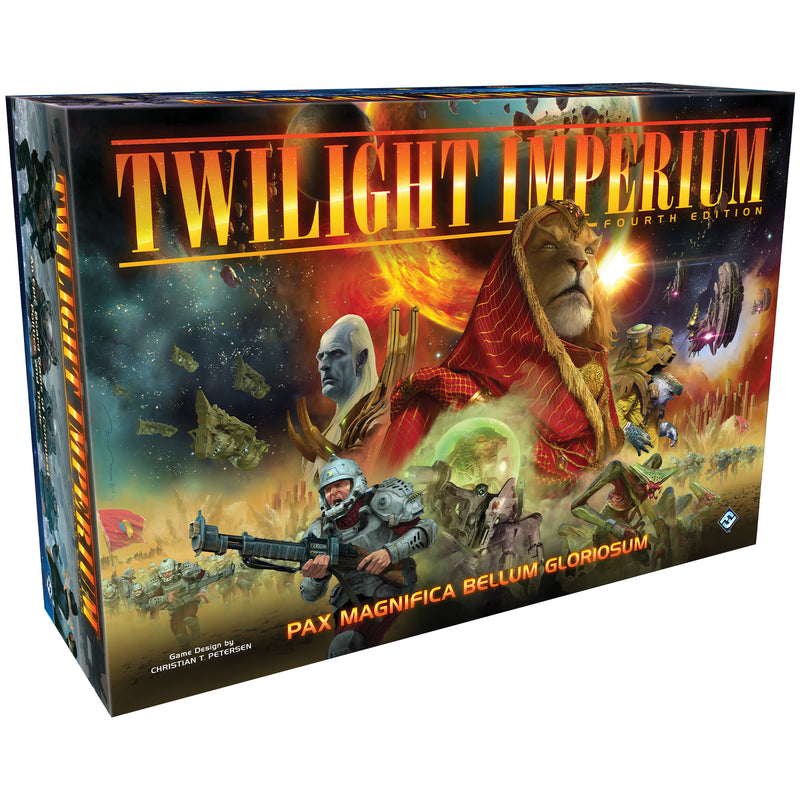
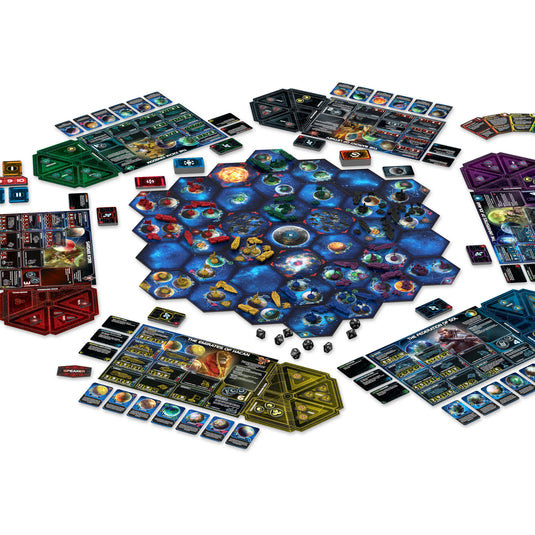
Twilight Imperium looks like a game about fleets. Its more revealing moments happen when someone asks what it would cost for those fleets to stay where they are. A neighbor needs one planet to score. You need that neighbor's trade. A third player wants both of you distracted. The map gives every conversation a concrete subject and makes an apparently modest agreement matter.
This guide focuses on the Fourth Edition base game for three to six players. It is an assessment of the rules and experience they create, not a claim of personal play. The goal is to help you decide whether your group wants this particular kind of long, argumentative, highly interactive strategy day.
How you actually win
The standard game is a race to ten victory points. Public objectives become available over time; secret objectives give players less visible ambitions. The largest fleet and widest territory do not automatically win. They are tools that may help you satisfy a scoring condition, defend one, or persuade somebody to cooperate.
That distinction changes sensible play. Suppose a public objective asks for a particular collection of controlled planets. A glorious battle somewhere else may cost ships, resources, and an activation without bringing you closer to that point. Conversely, a negotiated temporary border adjustment could be more valuable than destroying your neighbor. Before investing in a plan, identify what it scores and when.
In the status phase, you normally score at most one public and one secret objective, with other scoring opportunities depending on their specific rules. You also need control of every planet in your home system to score public objectives. Your home is therefore more than a starting location: an undefended capital can undermine an otherwise impressive scoring position.
The round has four different conversations
Strategy: players choose numbered strategy cards. These determine initiative and provide powerful primary abilities. You are choosing both a tool and your position in the turn order. Leadership helps with command tokens, Trade with economic exchange, Technology with research, and Imperial with scoring opportunities. Each choice has an opportunity cost.
Action: players alternate individual actions in initiative order, rather than completing an entire empire's round at once. Tactical actions activate systems, move ships, resolve encounters, and permit production where appropriate. Strategic actions use your strategy card. Component actions come from specific cards or abilities. You must use your strategy card before passing; passing also does not stop you following other players' strategy-card secondaries.
Status: eligible objectives are scored and the game performs its upkeep and resets. Agenda: once the custodians token has been removed from Mecatol Rex, the political phase adds votes on galactic matters. Planets' influence now matters at a shared political table, not just on your own sheet.
Command tokens turn plans into commitments
You distribute command tokens among tactics, fleet, and strategy pools. These are three distinct pressures. Tactics supports system activations. Fleet limits the number of your non-fighter ships in a system. Strategy pays for many secondary abilities when another player resolves a strategy card. Having money does not compensate for lacking the kind of command capacity your plan needs.
Activating a system also matters spatially. Once one of your command tokens is in a system, ships there are generally committed until the relevant restriction is removed. You cannot assume that a fleet can move, fight, and then freely redeploy again because you have another action available. Specific effects can change that, but exceptions should be planned around, not imagined.
A useful planning exercise is to describe a round in plain language: “Take that system, follow Technology, build replacements, keep enough fleet capacity here.” Then count what each step requires. This catches the common beginner problem of possessing several individually affordable ideas that cannot all be executed together.
Strategy cards let someone else control your timetable
The owner of a strategy card gets its primary ability. Other players can often pay for its secondary ability. Consequently, picking a card influences the whole table, and choosing when to play it can be as important as choosing it in the first place.
Imagine you intend to use a secondary ability but have not arranged the resources or strategy token. If the owner plays that card before you prepare, your plan may disappear. Ask about timing, make reasonable requests, and recognize that an opponent has no general obligation to preserve your preferred sequence. A promise about future behavior has a different status from an immediately resolvable exchange.
This is why the game's negotiation feels integrated rather than decorative. Players bargain over opportunities produced by actual procedures. A quiet economic round can contain considerable tension even if no one rolls combat dice.
Trade, deals, and the limits of a promise
Commodities are not simply money you spend yourself: when traded to another player they become trade goods. Trade goods are flexible economic resources. Neighbor relationships and transaction rules govern what exchanges are legal, so “I will pay anyone across the galaxy” is not always an available action.
Deals that can be resolved immediately are binding under the rules. Promises that depend on future actions are generally nonbinding. That distinction is worth explaining before somebody pays for peace next round and discovers that their partner can legally change direction. The social consequences may still be substantial: the rules permit a broken promise, but the table remembers who made it.
Negotiate the smallest useful agreement. “Do not attack me ever” is vague and difficult to value. “Leave this planet alone until I score, in exchange for this legal payment now” makes the competing interests clearer, while still requiring everyone to understand what the rules actually enforce. Avoid giving away a scoring route simply because a trade feels mutually friendly.
Combat is a means, not a separate victory track
Fleets threaten space; ground forces take and hold planets. Transport capacity, movement, technology, and the presence of actual infantry all affect whether an attractive target can really be captured. Winning a space battle does not automatically provide the ground presence needed for your objective.
Dice also make combat uncertain. Plan for losses and for the player who benefits from your losses without taking part. If you and a neighbor spend a round destroying each other while a third empire scores undisturbed, a technically successful attack may still be strategically poor.
That does not mean avoiding all conflict. A credible threat creates bargaining power; a well-timed attack can deny a decisive point. The useful question is what the battle changes in the race, not whether your fleet is large enough to start one.
Faction identity creates different incentives
The base game includes seventeen factions with different abilities and starting situations. Trading specialists, mobile forces, and military powers make the same map feel different because they value different opportunities. Learn your own faction's unusual rules and the conspicuous abilities of your neighbors before relying on a generic assumption.
For a first game, use the recommended introductory setup and faction guidance in the Learn to Play booklet. A balanced-looking custom galaxy is not automatically a good teaching map. Do not turn faction selection into a homework contest where an experienced player understands everyone's starting economy and a beginner understands only the artwork.
How to host a first game that has a chance of finishing
- Reserve a day, including setup and teaching. The retail estimate is four to eight hours; a learning table needs a buffer rather than a hard dinner deadline.
- Learn before people arrive. Have one person read the Learn to Play rules and prepare the introductory layout. Share the broad structure beforehand.
- Teach points early. Explain objectives, home-system control, and scoring timing before people spend the opening round building aimlessly.
- Keep shared information visible. Objectives and strategy-card timing should not require repeated searches through a crowded table.
- Agree on the social tone. Competitive negotiation needs room for refusal. A player should be able to decline a deal without defending their personality.
Base game, expansions, and purchase traps
Start with a complete Twilight Imperium: Fourth Edition base game. Prophecy of Kings and Thunder's Edge are expansions, not cheaper substitutes for that box. They add options and systems; neither is necessary for a first base-game session. The official Codex material also has its own compatibility and implementation requirements. Decide together which rules and components the table is using before teaching.
A used copy deserves a careful inventory. Faction materials, system tiles, objectives, technology, tokens, and plastic units all play a role. A box with a large quantity of ships can still be incomplete. Third Edition products, organizers, replacement components, novels, and roleplaying material are different purchases.
Is it the right event for your group?
Choose it if negotiation is enjoyable even when you lose an argument, long-term plans are satisfying even when they change, and everyone wants to participate in a shared political contest. Pass if your group mainly wants quick tactical battles, simultaneous play with little waiting, or reliable completion in a short evening.
The appeal is not simply that more systems make a game more impressive. It is that one system gives another a reason to matter: a vote changes a border, a border changes trade, and trade changes who can afford the point everyone is now trying to stop.
Buying links and rules
As an Amazon Associate, B3 earns from qualifying purchases. Check edition, language, seller, and complete contents before buying.
Twilight Imperium: Fourth Edition base game on Amazon
Use Fantasy Flight Games' official game and rules resources for the Learn to Play booklet, current reference material, and expansion information. This guide uses the base-game structure; apply any updates your table has explicitly adopted.
Explore our guide to different kinds of immersion, our science-fiction book and game pairings, or other individual game guides.