The First Chapter Guide: Original Decks, Booster Packs, and Buying Today
Affiliate disclosure: As an Amazon Associate, B3 earns from qualifying purchases.
The First Chapter is where Lorcana began, but “the first set” is not the same recommendation as “the first thing you should buy.” In 2026 I would approach it as an older collection, a source of specific cards, or a way to recreate the original starter matchups. I would compare a newer beginner product before paying extra simply to begin at the beginning.
The attraction is understandable. Elsa, Mickey, Maleficent, and many other recognizable glimmers establish the game’s visual language. Its relatively direct starter plans can also make the basic lore race easier to see. The important buying question is whether you want that original experience or just a sensible way into Lorcana today.
Moana’s Princess turn: quest in the right order
Moana — Of Motunui quests for three lore and can ready your other Princess characters when she quests. Those characters cannot quest again for the rest of the turn. The reward is protection or another legal use of a ready character, not a second wave of Princess quests.
Suppose two dry Princesses can quest safely and Moana is ready. Quest with those Princesses first, then with Moana. If you use her ability, the others are ready afterward and ordinarily unavailable as challenge targets. If you quest with Moana first and apply the ability, the restriction prevents the other Princesses from making their planned quests that turn.
That is a meaningful reason to examine Amber/Amethyst: it teaches a sequence in which an ordinary lore push ends with a less exposed team. It is not a guarantee of safety from actions, damage abilities, or other legal answers. Read the opponent’s available threats before committing every important character.
Mickey and the deck’s ordinary early characters still matter when Moana is absent. I would keep a hand with useful affordable plays over a hand of expensive favorite characters. The synergy is an improvement to a functioning board, not a replacement for building one.
Aladdin’s challenge can move both lore totals
Aladdin — Heroic Outlaw has Shift 5 and a printed cost of seven. During your turn, banishing another character in a challenge with him gains you two lore and makes each opponent lose two. That creates a different route through the race from simply questing with every available character.
In a hypothetical duel, an opponent at nineteen lore with an exposed quester may present an attractive challenge. If Aladdin can legally banish it, the exchange can both remove a future quest and lower that opponent’s total. Compare that with your own available winning quest before choosing the attack.
Do not count every removal as Aladdin’s reward. The banishment must come from the qualifying challenge during your turn. Also check the return damage: a mutual banishment may still be useful, but a surviving Aladdin and a sacrificed Aladdin produce different future turns. Cruella’s disruption and the deck’s evasive pressure should support the same race rather than become unrelated side projects.
Aurora protects other characters, with limits
Aurora — Dreaming Guardian has Shift 3 and gives your other characters Ward. The word “other” matters: her own ability does not automatically grant Ward to herself. Ward restricts opponents choosing those characters except to challenge; it does not prevent every effect that affects a board without choosing them.
I would use the Sapphire/Steel matchup to practice protecting a developing team while still managing combat. If Aurora lets valuable allies keep questing safely against targeted effects, preserving her may be more useful than spending her on an ordinary trade. If the opposing answer bypasses Ward, relying on that protection alone is a mistake.
For all three starters, play one game with the box’s featured card treated as unavailable. Can the opening still produce useful turns? Then add the featured interaction back in. That exercise makes it easier to buy upgrades for the actual deck rather than for a fantasy turn that requires every foil at once.
Card references: Moana card reference · Aurora card reference · Aladdin printed card text. Gallery illustrations may show a reprint or alternate treatment; the analysis concerns the named card’s abilities, not a promise of that treatment in the starter.
The original three decks offer three different lessons
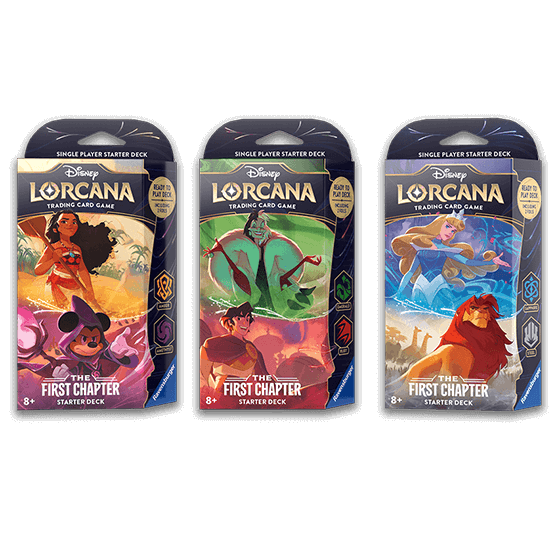
The First Chapter has three starter combinations: Amber/Amethyst with Moana and Mickey Mouse, Emerald/Ruby with Cruella De Vil and Aladdin, and Sapphire/Steel with Aurora and Simba. The names identify products; there is no leader zone in Lorcana, and the two characters on a box do not begin the game in play.
The Amber/Amethyst route is the one I would inspect for a learner interested in developing characters and maintaining enough cards to keep taking useful turns. Its practical teaching question is when a character should collect lore and when it should preserve the board. A wide team is only valuable if its questers survive long enough to act.
Emerald/Ruby is an appealing comparison for a player who wants to see how evasive pressure and disruptive effects change the race. An Evasive character can be difficult to challenge, but it is not immune to actions or abilities. Play against it by identifying actual answers rather than declaring a game unwinnable when ordinary challengers cannot reach it.
Sapphire/Steel points toward resource development and combat decisions. Its useful lesson is that spending an early turn on future resources can leave you behind on the board. More ink matters only when it becomes useful plays before the opposing lore total ends the game. I would not keep a hand of late cards merely because the deck has a resource plan.
Recreate a starter matchup before trying to perfect it
For a casual household project, two intact stock decks are a clearer starting point than two piles assembled from someone else’s leftover bulk. Preserve their lists and play several games before changing anything. If one deck seems dominant, swap who plays it and compare opening hands and sequencing, not just the winner.
I would record the first turn each deck failed to spend ink usefully, whether a player inked a necessary answer, and the turn where questing became more important than further challenging. Those three observations reveal more than a vague judgment that a color pairing is weak.
If you improve one deck, decide whether the other should improve alongside it. A more consistent deck can be a better independent constructed project while becoming a worse teaching opponent for an untouched starter. That is a matchmaking issue rather than a reason to avoid upgrades.
The booster appeal is breadth, not a promised collection
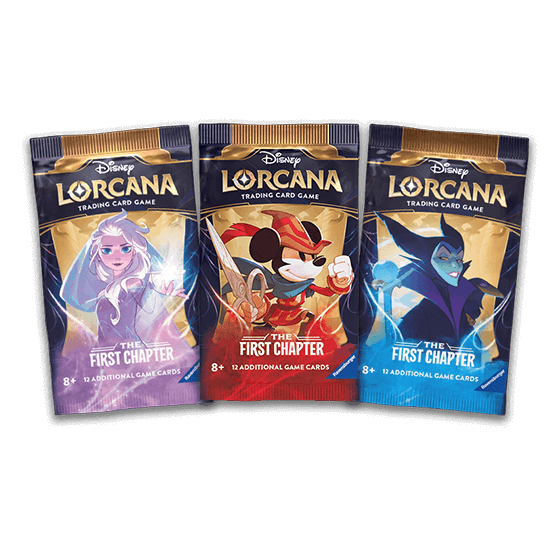
The set’s packs contain twelve random cards. Wrapper artwork does not restrict the contents to the character pictured on the wrapper. Buying an Elsa wrapper is not a method for selecting Elsa cards.
I would use a few packs to experience the original set’s variety, then make a wants list. Older sealed product may carry a collector premium that has little connection to the gameplay value of the ordinary cards inside. Compare the exact cards you want with the sealed price before assuming a box is the efficient route.
Also distinguish a base-card collection from a complete collection of alternate treatments. Those are different projects. If you want one ordinary copy of each card, a premium version need not become a new mandatory slot every time you see one. You can admire an illustration without adding its market price to the definition of completion.
The early Trove has different contents from later Troves
The First Chapter Trove includes eight packs, two deck boxes, game tokens, and a player’s guide in its storage box. Later Troves often feature different dividers and trackers. Do not transfer the contents of a modern Trove onto a listing for this one.
The guide and original packaging may be meaningful to a collector recreating the launch. A player who simply needs a lore counter should compare a simpler solution. I would value each accessory by its intended use rather than multiply its original retail allocation into a claim about present-day resale value.
The gift set is different again: it features Mulan — Imperial Soldier and Hades — King of Olympus, with playable and oversized versions plus four packs and tokens. Oversized display cards are not normal deck cards. A gift-set purchase is not a substitute for a full curated deck.
What rotation means for this purchase
The First Chapter is outside the current Core set pool. That does not mean every physical card printed in it is unusable: a card with the same full identity reprinted in a legal set can qualify. Check the exact version and current rules. Infinity and agreed casual games offer other uses for older cards, with Infinity still subject to its own banned list.
For an event-focused buyer, I would check the intended deck first, then buy cards. For a home collection, I would decide whether the goal is historical play, a favorite-character binder, or a broader Infinity project. None requires buying a sealed original box merely to make an older printing feel more authentic.
My recommendation
Choose The First Chapter when you specifically want its original characters, products, or starter experience. Choose a newer beginner product when you primarily want a straightforward first game and the newer option is the better delivered purchase.
The original set remains interesting because it shows the basic decisions clearly: develop, challenge, or collect lore. Its age should give the purchase a purpose, rather than become the reason you accept any price attached to it.
Find the product
View The First Chapter booster display on Amazon. Confirm the selected quantity, language, seller, and delivered price.
Continue with B3’s Lorcana guides
Browse all Lorcana guides · Learn to play · Compare your first purchase.
Sources and scope
Checked October 21, 2026: official The First Chapter products and card previews, current rules and release notes, and the official rotation explanation. Product facts and printed mechanics are separated above from B3’s proposed buying and practice methods. Prices in worked examples are hypothetical; live prices, stock, event availability, and pull odds are not promised.