Shadows of the Galaxy Booster Buying Guide: Bounty Hunters, Smuggle, and Buying After Rotation
Shadows of the Galaxy is the SWU set I would investigate for someone drawn to bounty hunters, scrappy Outer Rim characters, and the idea that a card you put into resources might still have a later job. Its appeal is the messy middle of a game: the reward attached to an enemy, the prisoner being guarded, and the card you can still play from an unexpected place.
That makes it a distinctive older set to explore. It does not make a booster box the right upgrade purchase for every Mandalorian fan. Before buying, decide whether you want the set's limited environment, a fixed starter pairing, or particular cards for a known list.
In this buying guide
- What you get: compare the actual packages
- Three mechanics give the set its personality
- A buying example: one deck problem versus a whole environment
- The Mandalorian and Gideon starter avoids a common mistake
- The post-rotation question comes first
- Make a limited session reward the set’s decisions
- My stopping point
- Price the experience, then set a stopping point
- Find the correct product
- Keep exploring
What you get: compare the actual packages
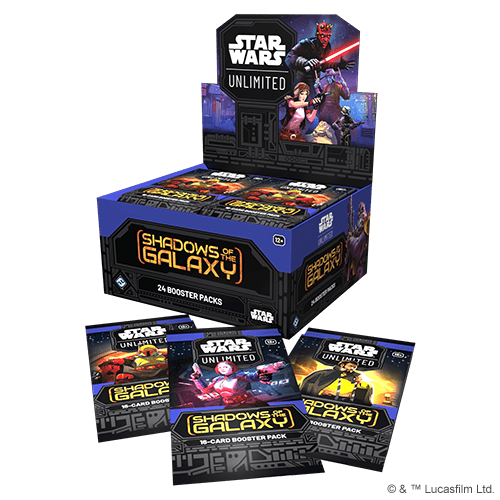
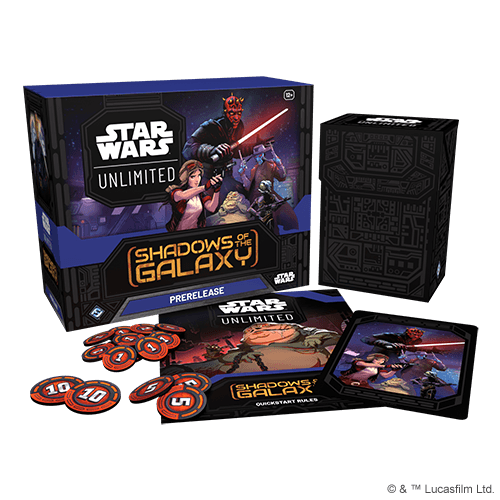
A standard display contains 24 packs. At 16 cards per pack, that is 384 cards, including leader and base/token slots; it is not 384 distinct main-deck cards. A prerelease box provides six packs and supporting materials. A retail prerelease box does not automatically include entry to a store event.
This set uses the earlier pack structure: nine commons, three uncommons, one rare or legendary, one leader, one base/token, and one foil card, with applicable variant replacements. Neither a legendary nor a particular card is guaranteed in each pack.
The fixed The Mandalorian and Moff Gideon Two-Player Starter is a different product. Buy it for the supplied list; buy boosters for randomized cards. There is no original Carbonite Edition release for this set. Carbonite began with Jump to Lightspeed.
Three mechanics give the set its personality
Smuggle lets a card with that keyword be played from resources using its alternate cost and restrictions. Bounty attaches a reward to a unit that an opponent can collect by defeating or capturing it. Capture removes a unit into a guarded facedown state rather than treating it as an ordinary defeated card. Use the current rules for the details, especially what happens when the guard leaves play.
These mechanics make me value a coherent plan over a stack of individually exciting cards. A Bounty payoff needs opportunities to collect rewards. A capture line needs you to think about the guard's survival. A Smuggle card can make an early resource choice more flexible, but its later cost still has to fit your available resources.
A buying example: one deck problem versus a whole environment
Suppose your deck repeatedly runs out of useful late actions. You identify two exact Smuggle cards you want to test. Buying those copies lets you test the hypothesis immediately; opening a box gives you a different project and might not deliver them. I would choose singles for that problem.
Now imagine four friends want a closed-pool Outer Rim campaign. You can keep the cards together, build several lists, and let each session suggest a few changes. Here the randomized pool is part of the enjoyment. I would compare a box with enough prerelease products for the group, then choose the quantity that funds the games you have actually arranged.
The Mandalorian and Gideon starter avoids a common mistake
The set's Two-Player Starter contains two fixed decks led by the Mandalorian and Moff Gideon. It is the direct route to that supplied matchup. Standard booster packs are randomized; the set name on the wrapper does not promise either starter deck or all of its fixed cards.
I would buy the starter for learning those two plans, and boosters for exploring a pool. If you already own the starter, play it enough to identify a specific weakness before adding packs. Otherwise you can spend the entire upgrade budget before knowing whether you wanted better early plays, more ships, or a different leader.
The post-rotation question comes first
Shadows belongs to the first three sets that left Premier at A Lawless Time's release. Individual reprinted cards can have a different eligibility outcome, but the sealed box is not a current-format deckbuilding certificate. For an event, check each intended card and the current suspension list.
For Eternal or Twin Suns, ask how the actual group builds and plays. A card can have a useful home outside Premier without every old combo being legal or desirable. For casual paired decks, agree whether you are keeping a historical snapshot or applying current organized-play restrictions. Establish that before somebody buys upgrades for a different understanding of the game.
Make a limited session reward the set’s decisions
When building from an opened pool, separate reliable early development from conditional payoffs. Do not count a card you can eventually Smuggle as an opening play unless you can afford the relevant line. Check how many actual units your deck has after filling it with capture tools and rewards.
During games, record one instance where you wanted a resourced card back and one where capturing an enemy created a vulnerable guard. Those are useful review points because they expose what the mechanics ask you to manage. Simply recording which legendary won a game misses the decisions the set makes interesting.
My stopping point
I would stop buying once the collection supports the games I wanted or the remaining needs are a short list of exact cards. More packs may still be enjoyable, but they have become a separate opening purchase. Treating them that way makes it easier to keep both the hobby and the budget satisfying.
Do not pay an inflated price because a listing calls the product vintage, rare, or investment-grade. Check the actual contents and compare the delivered cost with a deliberate pool of singles. The most useful box is the one you have a plan to play.
Price the experience, then set a stopping point
Use delivered cost rather than the headline price. In a hypothetical comparison, a $96 display is $4 per pack; six loose packs at $5 each cost $30. The display has the lower unit price but requires $66 more spending. If you only arranged a six-pack experience, the larger order has to justify its extra quantity.
For a group, write down the format, number of players, required packs, token supplies, sleeves, and who keeps the cards before ordering. A normal draft uses three packs per person; sealed uses six. A 24-pack display therefore supplies eight draft entries or four sealed pools, before prize support or spare packs. Confirm the current procedure with your organizer.
For a deck upgrade, price the exact missing copies with shipping. Set your opening budget so the ordinary contents and the games are enough to justify it. Do not count on selling a chase card to make the purchase affordable.
Find the correct product
As an Amazon Associate, B3 earns from qualifying purchases.
View the Shadows of the Galaxy standard booster display on Amazon.
Confirm the selected edition, language, sealed condition, quantity, seller, and delivered price. This is a product-identity check, not a live stock or price promise.
Keep exploring
Learn the game · compare your first purchase · browse all SWU guides · understand Carbonite packs and their changing contents.
Product and rules check: October 22, 2026. Official sources: set products; shadowy insights danny schaefer; comprehensive rules update; eternally unlimited; limited play; current rules, errata, and suspensions. B3’s buying recommendations and planning examples are editorial analysis; prices used above are hypothetical.
Want two fixed decks instead? Read the Shadows of the Galaxy Two-Player Starter guide for both leaders, useful practice decisions, and the complete-box buying checks.