Shadows of the Galaxy Two-Player Starter Guide: Mandalorian vs. Moff Gideon
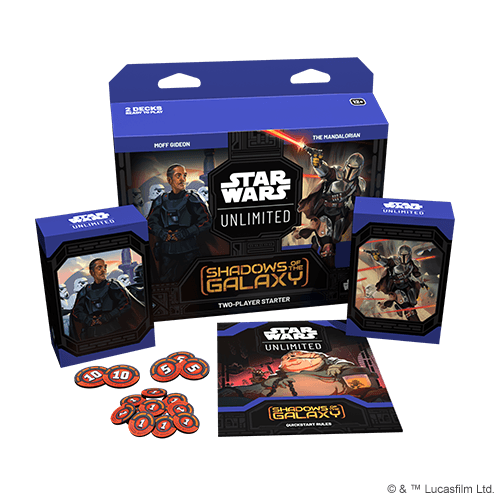
The Shadows of the Galaxy starter is the pairing I would investigate for someone who enjoys building a character up with equipment on one side and coordinating an inexpensive squad on the other. It gives two players complete fixed decks, but those decks ask different questions about where to invest their cards and when to risk an important unit.
That makes this more than an Outer Rim-themed alternative to Luke and Vader. The Mandalorian's upgrade interactions and Moff Gideon's low-cost-unit plan create distinct habits to learn. I would buy it because those habits sound enjoyable, while treating the current price and the intended format as separate checks.
In this starter guide
- Buy the complete pairing, not a character name
- The Mandalorian: equipment should earn the investment
- The token-upgrade distinction is easy to miss
- Moff Gideon: small units need useful fights
- Which deck suits which player?
- A useful opening-hand review
- How I would add cards after learning it
- B3’s verdict
- Still sold does not mean automatically Premier-ready
- Buying checklist and direct product link
- Where this starter fits in the wider range
- Learn the rules, then expand deliberately
Buy the complete pairing, not a character name
The Two-Player Starter contains two fixed 50-card main decks, leaders, bases, learning materials, counters, paper playmats/posters, and folded cardstock deckboxes. It supplies the Mandalorian and Moff Gideon matchup in one package. A booster display is randomized and does not supply these exact lists with certainty.
The fixed inventory includes reprinted cards as well as set-specific starter cards. The publisher explicitly notes that returning cards do not all arrive as full playsets. If you are buying for upgrades rather than two playable decks, compare the exact quantities in the package with the copies you need.
The Mandalorian: equipment should earn the investment
The supplied Mandalorian leader rewards playing upgrades by exhausting eligible enemies under his printed conditions. That creates an appealing two-part decision: an upgrade can improve a friendly unit while also changing which enemy can act. The power of that interaction depends on the timing and the actual legal target.
I would ask two questions before loading another upgrade onto a unit. Does it change the next meaningful fight? And how much of my board disappears if this one host is removed? A modest upgrade that preserves an attack can be more useful than a huge pile of bonuses on a unit the opponent can efficiently answer.
An exhausted enemy remains a defender and can still deal combat damage. Exhausting it can prevent its ordinary attack, but it does not automatically make a fight safe. Keep the distinction visible when deciding whether to attack that unit or use the opening to pressure the base.

The token-upgrade distinction is easy to miss
The official deck explanation distinguishes playing an upgrade from receiving a token upgrade through another effect. The latter does not by itself trigger the Mandalorian's upgrade-play ability. Likewise, moving an existing upgrade is not the same as playing a new upgrade card.
I would practice this by announcing exactly what each effect does: play a card, create a token, or move an attachment. If you describe all three as equipping something, it becomes easier to assume a trigger you did not earn. The card wording matters more than the everyday shorthand.
For an upgrade experiment, first record how often you had a suitable host and a worthwhile exhaustion target at the same time. If the host was usually absent, adding more upgrades may make the opening hand worse rather than making the engine more reliable.
Moff Gideon: small units need useful fights
Gideon's supplied plan rewards units costing three or less, with his deployed side adding Overwhelm to the relevant attackers. I would think of those units as a collection of tactical opportunities rather than disposable bodies. A cheap unit can still be the most valuable remaining attack in the phase.
When choosing an attack, compare the enemy's remaining HP with the damage you can actually deal and the power coming back. Spending an important attacker to remove an irrelevant blocker may waste the opening you needed. Conversely, clearing the enemy that threatens two later attacks can matter more than immediate base damage.
Overwhelm rewards the right defender, not simply any fight. In a simplified example, a five-power Overwhelm attacker hitting an unshielded unit with two remaining HP can send three excess damage to its base. Check prevention and attack restrictions before treating that as a guaranteed finish.
Which deck suits which player?
I would give the Mandalorian first to the player who enjoys developing a particular unit and using disruption to protect the investment. I would give Gideon first to someone who likes several affordable pieces and deciding which fight each should take. Neither description establishes a measured advantage in the stock matchup.
After the first game, swap. Pay attention to the moments where the other side's plan felt threatening. If Mando repeatedly commits multiple cards to a fragile host, that is a decision to review. If Gideon keeps adding bodies while leaving the space arena unanswered, that is a different problem.
A useful opening-hand review
Look for an affordable unit, a believable follow-up, and two opening resources you can actually spare. With Mando, do not keep a hand of upgrades with no usable host. With Gideon, do not keep only late-game cards because their effects look dramatic. A leader cannot compensate for every opening that fails to develop.
Before resourcing an interaction card, inspect the other deck's visible plan. An answer to one heavily upgraded unit may matter more than another midrange body; an early unit may matter more than a clever effect you cannot afford for several rounds. These are decisions to learn through the pairing, not a universal resource chart.
How I would add cards after learning it
Keep both stock lists recorded. Test a small number of substitutions addressing one repeated issue, such as finding hosts, maintaining early development, or contesting ships. Verify copy counts before recommending another card: an ordinary constructed deck cannot simply add fourth copies to make an effect more common.
For a household matchup, discuss changes together. An upgrade that makes one deck more efficient can reduce the fun of keeping the starter as a paired game. For a player moving into organized play, build toward a current legal list and price its exact missing cards instead.
B3’s verdict
I would choose Shadows for the contrast between equipment-focused disruption and a coordinated small-unit attack plan. It is particularly appealing when both players want to replay and understand their decisions. I would not buy it solely because the Mandalorian appears on the cover; the fixed lists and the games they support are what make the package useful.
Still sold does not mean automatically Premier-ready
All three original sets rotated out of Premier when A Lawless Time released. Reprints can make individual older printings eligible, so check the exact cards and current suspended list before taking a stock starter to an event. The age of the box alone does not settle every card’s eligibility.
For casual paired play, you can keep the lists together and agree on the rules you use. Eternal and Twin Suns have their own requirements; these are not ready-made Twin Suns decks simply because older cards can be used in that format. Decide where the starter will be played before pricing competitive upgrades.
Buying checklist and direct product link
As an Amazon Associate, B3 earns from qualifying purchases.
View the Shadows of the Galaxy Two-Player Starter on Amazon.
An exact product listing was identifiable at this check. Seller availability, delivery, and price can change; a listing is not evidence of a continuing factory print run. Confirm the complete two-deck product, language, condition, accessories, and delivered cost before ordering.
For a hypothetical price comparison, a $30 paired starter is $15 per supplied deck. Two individual decks at $22 each cost $44 before any shipping differences. The cheaper route is useful only if its leaders and learning experience suit you. Reserve room for sleeves rather than paying for a box whose contents do not match your plans.
Where this starter fits in the wider range
Spark, Shadows, and Twilight each used a Two-Player Starter. Jump to Lightspeed introduced the individually sold Spotlight Decks. Intro Battle: Hoth is a separate guided teaching product, and 2026 Twin Suns is a separate multiplayer release. Do not group those products with a main set just because their characters share an era.
The announced Icons 2027 Edition Starter Box is another separate product, with a planned November 20, 2026 release. Its staged teaching format starts with smaller decks; it is not a relabeling of this original 50-card pairing. Compare it as an upcoming alternative rather than implying it is already on sale.
Learn the rules, then expand deliberately
Use B3’s first-game walkthrough and embedded 8:45 tutorial for setup, combat, initiative, and regroup. Read the Shadows of the Galaxy booster buying guide before choosing packs for this collection.
Inspect the official complete starter decklists. Use the correct side for each leader and preserve the original list before making substitutions.

Compare first-purchase options · Browse the SWU guides.
Product and rules check: October 22, 2026. Sources: official starter explanation; official set products; rotation; current rules, errata, and suspended cards. Recommendations and simplified practice situations are B3 editorial analysis, not a claim of measured matchup results or a hands-on test.