Into the Inklands Guide: Locations, Starter Decks, Boosters, and Troves
Affiliate disclosure: As an Amazon Associate, B3 earns from qualifying purchases.
Into the Inklands is the Lorcana set that makes the battlefield feel less like a row of characters. Locations introduce another kind of permanent and another source of pressure. A location may contribute lore without asking a character to quest, but it also gives the opponent a different target to attack.
I would buy this older set for a location project, its character lineup, or its fixed starter matchup. I would not buy it assuming it is a required intermediate lesson between the original game and newer sets. You can learn Lorcana with a newer deck and return to locations when your chosen cards use them.
Pongo converts spare ink into a chance at another character
Pongo — Determined Father costs three, and once per turn you can pay two to reveal the top card. A character goes into your hand; anything else goes to the bottom. That is a conditional source of cards, not an automatic draw whenever you have spare resources.
With five ready ink, playing Pongo and immediately using the ability spends the whole five. Compare that with Pongo plus another affordable character. The ability can improve a later hand, while another character may be the development you need to keep up right now. Neither line is automatically correct because the engine button is available.
After several games, count how often the activation supplied a useful card and how often it displaced a play you already held. When tuning, maintain enough characters for the effect to hit, but do not replace every useful action with an inferior character merely to make the percentage larger.
Peter Pan makes a location’s lore value an immediate opportunity
Peter Pan — Lost Boy Leader gains lore equal to a location’s lore value when he moves there, once per turn. The relevant number is the location’s printed lore value, not its play cost or movement cost. A location with a valuable ability but no lore value does not provide the same reward.
Plan the whole payment: playing a location, playing Peter if needed, and moving him are separate costs unless another effect changes them. If the location is already present, the movement line can be much cheaper than building the entire package from an empty board.
For a practice position, place a legal location with a lore value on the table and compare Peter’s movement reward with playing another character for next turn. If the movement completes your win now, future development is irrelevant. Earlier in the game, a stronger board may collect more across several turns than a small immediate bonus.
The once-per-turn wording prevents turning repeated movement into unlimited rewards from the same Peter. It also makes unnecessary movement expensive: if you already received his trigger, paying to move again needs another concrete benefit.
Give Moana and Scrooge a productive resource turn
The Ruby/Sapphire deck asks you to decide which items and locations improve its actual game. A useful related engine in that list is Scrooge McDuck — Uncle Moneybags: his quest reduces the next item you play that turn by one. Quest before the intended item, and remember the reduction belongs to the next item rather than every item afterward.
A saved ink matters when you can spend it usefully. If the discount lets you play both the item and a needed character, the sequence has improved development. If it only helps you play another accessory while the opponent threatens a win, you may be solving the wrong problem.
Across the matchup, I would track the turns spent on infrastructure. Pongo’s activation, Peter’s movement, and an item discount all have attractive text, but the winner still needs enough effective quests or other lore gains. Ask what the next investment contributes before the race is likely to finish.
Card references: Pongo card reference · Peter Pan card reference · Scrooge printed card text. Gallery illustrations may show a reprint or alternate treatment; the analysis concerns the named card’s abilities, not a promise of that treatment in the starter.
What locations change
A location has its own cost and Willpower. It may have a lore value or an ability, and characters can move to locations by the appropriate rules or effects. The move cost is not the same as the cost to play the location. Read both before imagining the entire sequence fits into one turn.
An opposing character can challenge a location; the location does not strike back with a Strength value like a character. That makes attacking one a calculation about time. The opponent spends an available challenge preventing future value instead of advancing another part of the board.
For example, if a location is about to generate lore over several turns, removing it may be more important than trading into a small character. If the opponent is one quest away from winning, spending every attacker on a location may be irrelevant. Compare the projected race rather than treating all permanents as equal targets.
I would teach locations by adding one to a familiar game. Play it, identify its lore and ability, work through moving a character if useful, and show how the opponent can remove it. That is easier to absorb than introducing six different location exceptions before anyone has used one.
The two starter directions
The Amber/Emerald deck features Pongo and Peter Pan. I would examine it for a learner drawn to developing a team and using evasive pressure. Its useful question is when to keep growing the board and when enough characters are present to make a meaningful lore push.
The Ruby/Sapphire deck features Moana and Scrooge McDuck. I would compare it for a player interested in items, resources, and the extra decisions associated with locations. Having another card type creates options, but each option still costs a card, ink, or an action. A turn that plays several accessories without developing a functioning board can fall behind.
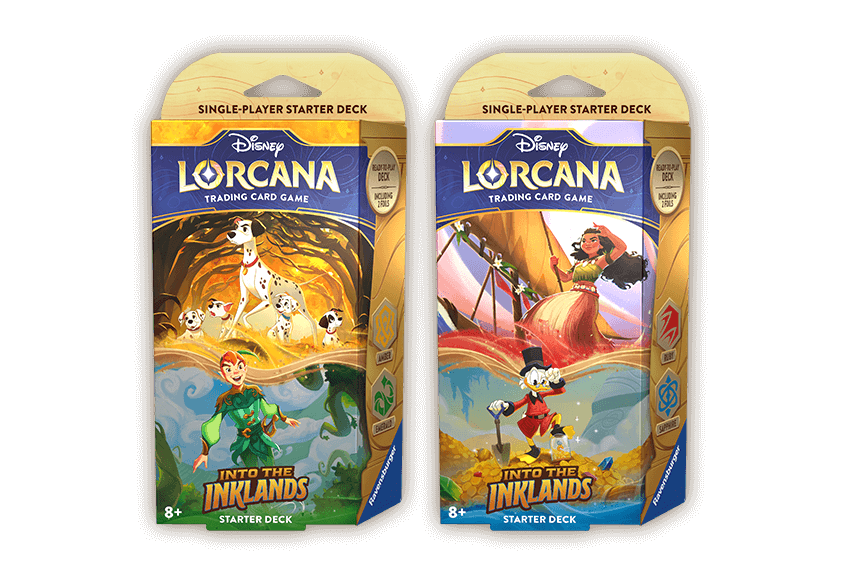
Neither deck has a leader that starts outside the shuffled sixty cards. The face characters identify the product and its themes. A good opening hand still needs affordable plays rather than a hope that the foil card will appear at exactly the right moment.
Moving is useful only when the destination matters
Before paying to move, name the benefit. Perhaps an ability requires a character to be at a location, or positioning will support a later effect. If there is no relevant benefit, moving a character simply because the option exists spends ink that could have developed another card.
A useful practice turn compares two lines: play a new character, or move an existing character and use the destination’s effect. Record the final board, remaining hand, and next turn’s likely lore. Do not judge only the current turn’s visible activity. A location engine can be valuable while looking quiet, and a busy movement turn can accomplish very little.
Be especially precise about trigger timing. A card entering a location, a card being moved by an effect, and a character already being at a location can matter to different abilities. Use the current rules for the actual card rather than invent a universal “location bonus.”
Choose packs, Trove, or the Stitch and Tinker Bell gift set
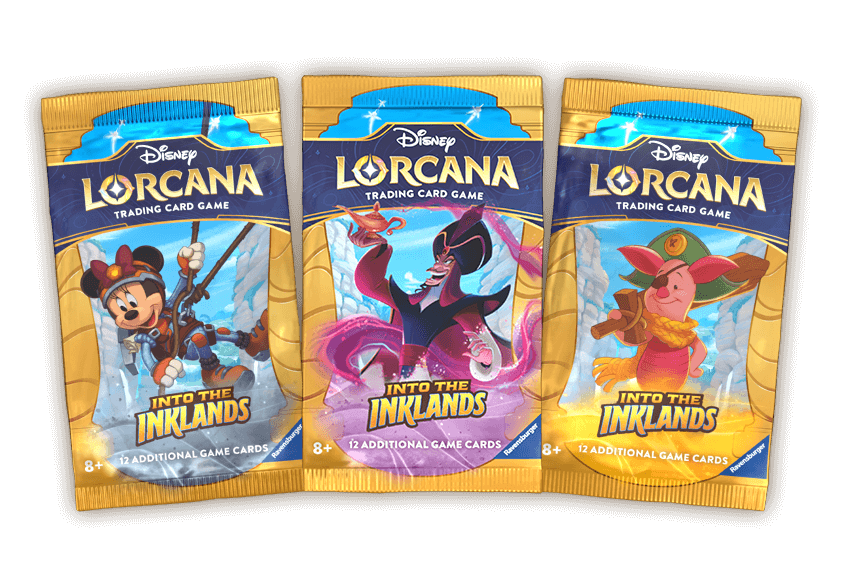
The packs contain twelve random cards. The Trove combines eight packs with storage, six ink-themed dividers, six damage dice, and a lore counter. Its use is organizing and tracking a collection; it does not supply a selected location deck.
The gift set features Stitch — Covert Agent and Tinker Bell — Very Clever Fairy, with playable and oversized cards, four packs, and counters. If those exact illustrations or included cards are your target, the named gift set is a more direct comparison than an unspecified quantity of boosters. Check a secondhand copy carefully: packaging photographs do not establish that the original packs remain sealed or present.
For a location deck, I would begin with an exact list of the locations and supporting cards needed. A set can introduce a mechanic without every booster supplying a balanced package for it. Opening first and identifying a project afterward is a collecting activity; completing a known constructed list is a different purchasing task.
Buying an older set in the current game
Into the Inklands is outside the present Core set pool. An older printing of a card reprinted in a legal set can still qualify by exact identity. Check the full card name, current text, and intended format rather than rejecting or approving the entire binder by its printed set number alone.
For home games, agree on the same expectations for both players. A location-heavy older deck and an untouched modern starter may produce a useful matchup, but that should be discovered through games rather than assumed from the age of the boxes. Preserve the stock lists when teaching so that changes are reversible.
My recommendation
I would choose Into the Inklands when I specifically want its location interactions, Pongo/Peter Pan or Moana/Scrooge stock decks, or the set’s collecting themes. I would choose singles when I already know the location package I need and packs when discovery is the intended entertainment.
The set is most rewarding when you learn to value a location in turns: what it costs now, what it contributes later, and what the opponent must give up to remove it. That is a more useful lesson than treating every new card type as something every deck must include.
Find the product
View Into The Inklands booster display on Amazon. Confirm the selected quantity, language, seller, and delivered price.
Continue with B3’s Lorcana guides
Browse all Lorcana guides · Learn to play · Compare your first purchase.
Sources and scope
Checked October 21, 2026: official Into The Inklands products and card previews, current rules and release notes, and the official rotation explanation. Product facts and printed mechanics are separated above from B3’s proposed buying and practice methods. Prices in worked examples are hypothetical; live prices, stock, event availability, and pull odds are not promised.