Disney Lorcana Gateway Guide: Learn in Stages and Know What to Buy Next
Affiliate disclosure: As an Amazon Associate, B3 earns from qualifying purchases.
Disney Lorcana Gateway is most interesting as a teaching product. Its value is the order in which it asks you to learn. You begin with a small, controlled set of cards, practice the core decisions, and then add cards that introduce more of the game. That is a useful approach when both people are learning and neither wants to study a full deck before playing.
I would buy it for that shared learning process. I would not buy it assuming the board is required for all future Lorcana games or that the box is a shortcut to a current tournament deck. This is a guide to the supplied learning experience and a practical plan for using it; it is not a claim of a B3 hands-on review.
What is actually in Gateway?
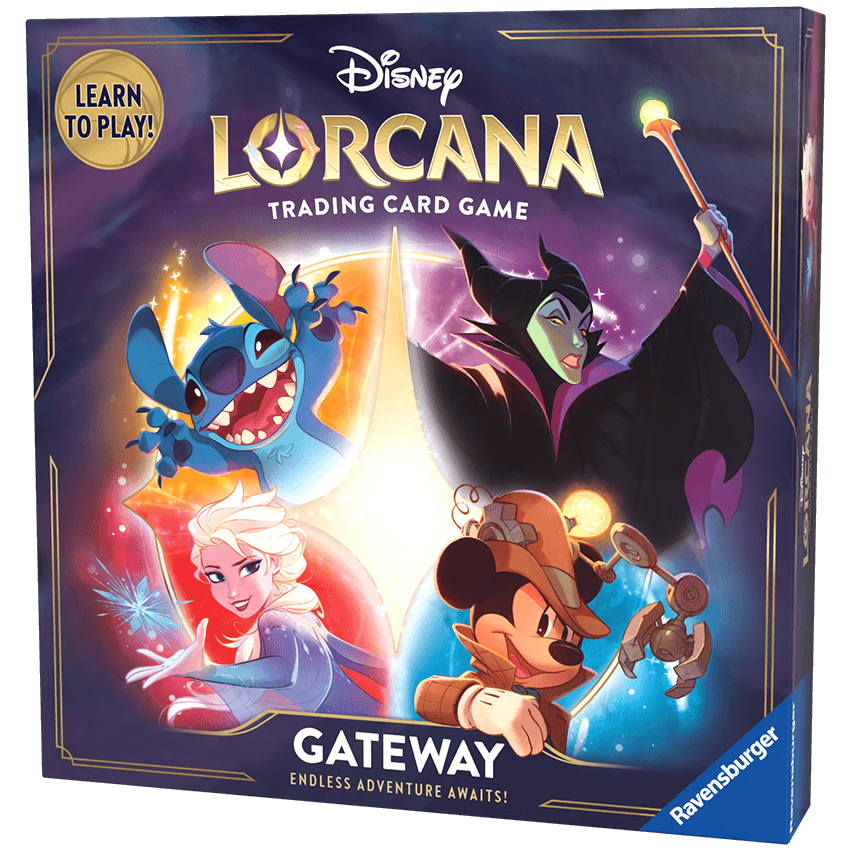
The official contents list includes two 30-card starting decks, four 18-card reward packs, a board, 30 damage counters, two character movers with bases, a rulebook, a guidebook, and two deck-tip pamphlets. The starting decks feature Stitch and Maleficent on one side and Elsa and Mickey Mouse on the other. The reward packs are fixed teaching additions, not random retail boosters.
Together, the starting decks and reward packs supply 132 cards. As the guidebook distributes the additions, the decks can grow to 66 cards each. That is why calling Gateway “two 30-card decks” tells only the beginning of the story. It is equally misleading to start with all 132 mixed together: the sequence is part of what you bought.
Before opening: keep the learning order intact
Start with the booklet labeled Read This First. The official first-game procedure tells you not to shuffle the starting decks, because the opening hands are arranged for the lesson. Do not open reward packs early just to see everything, and do not combine them with cards from other purchases before finishing the learning process.
I would keep separate labeled piles or bags for each side and each unopened stage. Put the guidebook where both people can read it, and place damage counters within easy reach. If one player has already played another TCG, that person should still resist replacing the supplied sequence with assumptions from a different game. Familiar vocabulary can conceal different timing.
The no-shuffle instruction belongs to the scripted first game. It is not a general Lorcana rule. Ordinary games require randomized decks. This distinction matters when somebody later reads a normal how-to-play guide and thinks one set of instructions must be wrong.
First goal: learn what turning a card means
Use the first game to connect visible actions with consequences. Adding an inkable card to the inkwell makes it available as one resource. Playing a character introduces a new piece that must normally wait for its ink to dry. Questing turns an eligible character sideways and advances your lore. Challenging uses that same opportunity to interact with an opposing exerted character instead.
Do not turn the first game into a test of memory. Ask the other player to point to the printed cost and lore value, then make the play with the cards visible. If they can explain why a character cannot quest yet, they have learned something more valuable than merely following an adult's instruction to wait.
A useful invented teaching question is: “This character can earn two lore, but the opponent can banish it afterward. Do we want the two lore now?” There is no universal answer without the rest of the board. The point is to notice that questing both advances the goal and exposes a character.
Use the gates as practice milestones
The guidebook's achievements determine when you unlock each addition. Follow the actual tasks and card allocations in your copy rather than racing to open all four packs. The product is asking players to practice, not merely sit through one explanation before receiving a larger pile.
I would add a simple check before moving on: can both players perform the new action without coaching? They do not have to choose perfectly. They should understand what they paid, what changed, and what remains available. If one player is repeatedly asking which cards can act, another game with the current stage is more useful than the next unlock.
Avoid turning a shared achievement into a punishment for the slower learner. If a task did not appear naturally, explain the relevant situation and continue following the guidebook. The goal is two people who want another game, not one expert collecting completion marks while the other watches.
When songs arrive, teach the opportunity cost
A song can normally be paid for with ink or sung by an eligible character. Singing preserves ink but uses a character that could otherwise have quested or challenged. That is the lesson to emphasize before discussing clever combinations. A drying character normally cannot exert to sing just because its printed cost is high enough.
Try comparing two invented lines aloud. In one, a dry character sings a useful song and you spend the saved ink on another character. In the other, you pay ink for the song and let the established character quest. Which line is better depends on the song, available ink, and what the extra character contributes later. There is no need to call singing “free” without explaining what you gave up.
When items or more involved character abilities appear, give each addition a similar question: what useful choice does this create? A repeatable item asks whether you can afford its activation and what it displaces. An enters-play ability asks you to resolve it when the character arrives, rather than waiting for the ink to dry unnecessarily.
Keep the board helpful, then learn to play without it
The board gives beginners a shared layout and a visible score track. It can reduce the small administrative questions that interrupt a first game: where do these cards go, which row is ink, and whose score moved? That is a reason to use it while it helps, rather than treating it as decorative packaging.
Once both players understand the zones, try an ordinary table setup. Keep characters, ink, discard piles, and lore clearly separated. Lorcana does not require this particular board, and future decks will not necessarily fit its teaching layout perfectly. Moving beyond it should feel like removing a useful reference after learning, not abandoning a required component.
Common learning snags
If a player runs out of playable cards, examine the ink decisions before blaming the deck. Inking every affordable character while keeping only expensive favorites can make the opening feel helpless. If somebody thinks a damaged character is weaker in every way, separate Strength, Willpower, and lore again. If every character quests automatically, practice one turn where a challenge prevents several future opposing quests.
Keep drying separate from being exerted. A new ready character is normally still unable to quest. A previously established exerted character readies on its next turn and can act again. Counters do not disappear just because the character stands upright.
Gateway uses staged teaching instructions, including its treatment of running out of cards. When you move into ordinary Lorcana, use the current comprehensive rules: the October 2026 document specifies an end-of-turn loss for an empty deck. Do not use an older tutorial's shorthand to settle a current standard game.
What should you buy after finishing?
Nothing is mandatory. The completed fixed decks can continue to provide games. First try swapping sides and finding one choice you handle differently. Replaying familiar decks is often the quickest way to understand why a card was difficult to use the first time.
If you want a fresh strategy, a specific ready-to-play deck provides a known list to learn. If you want to build a particular idea, inspect the cards you already own and buy precise missing pieces when appropriate. If opening random packs is itself the attraction, choose a small entertainment budget and understand that the contents may not improve either deck.
For a store event, check its format and current eligibility before taking the completed Gateway list. Older included cards and current Core Constructed requirements are separate questions. The ability to play together at home does not certify an unchanged deck for a particular event.
Who I would choose Gateway for
Gateway is a sensible candidate for two newcomers who want a structured, low-preparation introduction, especially when a board and physical learning milestones make the process easier. It is less compelling for players who already know Lorcana or specifically want to choose their first full deck around a particular strategy.
My recommendation is to judge it by the learning evening it enables. Can the people receiving it sit down together, follow the instructions, and enjoy a second game? If so, the teaching components have a purpose. If both players would skip them immediately, compare complete starter decks instead.
View Disney Lorcana Gateway on Amazon
Continue with B3’s Lorcana guides
Learn the rules with worked turns and example videos, or compare Gateway, decks, boosters, and other first purchases.
Sources and further reading
Checked October 20, 2026: official rules and release notes, including the October 8 comprehensive rules; official teaching lessons; Gateway contents; Fabled products and official art; two-player set contents; and formats.
B3 is an independent publication and is not affiliated with or endorsed by Disney or Ravensburger. Official card art and product images remain the property of their respective rights holders. Images are shown for product identification and discussion; depicted premium treatments are identified where applicable.