Nyctophobia: The Hunted Guide — Playing a Horror Game by Touch
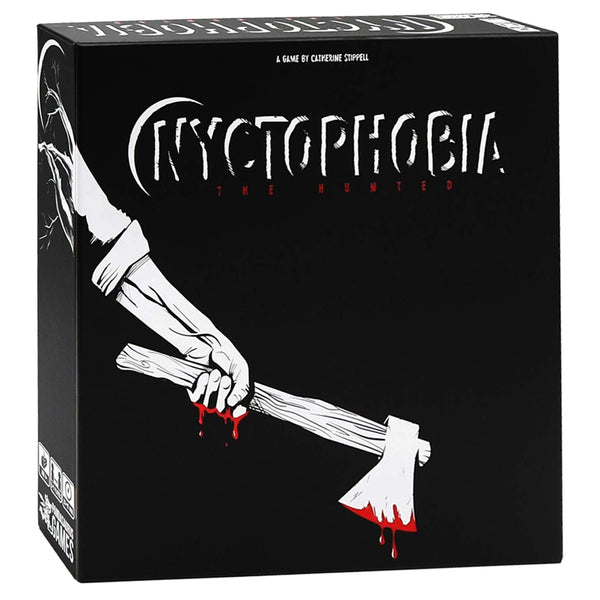
Many horror games ask you to imagine that you cannot see what is coming. Nyctophobia: The Hunted makes the missing view part of the rules. Most players wear blackout glasses and navigate a forest maze by touch, while one sighted player controls the hunter.
The interesting result is that ordinary information becomes valuable. Finding an edge, remembering a turn, or telling a teammate where a path is blocked can matter more than making a clever attack. It is a very particular invitation: a cooperative survival puzzle for the hunted players, with another person both opposing them and helping the physical game run fairly.
3–5 players · Rulebook: ages 9+ · 30–45 minutes
One hunter versus 2–4 hunted players · Tactile maze, memory, and communication
Edition covered: The Hunted, with Axe Murderer and Mage roles.
First check: everyone actively wants to play using blackout glasses.
What each side is trying to do
The hunted team must locate the car, call for help, and keep everyone alive through the required final stretch. Finding the car does not instantly win. The game continues until the player who called for help completes their next turn.
The hunter wins when any hunted player loses their last health token. That makes the most vulnerable teammate everyone’s problem. Racing your own piece to a promising location is not automatically useful if another player is about to be caught.
This is an opposing-player game, not a fully cooperative system where an app runs the threat. The hunter can see the complete board, but is bound by movement instructions, cards, and the duty to provide truthful procedural information.
How a hunted turn works
The hunter helps the active player locate their own piece. That player feels the immediately adjacent spaces, then makes the required two-space orthogonal movement, with opportunities to search again between and after steps. Trees block movement and limit what can be felt beyond them. Diagonal movement and unrestricted feeling around the board are not permitted.
The active player may also take an optional action before or after movement, subject to its restrictions. Sprinting adds distance without a final search, hiding trades participation for temporary protection, and throwing a rock can reveal a line of spaces or create a useful distraction. Calling for help is the special action available at the car.
The limitation on touch is the actual puzzle. If players sweep their hands across the whole maze, the game loses the uncertainty it is designed around. Teach the permitted search area before anyone puts the glasses on.
Communication is your shared map
Use north, south, east, and west consistently. “Left” depends on where someone is sitting, so it can make a correct observation useless to another player. Agree which side of the room is north and let the hunter repeat that orientation when needed.
A useful report names a location, an observation, and a degree of confidence: “After moving north twice, I reached an edge; there was an open space to the east.” That is more useful than “I think I found a way,” and it lets another player connect a separate discovery to the same mental map.
Keep uncertainty visible. If you are unsure whether two remembered spaces connect, say so. A confident but mistaken direction can cost the team more than admitting the gap.
Rocks give you information—and consequences
A thrown rock travels along a straight direction until it meets an obstacle or other relevant object. The hunter reports the distance and what it hit. That can reveal a corridor without moving your piece through every space.
The throw also places noise, which affects the hunter’s movement. A rock can therefore be an information tool, a diversion, or a defensive option. Those uses compete for the same limited resource.
Do not assume every throw is harmless scouting. A rock can hurt another hunted player, and a distraction that leads the hunter away from you may lead it toward a vulnerable teammate. Tell the team what you intend before choosing a direction, while following the communication restrictions of the current situation.
Hiding has a real cost
Hiding removes your piece from normal interaction temporarily, but a hidden player cannot speak to the other hunted players without breaking that concealment. The silence is part of the decision, not an invitation to keep directing the group from safety.
Think about what the team loses if the person with the clearest mental map stops communicating. Conversely, a wounded player who keeps talking from an exposed position may be risking the entire team’s survival. Use hiding to solve the immediate problem rather than treating it as an automatic end-of-turn habit.
The ordinary hide action also becomes unavailable after the call for help. Check the specific combat and card exceptions in the rulebook rather than assuming one general sentence covers every special case.
The hunter is a player and a facilitator
On the hunter’s turn, choose one of the two cards in hand, resolve the appropriate instructions, and draw back up. Noise affects movement priorities; without it, the nearest hunted player becomes relevant. Cards can supply exceptions, so follow the actual text rather than moving freely because you can see a better attack.
The hunter also guides fingers to pieces, identifies what is touched, and resolves the unseen board state. Be precise and patient in those jobs. Uncertainty about the maze creates tension; uncertainty about whether the hunter explained the rules honestly creates frustration.
The rulebook encourages atmosphere while respecting personal space. I would agree on the desired intensity before play. A quiet, accurate description can sustain suspense without sudden shouting or unwanted physical surprises.
Axe Murderer or Mage?
The Hunted includes two hunter decks. The Axe Murderer is the suggested starting role, with a more direct pursuit. The Mage adds disorientation through changes to the forest and the players’ sense of the board.
Start with the simpler pursuit while the group learns the tactile system. If remembering directions is already demanding, changing the landscape can turn an interesting challenge into an opaque one. Add the Mage because the team wants that extra uncertainty, not simply because it sounds more dramatic.
A first session that teaches the right things
- Show the physical system first. Let everyone handle their piece, a tree, and the board before the secret setup.
- Teach a sample legal search and move. Make clear that touch is limited to the permitted area.
- Fix the compass directions. Relate north and east to stable features in the room.
- Use a rulebook scenario. Avoid improvising a maze before understanding how the starting layouts work.
- Explain the finish. The car starts a survival countdown; one teammate’s defeat loses the game for the hunted.
- Choose a patient hunter. Rules guidance should remain clear even when the fictional pursuit becomes tense.
Who will enjoy it?
Nyctophobia is a strong candidate for players curious about a tactile, talkative survival puzzle. It asks the group to build a shared understanding from incomplete observations, which is quite different from silently calculating the best move on a visible map.
It is a weak fit for anyone uncomfortable wearing blackout glasses, relying on physical guidance, or being pursued in a horror setting. The printed age is not a substitute for asking about those preferences. It is also not a two-player or solo recommendation: the supported count begins at three.
For an RPG group, its most useful design idea is giving uncertain information enough structure to act on. “You cannot see” becomes playable because there are reliable ways to investigate. That lesson is worth borrowing even if this specific physical format is not right for your table.
Buying the correct edition and a complete copy
Look for Nyctophobia: The Hunted by Pandasaurus Games. Nyctophobia: Vampire Encounter is a separate version with a different hunter experience and rules; a similarly titled video game or book is unrelated to this purchase.
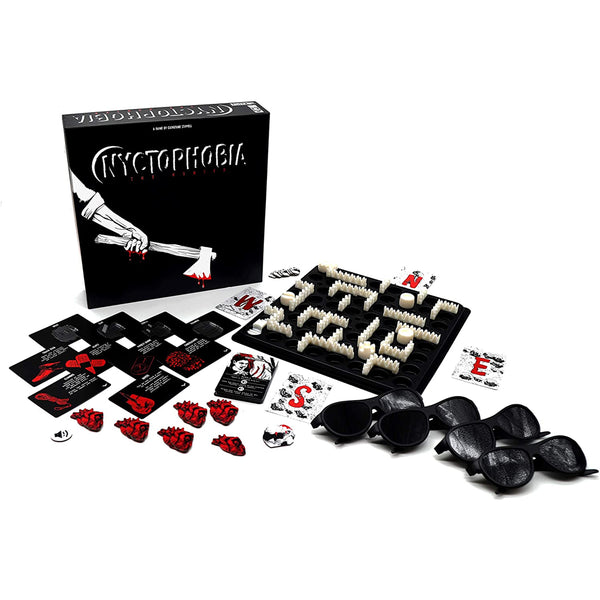
Check for the blackout glasses, maze board, trees, distinct player pieces, hunter decks, and tokens. In a used copy, missing physical parts can interfere directly with the tactile system. Ask for a contents photo, and check that the glasses work for the people who will wear them.
As an Amazon Associate, B3 earns from qualifying purchases. We have not verified a reliable exact Amazon listing for The Hunted, so the link below is a search. Compare the edition, condition, and price rather than assuming every result is the intended box.
Search Amazon for Nyctophobia: The Hunted →
B3’s take
Nyctophobia earns attention because its horror changes what players know and how they cooperate. A blocked path is more than a picture of a blocked path: it is a limit you discover through the act of playing.
Choose it if the group is excited by that restriction and someone wants to run the hunter fairly. Its unusual format is the reason to investigate it carefully, rather than a reason to assume everyone will enjoy it.
See our guide to different kinds of immersion, campaign-premise design ideas, or individual game finder.
References: Pandasaurus Games’ official introduction and edition comparison and its published The Hunted rulebook, available as a reference PDF. This is a rules-based gameplay guide.