Jump to Lightspeed Boba Fett Spotlight Deck Guide: Indirect Damage and Pilots
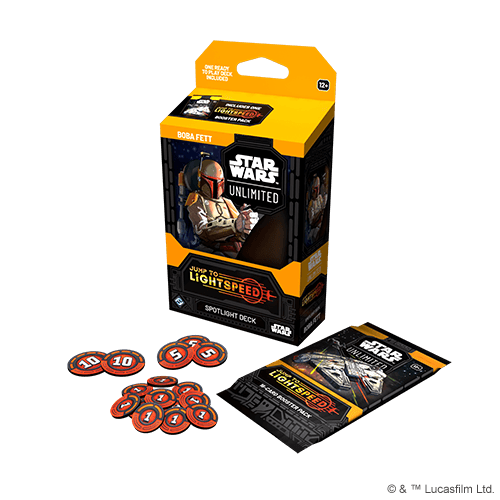
Boba Fett's Jump to Lightspeed deck applies pressure through damage that does not always arrive as a normal attack. The opponent has to distribute indirect damage, then face ordinary attacks and more targeted effects. Your job is to make those distribution choices increasingly uncomfortable instead of assuming the enemy will put the damage wherever you want.
I would choose this deck for someone who enjoys steady pressure and exact damage accounting. It is more interactive than a simple burn plan: enemy remaining HP, damaged-unit payoffs, pilot choices, and both arenas determine whether a point is meaningful.

Jump to a section
- Any Methods Necessary: this specific Boba
- Indirect damage: the opponent chooses, but within rules
- Start with an affordable damage engine
- No Disintegrations narrows choices; it does not select the victim
- Damaged-unit payoffs and the next attack
- Pilots: immediate value versus concentrated risk
- Choosing Boba's deployment form
- An action-order exercise
- What goes wrong and how to test fixes
- B3's verdict
- Official fixed 50-card main deck
- Buying the deck and choosing upgrades
- Learn the rules, then test the fixed deck
Any Methods Necessary: this specific Boba
Boba Fett — Any Methods Necessary is Jump to Lightspeed #009, Aggression/Villainy. When you deal non-combat damage, his leader ability can exhaust him to deal one indirect damage to a player. Exhausting him limits the ordinary frequency; it does not add another point to every damage event while he remains exhausted.
At six resources he can deploy as a normal 4-power, 7-HP ground leader unit or as a leader upgrade on an eligible friendly Vehicle without a Pilot. As an upgrade he contributes +4/+4 and deals up to four damage divided among units when deployed in that form. That targeted deployment damage differs from ordinary indirect damage because you make its distribution choices under its text.
The supplied base is Jabba's Palace. This is not the earlier Boba leader with a different resource engine. Check the subtitle and set number before importing advice or legality assumptions from another character-matched list.
Indirect damage: the opponent chooses, but within rules
The damaged player assigns indirect damage among their base and units. They cannot assign more to a unit than its remaining HP. The damage is unpreventable, so Shields do not simply erase it as they would an ordinary preventable damage event. Use the current rules for the Shield interaction rather than removing a token by habit.
Suppose an enemy has one unit with one remaining HP and another with four. A two-point indirect event cannot put both points onto the one-HP unit. That restriction limits how much a nearly defeated unit can absorb, but it still does not force the opponent to choose the target you prefer.
This is why wounded boards matter. As remaining HP decreases, the enemy's allocation options become tighter. Your attacks and direct damage should work toward that constraint instead of scattering damage with no plan to finish anything.
Start with an affordable damage engine
First Order Stormtrooper, Zygerrian Starhopper, and TIE Bomber are examples of early cards that fit the deck's non-combat-damage theme. An affordable source can make Boba's non-unit side relevant while also developing a body. A hand consisting only of large Vehicles and expensive answers cannot create that opening pressure.
Before keeping your six, pick two resources and identify the first play. Then check whether the hand offers a useful next-round action in the right arena. Ships are central, but the opponent may force an important ground fight before your preferred space plan is established.
Do not retain every direct-damage event merely because it can trigger the leader. Sometimes a body that produces repeated attacks is worth more than a one-use ping. Conversely, if an event removes the enemy's only useful attacker before it acts, its immediate value can justify delaying another unit.
No Disintegrations narrows choices; it does not select the victim
No Disintegrations can leave an eligible non-leader unit at one remaining HP. That makes subsequent damage dangerous and reduces how much indirect damage that unit can absorb. It does not state that the next indirect point must be assigned there.
Imagine the enemy would prefer to save that unit by putting the point on their base. Your line may still have gained value by pushing base damage, but it has not necessarily completed the removal you announced. If defeating the unit is essential, compare a targeted damage effect or a legal attack that guarantees the required result under the actual board conditions.
This distinction is a good test of the deck's strategy: are you happy with all sensible opposing choices, or does your whole plan depend on the opponent volunteering the worst one? Favor lines that produce pressure whichever reasonable allocation they make.
Damaged-unit payoffs and the next attack
IG-88 rewards having an enemy unit damaged, and the deck offers several ways to establish that condition. The power bonus is useful only if the resulting attack or defense changes a relevant exchange. Do not spend an entire action manufacturing a condition for a unit that cannot act before the enemy removes it.
Hunting Aggressor and Allegiant General Pryde are other reasons to evaluate your indirect events as parts of a network. The fixed list gives you samples of those roles at different copy counts. Learn which one your hand supports instead of assuming every game assembles the same board.
Fett's Firespray appears in two different printings in the inventory. The Jump to Lightspeed ship and the Spark of Rebellion version are not interchangeable entries with the same text. When discussing a combo, identify the actual printing you have drawn.
Pilots: immediate value versus concentrated risk
Bossk, Dengar, and other pilot-capable cards can serve as bodies or upgrades. A cheaper alternate play may improve an existing Vehicle, while a separate unit gives you another target and action source. Decide based on the next combat and the opponent's likely answer.
A large host with several invested cards can be powerful, but removing or disabling that one host can undo multiple resources of development. Check the ordinary Pilot restriction and the host's text. Do not assume a pilot leaves behind a separate ready ground body if the Vehicle disappears.
Bossk with Hound's Tooth is an example of a named package worth exploring, not a mandatory opening. If the pieces are not both available or the current target is unsuitable, an ordinary useful unit play may be better than waiting for the illustrated pairing.
Choosing Boba's deployment form
At six resources, the unit form offers an independent 4/7 body. The upgrade form adds stats to an eligible Vehicle and supplies up to four divided damage. Count whether that immediate damage removes threats, triggers useful effects, or merely wounds units the opponent can continue using.
For a simplified example, two unshielded enemy units each have two remaining HP. Four divided direct damage can potentially defeat both if they are legal targets and no other effects interfere. The same four points of indirect damage would leave the allocation to the opponent and could produce a different result. Do not use the two mechanics' names interchangeably.
If you lack a safe eligible Vehicle, deploying the ground body can be correct. Waiting for a perfect host leaves the leader's ready combat presence unused and may surrender the round. If a host is damaged or exposed to efficient removal, account for the extra cards and stats you place at risk by upgrading it.
An action-order exercise
You have a ready attacker, an affordable non-combat damage play, and Boba available to exhaust. One line uses the damage first to change the combat breakpoint, then attacks on a later action. Another banks an important attack before the enemy can remove the unit, then uses the damage afterward.
Count the opponent's response between those actions. If the attacker is vulnerable, delaying it may cost more than the extra damage gains. If the damage removes the only enemy that could threaten the attacker, leading with it may secure the whole sequence. There is no universal instruction to play events before attacks.
When Boba's extra indirect trigger becomes available, choose whether using the exhaust now is worthwhile. A later non-combat damage event might create a better allocation puzzle, but waiting risks ending the phase without using the leader at all. Evaluate the actual targets and remaining actions.
What goes wrong and how to test fixes
Damage spread across several healthy units can fail to remove any future attacks. Too many events can leave no lasting board. Too many large ships can strand the early hand. Diagnose which pattern is recurring rather than calling every loss a lack of expensive cards.
The deck already includes three copies of major pieces such as the early damage units, Hound's Tooth, Bossk, the JTL Firespray, Daring Raid, Force Choke, and No Disintegrations. Ordinary constructed play does not permit fourth copies as an upgrade shortcut.
If a damaged-unit payoff is consistently useful, test a third Hunting Aggressor while removing a card that repeatedly does not fit your turns. If you need a specific pilot interaction more often, test a third Dengar separately. Preserve enough early units and legal arena coverage for the added card to have a job.
B3's verdict
Boba is a good fit for a player who enjoys setting up a board where every enemy choice hurts. The most important discipline is recognizing who assigns each kind of damage. Learn to be satisfied with several reasonable outcomes, preserve bodies that can attack repeatedly, and use the pilot deployment's targeted burst when it produces a concrete swing rather than merely a larger ship.
Official fixed 50-card main deck
The leader and Jabba’s Palace base sit outside these 50 main-deck cards. Counts below follow the official product list; earlier printings and same-name cards can have different abilities. Use the linked original for printed card numbers and previous-set markers.
- 1 each: Allegiant General Pryde; IG-2000; IG-88; Boba Fett (unit, JTL 189); Fett’s Firespray (SOR 184); Electromagnetic Pulse; Grenade Strike.
- 2 each: Fifth Brother; Elite P-38 Starfighter; Dengar; Hunting Aggressor; Imperial Interceptor.
- 3 each: First Order Stormtrooper; First Legion Snowtrooper; Zygerrian Starhopper; TIE Bomber; Hound’s Tooth; Bossk; Fett’s Firespray (JTL 240); Daring Raid; No Good to Me Dead; Force Choke; No Disintegrations.
Inspect the official complete decklist image. The list includes both paired products; use the section headed Boba Fett.

Buying the deck and choosing upgrades
This is one player’s preconstructed deck, not a two-deck starter. An opponent needs their own playable deck. Check language, sealed condition, included accessories, and whether the listing is a single deck rather than a display or an individual leader card. Compare delivered prices; no live price or stock promise is made here.
As an Amazon Associate, B3 earns from qualifying purchases.
View the Jump to Lightspeed Boba Fett Spotlight Deck on Amazon.
Learn the rules, then test the fixed deck
For a quick visual introduction, B3’s How to Play guide includes an 8:45 beginner tutorial. It explains the core action rhythm; use the worked examples here for this exact leader and fixed deck.
Keep the stock deck together for the first games. Record one resource choice, one action-order decision, and one card that felt stranded. Change a few slots only after identifying a repeated problem. For the next purchase, compare complete decks, singles, and boosters in the buying guide.
Event play: check the current format, reprint eligibility, errata, and suspended list before bringing the stock deck to an event. These products mix printings from different sets; an old printing may remain legal through an eligible reprint, but a recent package is not itself a legality certificate. Proposed upgrades here are small experiments, not a verified competitive list.
Card and inventory checks: October 20, 2026. Sources: official Spotlight Deck overview, official first look and leader images, current rules, errata, and suspended cards, and the original decklist linked above. Future rule or format changes take precedence.
Return to B3’s Star Wars: Unlimited hub.
Scope: the official Jump to Lightspeed fixed Spotlight Deck, led by Boba Fett — Any Methods Necessary. This is rules-based analysis of the printed deck, with proposed practice and upgrade ideas; it does not claim B3 tournament results or hands-on testing.
Compare the paired deck: Jump to Lightspeed Han Solo Spotlight Deck Guide: Odd Costs and Pilot Deployment. Browse all twelve Spotlight Deck guides and the SWU learning guides.
Considering packs for upgrades? Read the Jump to Lightspeed booster buying guide before choosing a sealed product. For premium treatments, see Carbonite packs explained.