Archazia’s Island Guide: Dual Ink, Belle and Beast, Jafar and Iago
Affiliate disclosure: As an Amazon Associate, B3 earns from qualifying purchases.
Archazia’s Island is a useful Lorcana set to understand because dual-ink cards make the boundary of a deck visible. A powerful combination of abilities comes with a real restriction: the card belongs in a deck matching both of its ink types. It is not a flexible card that lets you choose either half when building the list.
I would inspect this older set for its dual-ink lessons, its pet-centered cast, or the Belle/Beast and Jafar/Iago starter plans. For a newcomer shopping today, I would compare the chosen older deck with a current two-player or single-player product before paying for its original release status.
Belle makes the discard pile a resource
Belle — Mechanic Extraordinaire costs nine normally and has Shift 7. Each item card in your discard reduces what you pay to use that Shift ability by one. The reduction is tied to Shift; merely having items in the discard does not reduce an ordinary nine-ink play by the same amount.
You also need a character named Belle to shift onto. With three qualifying items in the discard, a nominal seven-ink Shift can cost four, but the required target and ordinary restrictions still matter. Counting the discounted payment without counting the setup produces an imaginary bargain.
When she quests, Belle can put up to three item cards from the discard onto the bottom of your deck, gaining one lore per card moved. That creates a strong future quest, but also consumes cards that were supporting the discount. If another Belle is in hand, spending the entire item supply now can make a later Shift more expensive.
I would compare the immediate lore with the next turn you expect to need. If the quest and item conversion complete the win, save nothing for an irrelevant future. If the game will continue, choose how many items to move deliberately rather than assuming “up to three” always means three.
The Belle/Beast side therefore needs items that do useful work before reaching the discard. Spending several early turns on disposable infrastructure can still lose the race before a discounted Belle matters. Preserve affordable development and identify how the items actually reach the zone the ability uses.
Jafar recovers Illusions during the opponent’s turn
Jafar — Newly Crowned can return one of your banished Illusion characters to your hand during an opponent’s turn. The timing restriction is central. Deliberately losing an Illusion in one of your own challenges does not receive the same recovery from this ability.
Returning to hand also differs from returning to play. You may preserve the card, but you still need to pay to replay it, and it normally needs to wait before questing. An opponent who removes the same character repeatedly can tax your development even if you never permanently lose that card.
I would evaluate Iago and the other Illusions as temporary pieces that can contribute useful turns without assuming their recovery is free. Keep Jafar’s own survival in mind: the safety net depends on the relevant ability being present when the event matters.
The matchup rewards different removal judgments
Against Belle, identify the potential Shift target and the items in the discard, rather than judging readiness only by the opponent’s ordinary ink count. Against Jafar, distinguish between removing the recovery engine and trading into a piece that can return to hand.
Neither plan makes all ordinary damage or removal useless. A temporary answer can still buy the winning quest. The question is what the exchange accomplishes before the opponent rebuilds.
For practice, pause before a major removal play and describe the opponent’s likely next turn after it resolves. If the answer is “replay the same recovered character and continue,” compare another target. If the answer is “they cannot stop my next quest,” the temporary answer may be exactly what the race requires.
Card references: Belle card reference · Jafar card reference. Gallery illustrations may show a reprint or alternate treatment; the analysis concerns the named card’s abilities, not a promise of that treatment in the starter.
Dual ink: two identities, not a third-color loophole
A Ruby/Sapphire dual-ink card fits a Ruby/Sapphire deck. It does not let an Amber/Ruby deck borrow a little Sapphire while remaining a normal two-ink deck. Start with the deck’s ink pair, then identify which dual-ink cards belong inside that pair.
This is a useful sorting exercise after an opening. Put every dual-ink card beside its exact pair before assembling a deck. A pile containing several exciting pairings can look like a strong collection and still fail to form one legal constructed list.
Also read whether the particular card can become ink. Being dual-ink does not mean it contributes two ink or that its printed colors create a separate resource requirement when you pay its cost. Lorcana’s basic ink payment is different from games where different-colored resources are spent to satisfy colored symbols.
Belle and Beast: give the items a job
The Ruby/Sapphire starter features Belle — Mechanic Extraordinaire and Beast — Frustrated Designer. I would inspect it for a player who enjoys connecting items and characters into a developing plan. Its appealing puzzle is deciding which support pieces are worth the card and ink they consume.
A deck can have too much infrastructure. If you play multiple items before establishing a character that can contest the game, the opponent may build a lore lead while you prepare. A later engine needs enough time to repay that early investment.
My proposed practice test is to compare a setup-heavy opening hand with one containing an affordable character and fewer support pieces. Work through the first three turns against a hypothetical opponent who develops a character every turn. Decide when your engine begins producing a benefit and how much lore you conceded while waiting.
Jafar and Iago: understand the fragility of an Illusion
The Amethyst/Steel starter features Jafar — Newly Crowned and Iago — Giant Spectral Parrot. Its Illusion plan asks you to read Vanish and the surrounding recovery effects carefully. An apparently efficient character can carry a vulnerability that changes which opposing actions matter.
Vanish concerns being chosen by an opponent’s action. Do not enlarge that into “every action or ability makes it disappear.” The card and current rules define the event. A challenge, a character ability, and an action card are different things even when each is part of the opponent’s turn.

I would practice with three separate situations: an opposing action chooses the Illusion, an opposing character challenges it, and an ability affects it without the same choosing condition. State which rule actually applies. That method is more reliable than treating the word “illusion” as a general permission to improvise its fragility.
Recovery effects need equal care. Check when the card was banished, what full condition the recovery ability uses, and whether the returning card goes to hand or play. A card that can come back is not necessarily free to replay, and a rebuilt board may still have missed its chance to quest this turn.
The set’s collecting direction
The Aristocats, Bolt, and Lady and the Tramp give collectors clear projects. I would decide whether the project follows a film, a classification, or the numbered set. Those categories overlap but do not create identical checklists.
For a favorite-film collection, ordinary versions may accomplish the goal without every alternate treatment. For a full numbered binder, organize by collector number. For a playable pet-themed deck, sort by legal ink pair and role. Calling all three “collecting the pets” can hide very different purchases.
Compare the sealed products by their purpose
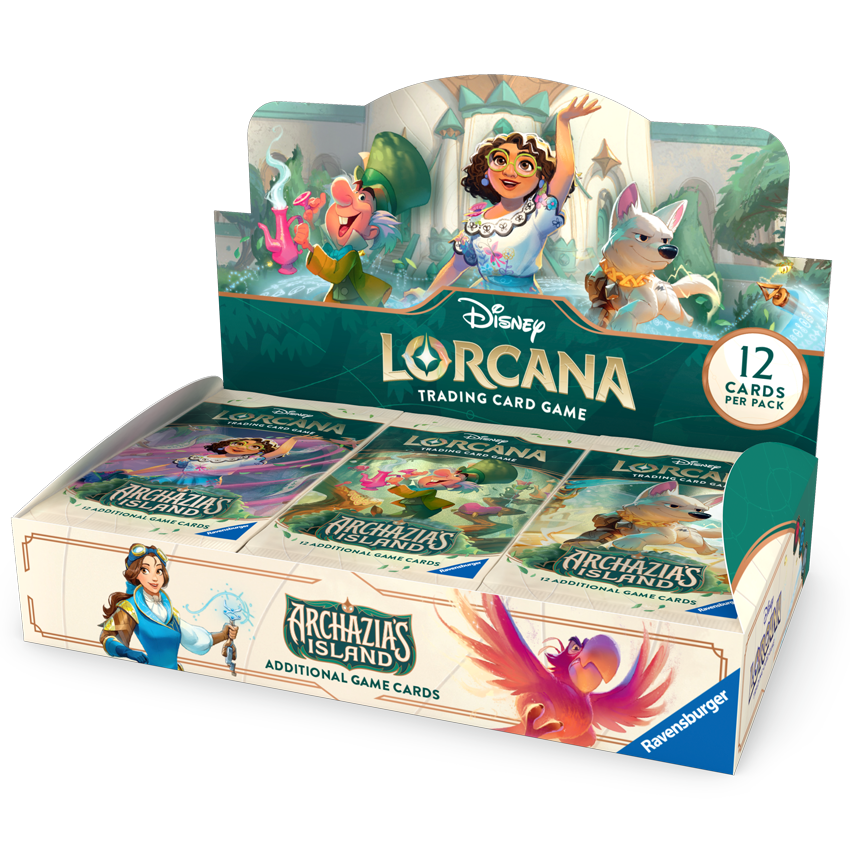
The booster display supplies random cards. The fixed decks supply selected lists. The Trove adds storage and tracking accessories to packs. The Lilo gift set is another named collection product that should be evaluated by its actual contents rather than assumed to contain a ready Lilo deck.
If you want to learn the dual-ink restriction, one intact starter gives you a clearer example than an arbitrary stack of boosters. If you want to build a specific dual-ink engine, exact singles let you choose both sides of the package. Packs remain a reasonable choice when exploring the collection is the point.
Read older listings for quantity and language. A “starter display” can mean a retail assortment containing several decks, whereas a single-player deck is one list for one player. Compare the actual selected offer before using the photograph to decide what you will receive.
Current formats and my recommendation
Archazia’s Island is outside the current Core set pool. Specific legal reprints can keep older physical copies usable by full identity. Check the current gallery and event rules before buying a stock older list for Core. Infinity and agreed casual play have other uses for these cards, subject to the appropriate restrictions.
I would choose Belle/Beast for the item-engine puzzle and Jafar/Iago for a more fragile, interactive plan. I would use the set’s boosters for a defined collecting project or discovery. Its lasting lesson is useful even in newer decks: a powerful card is only a good inclusion when it fits the deck’s restrictions and the turns you can realistically take.
Find the product
View Archazia's Island booster display on Amazon. Confirm the selected quantity, language, seller, and delivered price.
Continue with B3’s Lorcana guides
Browse all Lorcana guides · Learn to play · Compare your first purchase.
Sources and scope
Checked October 21, 2026: official Archazia's Island products and card previews, current rules and release notes, and the official rotation explanation. Product facts and printed mechanics are separated above from B3’s proposed buying and practice methods. Prices in worked examples are hypothetical; live prices, stock, event availability, and pull odds are not promised.