Ticket to Ride Guide: How to Play, Plan Routes, and Choose the Right Box
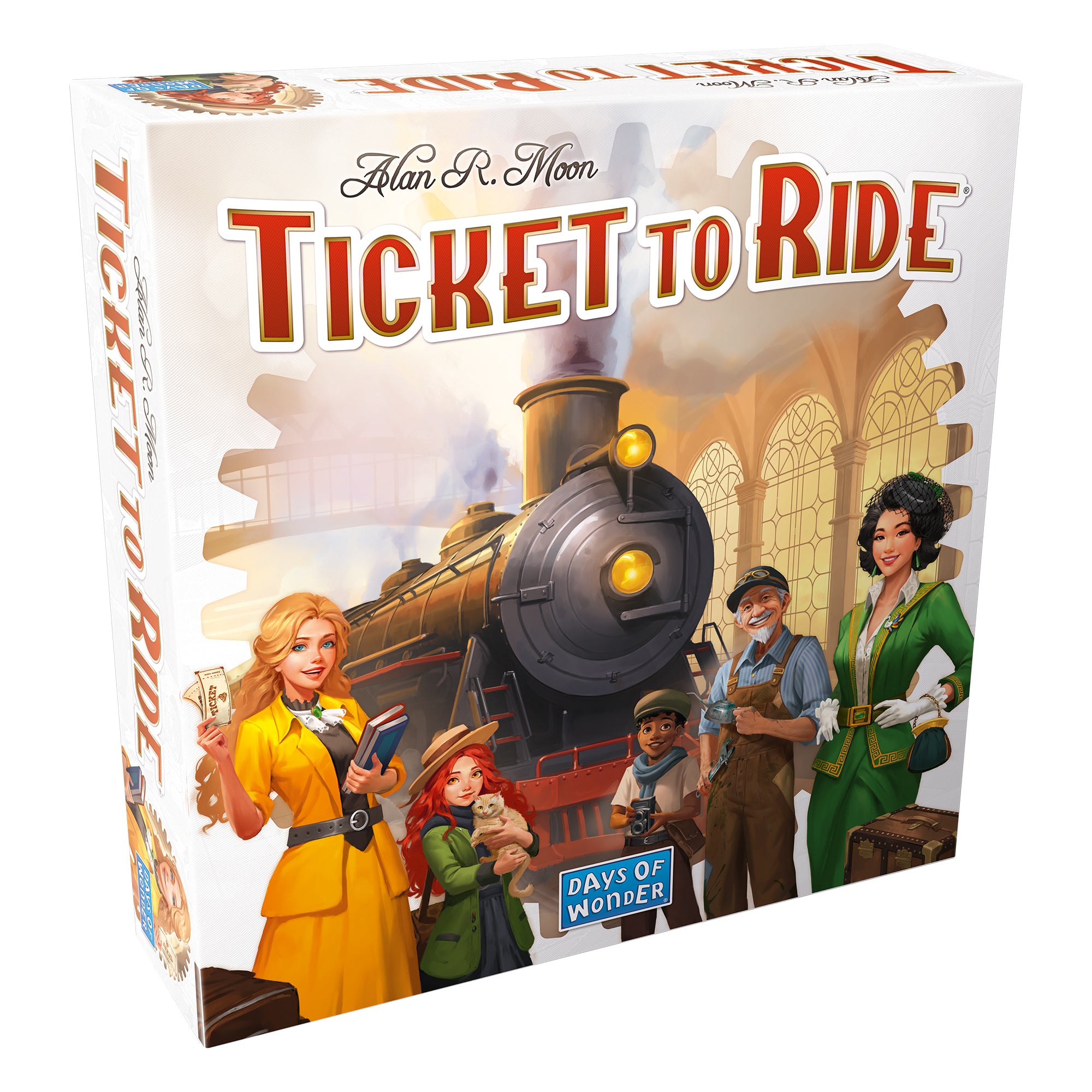
Ticket to Ride makes waiting feel like a decision. Drawing another useful card is easy to justify, until somebody takes the short connection your entire railway needed. The rules are approachable because each turn offers only a few actions. The tension comes from sharing a map with people whose destinations you cannot see.
This guide covers the North America base game and its 2025 Refresh rules, for two to five players. Older copies remain playable, but their setup is not identical: the refreshed game deals four starting tickets, while the older original dealt three. Use the booklet that matches your copy. This is an assessment of the design and rules, not a claim of firsthand play.
What the game asks you to build
Your plastic trains claim connections between adjacent cities. Your hidden tickets name pairs of cities you want to link through your own continuous railway. Several claimed connections can combine to complete one ticket, and the same network can support multiple tickets.
You score immediately for claimed routes, with longer routes offering more points. At the end, completed tickets add their printed values and incomplete tickets subtract them. The longest continuous path earns a ten-point bonus; tied players each receive it. The winner has the highest total, not necessarily the most tickets or the largest-looking patch of the map.
That scoring mix allows more than one sensible approach. A compact network with overlapping tickets can be efficient. A long route can be valuable even before it completes a ticket. What matters is the relationship between the points, cards, trains, and turns you invest.
Setup without the usual confusion
Each player starts with forty-five trains, a scoring marker, and four train cards. The shared market has five face-up train cards beside the draw pile. In the 2025 Refresh, each player draws four starting tickets and must keep at least two. Returned starting tickets go to the bottom of the ticket deck after being shuffled together.
Choose tickets as a connected plan rather than a collection of exciting numbers. Look for a shared corridor, a sensible branching point, and the colors you may need. Keeping more tickets is not free ambition: every retained ticket becomes a scoring obligation. Two that cooperate can be better than four that demand unrelated journeys.
One turn, one of three actions
Draw train cards. Normally take two, using the face-up display, blind draws, or one of each. Replace a face-up card immediately, so your second choice can use the newly revealed card. A face-up locomotive is different: taking it uses your entire draw action, and it must be your first selection. A locomotive drawn blindly counts as an ordinary draw, so it does not automatically end the action.
Claim one route. Pay a set matching the route's length and color, then place trains and score it. Locomotives substitute for colors. A gray route accepts a set of any one color, not a miscellaneous collection of leftovers. Claim the whole route in one turn; you cannot reserve it with a few trains and finish paying later.
Draw more tickets. Draw three, if available, and keep at least one. You cannot return an old ticket because your new cards look easier. This action can reward a well-positioned network, but it also spends a turn and creates another obligation.
A route is not the same thing as a ticket
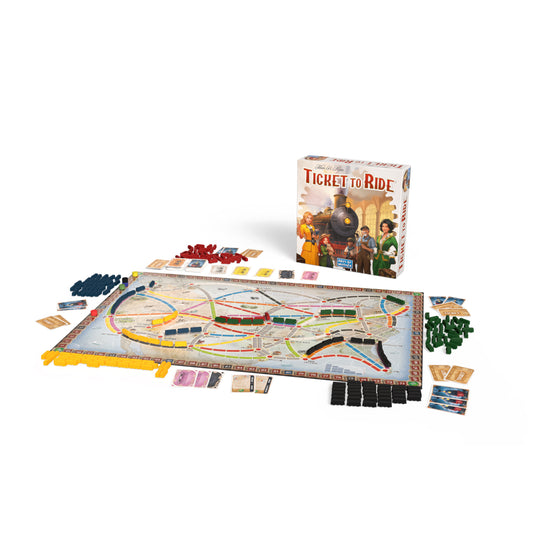
A route is the printed connection between two neighboring cities. A ticket may require a chain of several routes. Claiming one route earns its route points immediately; completing a ticket is checked through your network and scored at the end.
For example, a ticket between distant cities might be satisfied by a direct corridor or a longer detour. Both can work if every link belongs to you and the path is continuous. Another player's trains cannot fill a missing section. You may also claim a route that does not yet connect to your existing network, which can secure a bottleneck before building toward it.
Explain this distinction during the teach. Otherwise a beginner can spend several turns believing that a colorful line near the right city has completed a journey it does not actually connect.
Deciding when to stop collecting and start building
Train cards in hand preserve options; trains on the board secure space. Waiting can hide your intentions and let you choose among several plans. Waiting too long lets someone else choose your detour for you. The best time to build depends on how replaceable the connection is.
Identify your narrowest dependency early: a short single route, a crowded city entrance, or a connection that serves several plausible destinations. Compare that with a long section for which several alternatives exist. It is often sensible to secure the fragile part before completing the visually impressive part.
Do not spend every turn blocking. A block costs a claim action, cards, and trains, and may help a third player more than it helps you. It is strongest when the connection also improves your own network or denies something genuinely important. The threat of a block supplies tension without requiring every game to become a grudge match.
Reading opponents without knowing their tickets
You can see claimed routes and face-up card choices. Those clues suggest intentions but rarely prove a destination. A player collecting blue might need a specific connection, be preparing several possibilities, or simply be taking good available cards.
Watch consequences rather than inventing a complete secret plan. If a neighbor's railway approaches the only practical path you need, act on that visible risk. You do not have to solve every ticket in their hand to recognize that your plan is becoming vulnerable.
Likewise, avoid keeping an impossible ticket just to disguise your intentions. Hidden information is useful only when the plan it protects can still score.
Two players and five players feel different
At two or three players, only one side of a double route can be used. Once claimed, the parallel connection is closed for everyone. At four or five, both routes can be claimed by different players; one player still cannot take both.
Fewer players can give the map more room in some areas, but the double-route restriction keeps key connections contested. A fuller table adds more competing plans and more changes between your turns. Do not promise a universally gentle game just because the box is suitable for families.
The ending can arrive before your network looks finished
When someone ends a turn with two or fewer trains remaining, every player, including that person, receives one final turn. Watch remaining train supplies, not just the apparent size of the map. A player using long routes can accelerate the ending while you are still gathering cards.
Near the end, count actual turns needed. If you must draw cards and then make two separate claims, one last turn cannot rescue the plan. Drawing new tickets can be worthwhile when your railway already connects many cities, but it is a risk with a compulsory keep. It should not replace checking whether your existing obligations are finished.
Rules that are easy to misteach
- Gray does not mean mixed colors. Use one matching color set, supplemented by locomotives if needed.
- You cannot draw and claim on the same turn. They are separate actions.
- Face-up wilds have a special cost. A blind locomotive follows the normal blind-draw rule.
- Tickets do not have to use the shortest path. They need a continuous path of your trains.
- Longest path is not total network size. Branches do not all automatically count, and no plastic train may be counted twice in that path.
- Other editions have extra rules. Stations, tunnels, and ferries are not part of this basic North America explanation.
Which box should a new buyer choose?
The North America base game is complete on its own. The refreshed box has updated presentation and a changed starting-ticket setup, so use current instructions when teaching it. An older complete copy can still be a sound choice; do not assume it needs replacing merely because the artwork changed.
Ticket to Ride: Europe is a different standalone map with additional rules. First Journey is designed as a simpler children's entry point. City games such as New York offer a shorter format. USA 1910 adds cards and variants to the appropriate base game, while Map Collection products have specific component requirements. Read the product description before treating every cheaper Ticket to Ride box as interchangeable.
For a used game, confirm train counts, the board, train cards, tickets, and scoring pieces. Check language and whether expansion cards have been mixed into the base deck. A tidy starting set is more valuable to a new group than a confusing assortment of extras.
Buying and learning links
As an Amazon Associate, B3 earns from qualifying purchases. Check the selected edition, language, and seller before buying.
Ticket to Ride North America base game, 2025 Refresh, on Amazon
The official Days of Wonder page provides current and older rules. For a first session, teach one sample card draw and one sample claim, show how a multi-route ticket completes, and explain the final-round trigger before beginning.
See our guide to choosing a game people will learn, our first-game gift recommendations, and individual game finder.