Tainted Grail Fall of Avalon Guide: Exploration, Survival, and Version 2.0
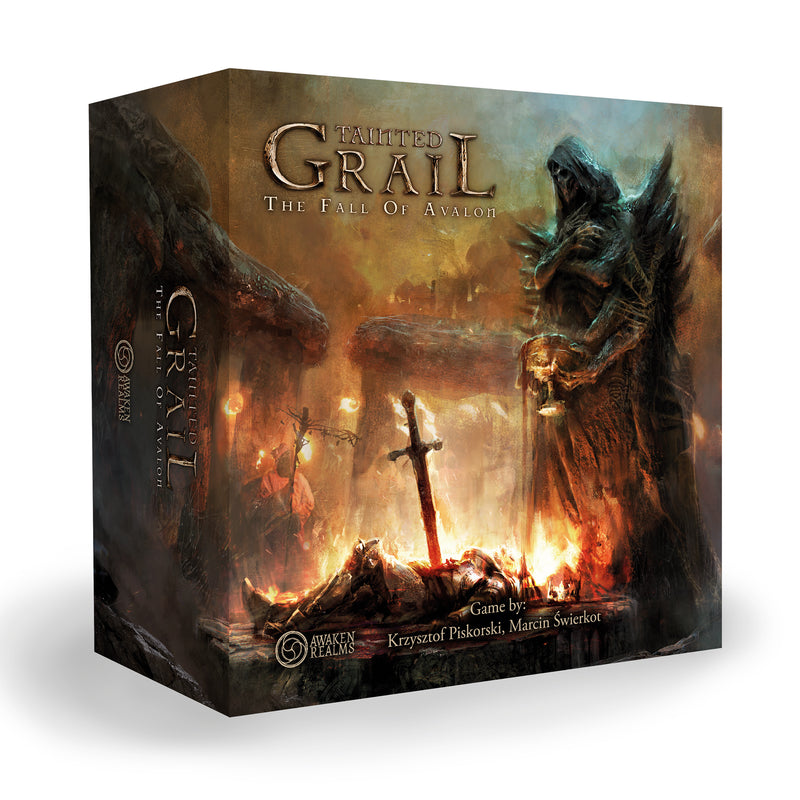
In Tainted Grail, reaching an interesting place is only half a plan. You also need the energy to travel, the resources to keep a route open, and enough resilience to handle what you find. The landscape is not a menu of stories waiting patiently for you. It is a place you are struggling to keep accessible.
The Fall of Avalon blends Arthurian and Celtic inspiration with a bleak survival campaign for one to four players. This guide uses the 2.0 rules and keeps campaign revelations out of the explanation. It is a rules-informed assessment, rather than a claim of firsthand campaign experience.
What you actually do in a session
You control unlikely survivors following the trail of a failed expedition. Location cards form the visible map. Traveling moves you between connected locations, exploration sends you into numbered journal passages, and local actions help you gather resources or interact with the place. Events advance the situation over successive days.
An evening might begin with a clear destination, then become a question of whether to pursue a nearby lead before the route becomes harder to maintain. A journal passage can grant a status, change a location, provide a secret, or open another line of inquiry. The campaign remembers more than the prose you personally remember, so accurate records are part of play.
The central choice is not simply “left or right.” It is whether a detour is worth its travel cost, what the party knows about the destination, and what it will give up by spending another day. That is where the game creates its particular kind of exploration.
Menhirs make the map a logistical problem
Guardian Menhirs hold back the wyrdness and support the accessible world around them. They have limited duration. Activating another one requires resources and sometimes additional conditions. You cannot treat the revealed map as permanently safe territory and wander indefinitely without considering that support.
Before committing to a journey, check which locations remain supported, how long the relevant Menhirs will last, and what another activation would cost. Those costs scale with the total player count, not merely the characters standing together at the statue. Sending one well-supplied scout does not automatically turn a four-character campaign's activation into a solo price.
For example, suppose a promising location is two moves away and the local Menhir is nearing the end of its duration. Reaching the story may be possible today, but returning and preparing the next activation may not be. Gathering first looks less exciting than exploration, yet it can be the action that makes the expedition viable. This is a planning example, not a description of a specific quest.
Energy, health, and terror are connected
Energy pays for many actions and travel. Health is not merely a countdown to defeat: its limiter also constrains other tracks. Terror can create further trouble when it exceeds what the character can bear. Damage and fear therefore change the practical size of your next plan, not just your willingness to risk a future encounter.
The day structure matters because recovery, events, and countdowns happen at defined times. Use the Order of the Day reference rather than jumping directly from one dramatic passage to another. Skipping a quiet upkeep step can make a campaign easier or harder in ways that are difficult to untangle later.
Version matters here. The 2.0 standard rules changed resting: eating food at day's end is no longer mandatory, and declining food does not automatically exhaust your character as it did under the older default procedure. Food can still provide useful recovery. Do not combine an original-rulebook memory, a 2.0 reference card, and an online explanation of Challenge Mode into one accidental ruleset.
Exploration is authored, but your information is incomplete

The Exploration Journal supplies branching situations. Character attributes, statuses, earlier choices, and discovered information can affect what options are available. Read the entry you are directed to and obey its instructions; reading ahead to judge which result is most rewarding weakens the uncertainty the campaign is built around.
A useful journal has three kinds of notes: confirmed facts, open leads, and your own interpretation. “We were told this” is different from “this is true.” Separating them preserves the pleasure of discovery without requiring everyone to memorize a long campaign.
Prepared branching fiction still has boundaries. You cannot expect the game to respond to every clever proposal a human game master might entertain. Approach the available choices as the game's vocabulary. Its strength is the accumulation of consequences inside that structure, not unlimited improvisation.
Combat is a card sequence, not just an attack roll
Encounters use a separate procedure. In combat you play cards into a sequence, connecting keys where the rules permit and resolving their effects. Your attributes help determine which connections are usable. Cards can provide immediate benefits, alter the exchange, and interact with other cards in the sequence; the enemy responds according to its own instructions.
The important habit is to look beyond the first legal card. A useful opening should leave a workable continuation. A spectacular effect that closes off the rest of your hand may be worse than a modest card that supports the sequence you actually need. Read timing carefully, particularly effects that persist or wait for another part of the encounter.
Escaping is an option with costs and consequences, not a universal reset. Before entering an avoidable fight, consider what success would accomplish, what the party can afford to lose, and whether the next destination is still reachable afterward. A combat victory can be strategically expensive.
Diplomacy uses a related system with different goals
Social encounters also use cards and connections, but should not be treated as ordinary combat with names changed. The encounter's stages and rules tell you which kinds of progress matter. An effect useful in one exchange may be irrelevant in another, so read the current requirement instead of assuming your usual sequence is correct.
Developing separate combat and diplomacy decks gives character progression two practical faces. Raising an attribute or acquiring a new card matters because it changes the connections and responses you can produce. When choosing an improvement, ask which recurring problem it solves, rather than buying whichever card looks strongest in isolation.
Solo, two players, or a larger party?
Solo play makes the exploration decisions coherent: one person owns the pace and the notes. Controlling additional characters increases the tools available but also the hands, resources, and encounter choices to manage. More characters should be a deliberate choice, not an assumption that a lone character cannot be a valid starting point.
With several players, agree how you will share reading and strategic decisions. The suggested Chronicler role can keep the campaign organized, but should not turn one person into the sole author of everyone's choices. Characters can act separately when rules allow; that freedom also creates more information to communicate and more reasons for someone to wait.
A regular smaller group is often a better practical fit than the largest supported table with inconsistent attendance. Narrative continuity is a resource too. A brief recap before each session can save considerable confusion without revealing information a character has not learned.
Choose a mode before frustration chooses for you
The 2.0 rules offer Story, Standard, and Challenge approaches. Story Mode supplies optional adjustments aimed at reducing pressure, including encounter setup, the health limiter, and Menhir costs. Challenge options add demands. Read the exact modifiers and agree which ones apply rather than relying on a vague promise to “play easier.”
Using a supported mode is a sensible way to match the game to the reason you bought it. If everyone is there primarily to uncover the world, reducing friction can preserve the experience. If maintaining a precarious expedition is the attraction, removing all pressure may remove the decisions you wanted. Review the fit after a session, not midway through a bad outcome just to reverse it.
Buying the right version and checking a used copy
You need The Fall of Avalon core game for this campaign. Kings of Ruin is a different standalone Tainted Grail adventure. It is not an expansion required to complete this one. Expansion campaigns, miniature sets, update materials, and the digital game are different products.
Ask a seller to confirm whether a Fall of Avalon copy is the original or 2.0 version. Awaken Realms provides an official identification guide, including the marking on the back of the box. Do not assume a store's old product photograph establishes which version it currently ships. Original owners should consult the official update materials rather than assuming a rulebook download alone changes every relevant card and journal entry.
For a used copy, check cards, location decks, trays, dials, the Exploration Journal, and recorded campaign state. Language is particularly important in a text-heavy game. A bundle with many miniatures is not necessarily the most useful edition or the most complete starting box.
Who should choose it?
Choose it for dark discovery, meaningful uncertainty, and a campaign whose survival systems reinforce an inhospitable setting. Pass if you need brisk scenes, little administration, or a light fantasy evening. Its mature tone also deserves an actual conversation with the group, rather than a promise that an Arthurian theme means familiar heroic comfort.
The decisive question is whether preparing to reach a story feels like part of that story. If it does, the Menhirs, dwindling energy, and awkward encounters can give the next location real weight. If it does not, there are easier ways to enjoy an excellent setting than repeatedly negotiating with a system you resent.
Buying links and official resources
As an Amazon Associate, B3 earns from qualifying purchases. The Amazon link is a search; a matching English-language 2.0 base-game listing has not been verified.
Search Amazon for The Fall of Avalon core game
Consult Awaken Realms' official downloads for Fall of Avalon rules, references, and update files, and the official version-identification instructions before choosing a copy.
See where it fits among fantasy adventures and games that feel like a novel, or compare our individual game guides.