Mice & Mystics Guide: How the Adventure Plays and Who It Suits
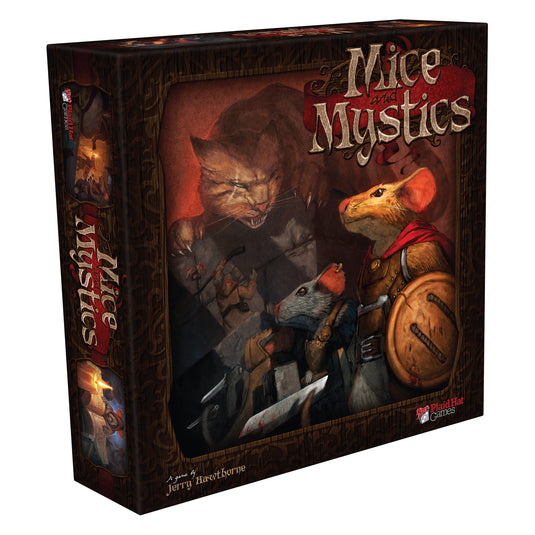
A kitchen is a more interesting dungeon when a cockroach is a serious opponent and the cat is a looming disaster. Mice & Mystics: Sorrow and Remembrance uses that change of scale to give a familiar fantasy adventure a different texture. Its heroes are people transformed into mice, trying to save their kingdom while navigating a castle that has become enormous.
The appeal goes beyond the premise. A chapter gives the party a purpose, then movement, combat, searching, and a tightening clock turn that purpose into a sequence of shared problems. The important qualification is that this is a tactical adventure with a storybook, and it asks more of its players than its charming cover might suggest.
1–4 players · Official game-page guidance: ages 10+ · 60–90 minutes
Cooperative chapter-based fantasy adventure · Dice-driven combat and exploration
Start with: Sorrow and Remembrance, the complete core game.
Best fit: readers and families who want a continuing adventure and are willing to learn its tactical rules.
The storybook gives each session a job
The included Sorrow and Remembrance book supplies the story, chapter setup, objectives, and special rules. You choose a chapter and build its rooms using the illustrated tiles. These are room-sized spaces with terrain and features; you do not simply place miniatures on the pages of the storybook.
Start at chapter one and work forward if you want the intended introduction. One person should review the chapter before the session, particularly its room rules and unusual encounters. That preparation prevents the group from stopping at every doorway to discover how the current scenario works.
The campaign follows an authored story. Your choices matter through the challenges you solve and the resources you preserve, but this is not a blank world where every improvised plan can be adjudicated by a game master. Choose it because you like following characters through an adventure, rather than because you want unlimited narrative freedom.
What happens on a mouse’s turn
Initiative cards establish an order for the mice and minions. On a mouse’s turn, you can move and take one action, in either order. The action menu includes scurry, battle, search, recover, and explore. Other permitted actions, such as sharing or equipping, follow their own restrictions.
Movement uses the mouse’s move value plus the number on an action die. This makes your destination a planning question rather than a guarantee. A turn that leaves you exposed can become expensive if you assumed the best possible movement roll.
Each choice serves a different need. Battling removes a threat, scurrying extends movement, searching offers resources, recovering handles certain conditions, and exploring moves the group between rooms or relevant tile sides. Before you choose, ask what the chapter needs next. Improving one mouse is less useful if the party runs out of time reaching the objective.
The dice create two economies: wounds and cheese
Battle uses the appropriate symbols on the action dice, with attack and defense values determining how many dice are rolled. Weapons, abilities, minion types, and positioning change what a good attack looks like. Read the card text carefully rather than assuming every weapon works against every target in the same way.
Cheese is not just a cute resource name. Mice gather it to fuel abilities and can spend it to develop their options. That creates a useful tension: a powerful ability now can keep the group safe, while saving resources may improve what the mouse can do later.
Minions also generate cheese. Their cheese goes onto a shared wheel; filling it triggers a surge and advances the chapter’s time pressure. The same dice system that produces a narrow escape can also bring the next wave closer. That is why a safe-looking fight can still cost more than health.
Why searching is not free time
Searching can uncover equipment, useful items, and events. It is tempting to turn every quiet room into a shopping stop. The game resists that habit: when no minions remain, the rules add cheese to the minion wheel at the appropriate point in the round, moving you toward another surge.
The practical question is whether another search improves the party’s chance of completing this chapter enough to justify the delay. A specific missing tool or badly equipped hero can make the search worthwhile. Looking for one more attractive card without a plan is a different proposition.
Use special room searches when the chapter directs you to them, and distinguish their instructions from an ordinary search. A story objective may depend on a particular interaction rather than on drawing enough random cards.
What makes the castle feel large
The strongest thematic idea is that everyday objects become terrain, threats, and tools at mouse scale. A room does not need to be a new fantasy continent to offer a different kind of problem. The illustrated boards, party items, and character abilities help familiar domestic spaces become an adventure landscape.
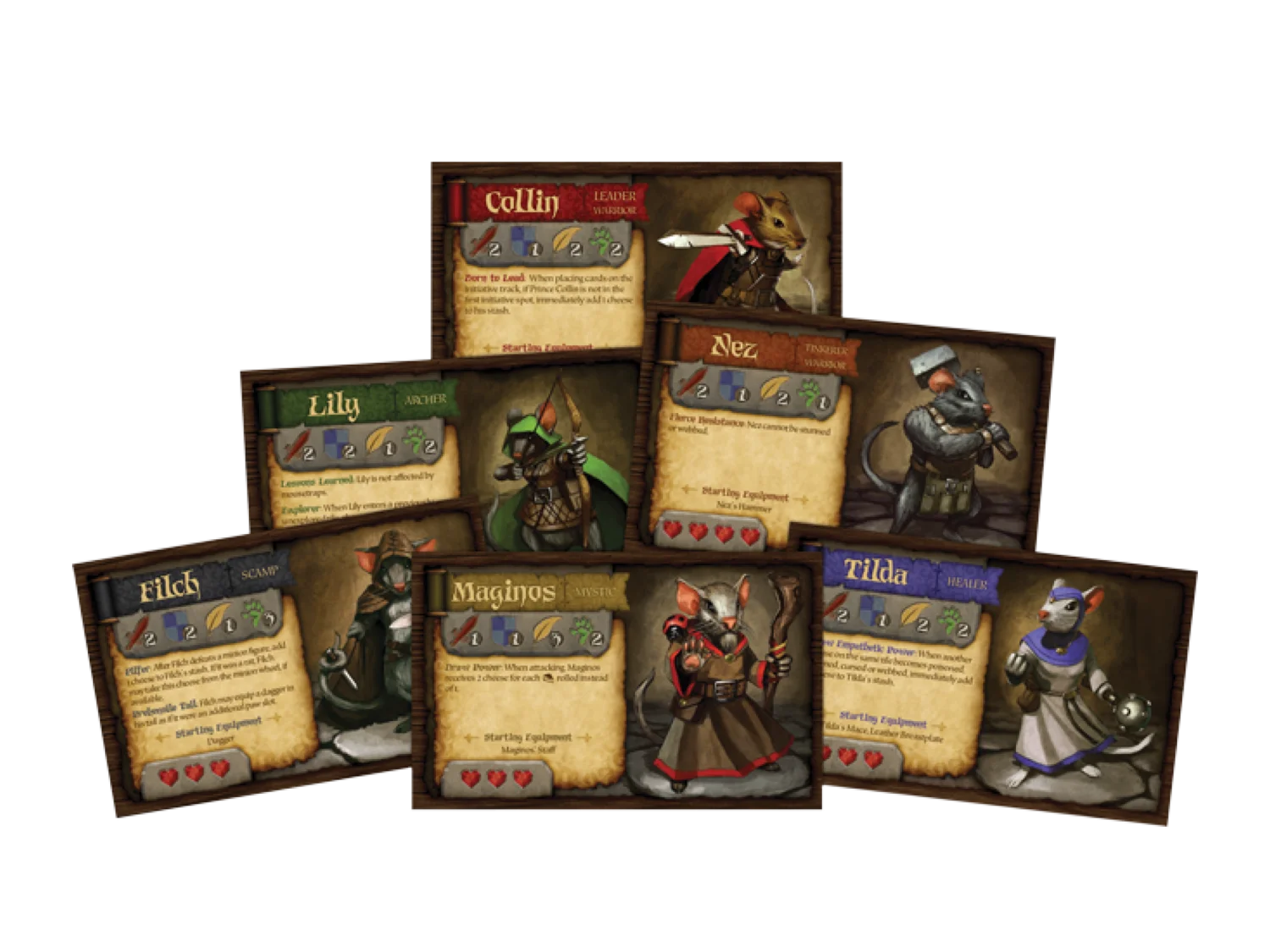
Characters also create different jobs within the party. Collin’s leadership, Nez’s strength, Maginos’s magic, and Tilda’s support make the choice of a mouse more meaningful than choosing a color. Read the actual abilities together and decide who is going to protect, attack, and handle the next task. There is no need to turn that into one player commanding everyone else.
How the chapter clock changes your tactics
The story control board tracks progress toward the chapter’s ending. If the hourglass reaches the designated end before the victory conditions are met, the mice lose. Captures and surges can make that deadline arrive sooner.
Focus the group on the win condition. A fight is sometimes a problem to solve quickly; sometimes it is a reason to reposition or make better use of an ability. Clearing the board is not automatically the objective, and collecting everything is not automatically a sensible strategy.
Expect failed chapters to be possible. The dice can produce painful outcomes, and learning room-specific rules takes attention. If your group finds repeating an adventure intolerable, that matters more than whether it loves the fiction.
Campaign progress without a legacy reset problem
The campaign rules let mice retain story achievements and earned abilities. Each mouse can also keep one search card from the previous chapter in addition to starting equipment. Cheese, party items, and individual achievements do not simply carry forward as an unlimited stockpile.
This is continuity with limits: you remember what the mice learned without taking every item from the castle into the next scenario. Record the persistent information clearly. Unlike a destructive legacy system, the core rules do not ask you to permanently alter the game to follow the story.
Check chapter instructions whenever they override the general rules. The storybook is part of the system, not optional flavor.
Is it right for families, solo play, or two players?
For families: it can support reading aloud, teamwork, and a recurring adventure. An adult should learn the rules first. Official and retail age labels vary, so judge the actual demands: reading ability, patience with a longer session, remembering card effects, and coping with bad rolls.
For one or two players: supported player count does not mean each person always manages just one mouse. Chapters commonly use a party of four, so a smaller group shares responsibility for additional heroes. Solo play is therefore a multi-character cooperative puzzle rather than a single-hero quest.
For adults: the mouse premise does not make the tactical decisions irrelevant. It is most attractive if you want the characters and story enough to accept rules exceptions and dice uncertainty. A group that mainly wants a tightly controlled optimization contest may find that uncertainty frustrating.
A useful first-session checklist
- Read the core rules and the first chapter before gathering the group.
- Prepare the required mice, starting equipment, room tiles, and chapter objective.
- Demonstrate movement, one attack, cheese collection, and a minion turn.
- Explain how the cheese wheel and hourglass can cause a loss.
- Let each player choose their own action, offering advice when requested.
- At the end, record only the progress that the campaign rules allow you to retain.
Leave enough time for setup and reading in addition to the stated play time. If people can only offer a short, distracted window, save the first chapter for a better evening.
Buying the right Mice & Mystics box
Sorrow and Remembrance is the core game covered here. Heart of Glorm and Downwood Tales continue or expand the adventure and require the base game. Check that a listing includes the core rules, storybook, room tiles, mice, minions, cards, and custom dice rather than selling an expansion or replacement figures.
The book and special dice are especially important in a used copy. A box of miniatures is not a playable copy of the adventure.
As an Amazon Associate, B3 earns from qualifying purchases. Confirm language, condition, seller, and contents before ordering.
Check Mice & Mystics core game on Amazon →
B3’s take
Mice & Mystics is a good candidate when you want a story that gives the tactical session a reason to matter. Its best idea is making an ordinary castle feel enormous through the mice’s capabilities and vulnerabilities. The adventure earns its character from that scale, not just from reading a paragraph between fights.
Make room for the rules, the dice, and the chapter clock. If your group enjoys a shared story but needs every evening to end in an effortless success, the charming box is making a promise the game itself does not make.
Explore our board games that feel like a novel, narrative game-night guide, or individual game finder.
Rules and product reference: Z-Man Games’ official page and English rulebook. Gameplay analysis is based on those rules; no firsthand campaign completion is implied.