Just One Guide: Rules, Better Clues, and Family Game Night Fit

Just One gives a cooperative word game an excellent complication: the most obvious helpful clue may be exactly the clue everyone else writes. If several people choose it, every copy disappears. You want to be understandable without being predictable, while remembering that the person who matters is the guesser, not the friend you hope will admire your reference.
This guide explains the current English rules, including the 2025 Refresh's three- and four-player variant. It is a rules-informed assessment and practical hosting guide, without invented firsthand play claims.
The entire loop, before the details
One player cannot see the target word. Everyone else secretly writes a valid one-word clue. The clue writers compare their answers while the guesser looks away, cancel matching or invalid clues, and reveal what survives. The guesser makes one guess or passes. Then the active role moves to the left.
You begin with thirteen random cards. Correct answers create your team's score; passes and errors consume cards differently. A completed game therefore does not guarantee thirteen separate guessing turns. The deck is a shared opportunity budget, and a wrong guess can use an additional opportunity.
Set up and run the first round
Give everyone an easel and an erasable pencil, and prepare the thirteen-card deck. The active player takes the top card without looking at its face, places it so the others can read it, and chooses a number from one to five. That number identifies the target word. If clue writers do not know the word, the rules allow them to ask for a different number.
Clue writers choose independently. Do not announce categories, negotiate who will use the obvious clue, or signal that someone should change theirs. The lack of coordination is the point of the challenge. Once all clues are written, the guesser closes their eyes while the others compare them and hide canceled easels.
Teach one practice example before using the scored deck. Show both a canceled pair and a surviving clue, then explain what a wrong answer costs. People can understand the system immediately without being surprised by a penalty they were never told about.
A worked example of why the mechanism matters
Suppose the target is castle. Two people write moat, one writes fortress, and another writes turret. Both copies of moat disappear. The guesser sees only fortress and turret. Those clues may be enough, but the group has lost a useful connection through duplication.
Now imagine everyone tries so hard to be different that each chooses an obscure private reference. More clues survive, but they no longer work together. Originality is useful only when the surviving information still points toward the answer. The sweet spot is a second clear association, not the most distant association anyone can invent.
This is an illustrative example, not a guarantee that those exact words appear in every printing's deck.
What counts as a duplicate?
Do not keep one copy of a matching clue: cancel all of them. Three matching clues all disappear. Matching also includes singular and plural versions, words from the same family, and spelling variants caused by mistakes. Changing a letter or adding an ending does not protect an otherwise duplicate clue.
Meaning alone does not make two different words identical. Two distinct clues can point toward a similar association without automatically canceling. Follow the printed categories rather than deciding that anything “basically the same idea” must go. Overly broad cancellation turns a readable word game into a debate about how far language can be stretched.
Valid clues and common rules disputes
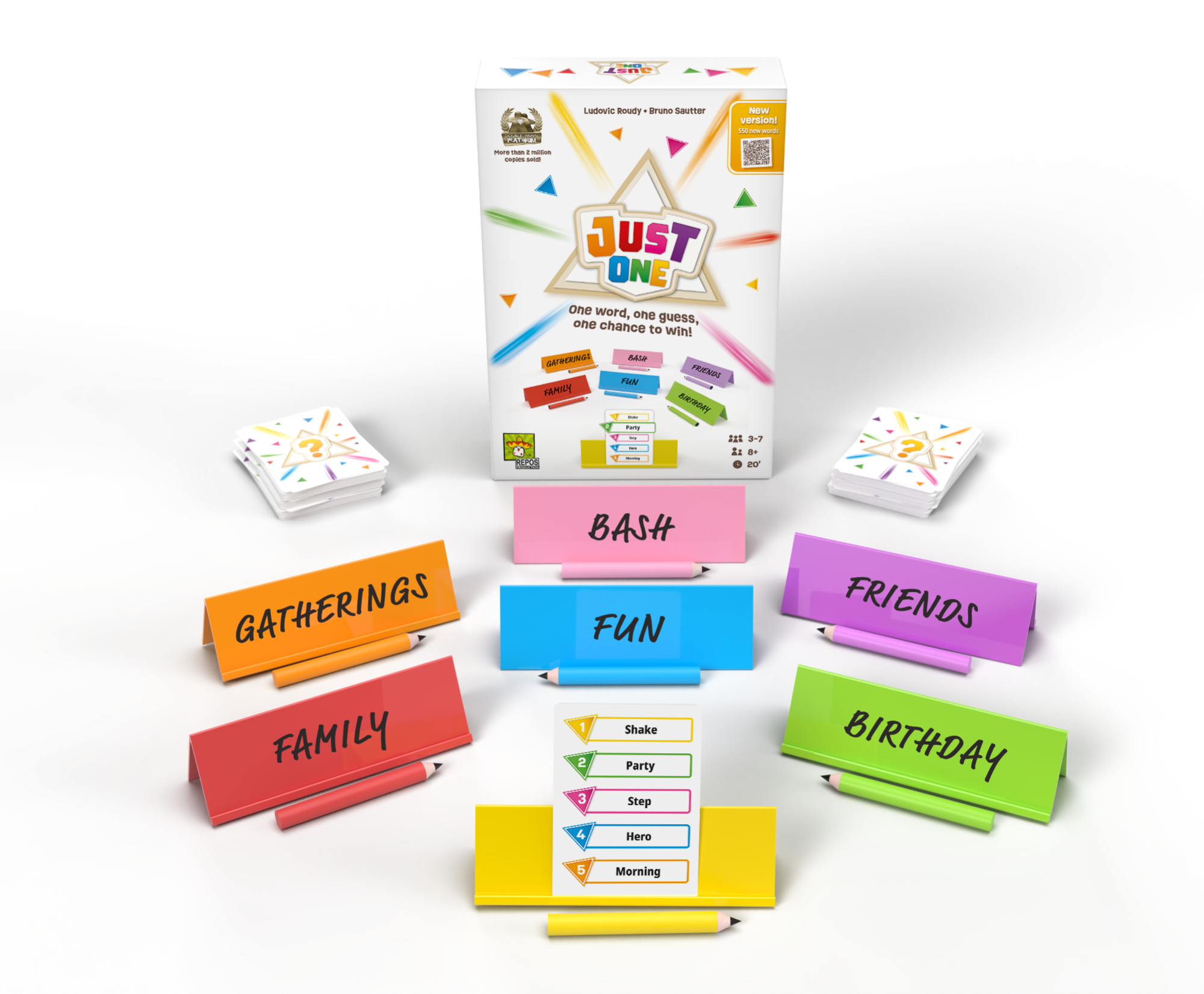
A clue must be no more than a single word under the rules' definitions. Accepted forms include compound words, proper names, numbers, acronyms, onomatopoeia, and special characters. A proper name that conventionally contains a space is not automatically forbidden: the rulebook explicitly gives examples such as Red Bull. Do not replace the actual rule with a rigid character-count test.
You cannot use the target translated into another language, a word from the target's family, an invented word, or a homophone of the target. Those restrictions stop a clue from simply disguising the answer. A clue that nobody understands may be unhelpful, but that alone does not make it invalid.
Resolve uncertainty among the clue writers before the guesser looks. Keep the discussion quiet enough that it does not leak the target or a canceled clue. If the group wants a looser house rule, agree before the game and recognize that the resulting score is not directly comparable to a standard-rules attempt.
One guess, a pass, and the real cost of an error
A correct guess wins the current card. A pass loses that card only. A wrong answer loses the current card and the next card from the deck. If no card remains to pay that extra cost, remove a previously won card if possible. When all clues cancel, put the target card away and move to the next round without a guess.
This creates a useful difference between having a plausible answer and having enough evidence. When several words fit equally well, passing can protect the team's remaining opportunities. At the same time, nobody should be pressured to perform a mathematical confidence calculation at a casual gathering. Explain the choice, allow a decision, and move on.
Clue writers should resist helping during deliberation. Facial reactions, emphasis, and sudden laughter can reveal whether a proposed answer is close. The surviving written clues are the information the guesser is meant to use.
How to write a better clue
- Think of the guesser. A familiar association for them is more useful than a clever reference only you know.
- Notice your first answer, then consider the next clear one. The first is a plausible collision risk; the second should still be easy to connect.
- Keep a useful category or feature in view. A clue can point to function, place, material, or a recognizable name rather than merely a synonym.
- Do not overcorrect after one cancellation. An obvious clue can be exactly what the next round needs if nobody else chooses it.
- Discuss after the reveal. Learning why an association failed helps future rounds without defeating independent clue writing.
Three or four players need the right variant
The game supports three to seven. In the current three- and four-player variant, every clue writer takes two easels and writes a different clue on each. The active player needs only the easel holding the card. Other rules still apply, including cancellation and the different costs of passing and guessing incorrectly.
That provides more information at a small table, but it also gives each writer more chances to collide. Do not confuse “two clues” with permission to write a two-word sentence on one easel. Each clue must independently be valid. Older printings may describe a different small-group variant, so check the rules included with your copy.
Family fit, language, and keeping the mood right
The box recommends ages eight and up, but reading comfort and shared language matter more than a birthday. A multilingual group can have very different associations even when everyone understands the target. That can be entertaining if the table is curious and patient; it can be tiring if people repeatedly have to defend unfamiliar references.
For family play, explain an unknown word before using a different number as the rules allow. Do not pretend that a deck of everyday words guarantees equal cultural knowledge. Keep score as a shared result and avoid treating the guesser as the person responsible for a failed round. Clue quality, cancellations, and interpretation all belong to the same team.
A casual session can also stop after a practice round if the group is not enjoying the activity. Being easy to teach does not make a word game universally appealing. Players who prefer spatial planning or direct competition may want a different fallback.
Which version should you buy?
The 2025 Refresh advertises 550 new words and includes a complete playable set. The older edition is also a complete game; existing owners do not need to replace it to keep enjoying the core mechanism. Confirm the language because the cards themselves are the main content. A foreign-language bargain or a small promo pack is not an equivalent starting purchase.
Check that a used copy has enough working writing tools and easels as well as its cards. Worn or dried-out supplies can be a more immediate problem than cosmetic box wear. Use suitable erasable replacements and test them before guests arrive.
Buying and official rules
As an Amazon Associate, B3 earns from qualifying purchases. Confirm the selected language, edition, and seller before buying.
Just One, 2025 Refresh, on Amazon
The official Repos Production page provides current rules and component information. Use its English rules for the refreshed version described here.
For more help choosing, read our guide to games people will learn and first-game gift recommendations, or browse individual game guides by category.