Azul Guide: How to Play, Score, and Choose Your Tiles
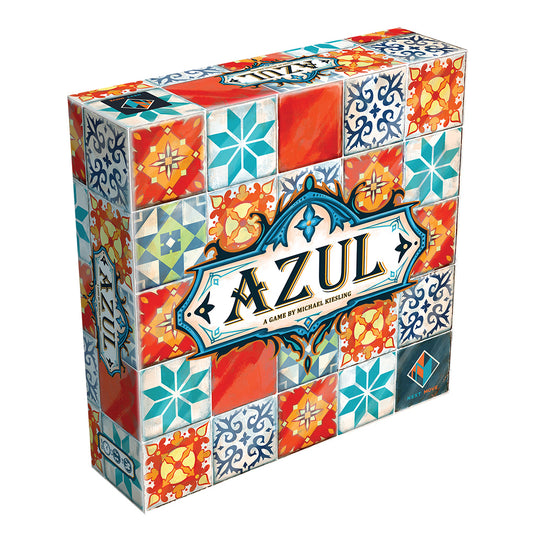
Azul looks like a peaceful exercise in making a wall beautiful. Its more interesting quality is how quickly a useful group of tiles can become a problem. You are choosing from a shared supply, and every choice changes what the next player can take.
My recommendation: original Azul is a strong option for people who want a small set of actions with decisions that remain interesting. I would be more careful recommending it to someone who wants a purely private puzzle. The interaction is quiet, but watching an opponent’s board is part of playing well.
Designed by Michael Kiesling, the original game supports 2–4 players, is marked 8+, and is listed at 30–45 minutes. Those numbers describe the product; a first teach and scoring explanation need their own time.
How the game works
Put out five factory displays for two players, seven for three, or nine for four, each holding four random tiles. Use the colored wall for a first game. On a turn, take every tile of one color from one factory or the central pool. Leftovers from a chosen factory go to the center. Place your selection in one legal pattern line; overflow goes to the floor. The first player taking from the center also takes the starting marker and its floor penalty.
Once the supply is empty, completed pattern lines send one tile each to the wall, resolved from top to bottom. Other tiles in those completed lines are discarded; unfinished lines remain. An isolated wall tile scores one. With neighbors, score the contiguous horizontal and vertical groups it joins, counting the new tile in each applicable group. Deduct floor penalties.
The game ends after wall-tiling when someone completes a horizontal wall row. Add bonuses: two per complete row, seven per complete column, ten per completed color. Highest total wins; completing a row triggers the ending but does not itself award victory.
The rule that explains most early mistakes
A pattern line prepares one tile for the wall. Filling a long line is not the same as placing several wall tiles. That distinction explains why a seemingly generous selection may be less useful than it looks.
You also cannot prepare a color for a wall row that already contains it, and a partially filled pattern line accepts only its existing color. I would teach those restrictions before discussing advanced planning. Otherwise a beginner can make several apparently sensible choices and discover too late that their plan was never legal.

Why drafting is more important than decorating
Imagine an invented position in which you need two blue tiles, but a factory offers three. Completing your line comes with an extra tile you cannot fit there. That can still be a reasonable choice, but it is a choice with a cost. The appealing color does not erase the penalty.
Now consider what you leave behind. A factory you empty may add a useful color to the center for someone else. Alternatively, an opponent who has almost no legal space for a color may be heading toward an unpleasant final selection. Azul’s tension comes from both boards sharing the same supply.
I would teach a new player to ask three questions: where will these tiles go, what remains after I take them, and what might I be forced to take later? Those questions are more useful than an opening recipe that assumes the supply will cooperate.
A practical first-game plan
- Keep useful space available. Do not commit every line to a different unfinished hope. A flexible board makes an awkward late draft easier to absorb.
- Build connections deliberately. Think about where the eventual wall tile will land. A completed line can be less valuable than another that connects to a stronger existing group.
- Look up from your board. You do not need to calculate everyone’s best move, but notice which colors opponents can still use.
- Check the ending before chasing bonuses. A long project that needs another round is only valuable if that round happens.
For a teaching game, explain the consequence of a selection before a beginner commits to it. Once they understand, let them choose. Repeatedly telling someone the optimal pick can make a simple game feel like a test they are failing.
Two players versus three or four
Two would be my choice for a more direct contest. With one opponent to observe, it is easier to connect their needs to your next decision. That can make the interaction feel sharper. It is an editorial assessment of the structure, not a claim that everyone will prefer it.
Three or four can suit a more sociable table. More people draw from the same market, so a plan can change before your next turn. Players who want tight control should consider whether that uncertainty sounds enjoyable. Players who enjoy responding to a changing offer may find it keeps the table engaged.
The important fit question is whether everyone accepts that taking the useful tiles can leave someone else with an awkward turn. That is ordinary competition here. A group wanting a wholly cooperative evening should choose on that basis rather than on the inviting artwork alone.
Which Azul box should you buy?
As an Amazon Associate I earn from qualifying purchases.
Check original Azul on Amazon. Match the original box pictured above, language, and full contents. The original product code is NM6010.
The Azul name covers several distinct products. Do not assume a box with a subtitle is the original game or a required improvement. For someone learning from this guide, the clearest starting purchase is the original base game. The gray reverse board is an optional variant already in that box; leave it until the standard wall makes sense.
I would buy one complete game and play it before considering accessories. What matters most is whether the shared draft and scoring puzzle appeal to the table.
Verdict: an attractive puzzle with a competitive edge
Azul’s appeal is the gap between a simple selection and its consequences. A turn can be easy to describe while still asking whether you are helping your own board, opening an opportunity for someone else, or leaving yourself exposed.
I would recommend it to players who enjoy seeing a plan take shape and can accept an occasional costly round. I would hesitate if the group wants a strong unfolding story, extensive negotiation, or a game where everyone can ignore the other boards. Its substance is in the draft.
See how to choose a game everyone will learn and games for someone new to the hobby for its two list placements.
Rules-informed guide and buying assessment; no first-hand play claim. Sources: Next Move’s original Azul page, official English rules, and Asmodee’s teaching overview. The official rules govern exact placement, scoring, and ties.