The Long Way to a Small, Angry Planet: Come for the Crew, Stay for the Questions
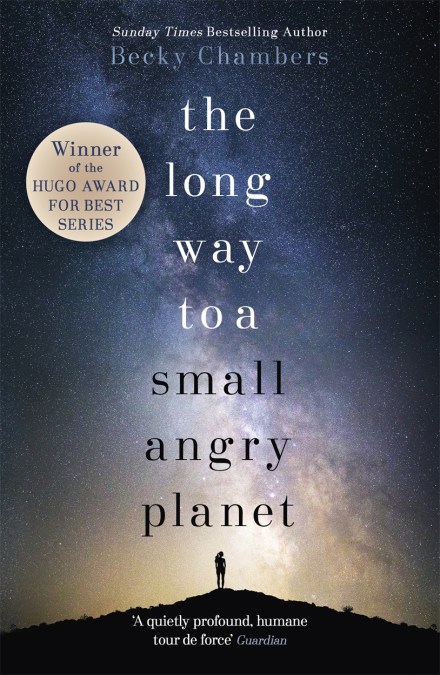
A spaceship can be a workplace before it becomes a battlefield. That is the useful starting point for Becky Chambers’s The Long Way to a Small, Angry Planet. The Wayfarer has a crew, a job, systems that need maintenance, and people whose ideas about a reasonable life do not automatically agree. The destination matters. So does the question of whether these people can share the journey.
My recommendation: choose this when you want to get attached to a science-fiction crew. Choose something else when you need a tightly accelerating thriller. Calling it comforting tells only half the story; comfort here depends on people doing the work of understanding one another.
What the crew actually does
Rosemary Harper joins the patched-up Wayfarer looking for distance from her past. The ship builds hyperspace tunnels, and a lucrative contract offers its crew a route toward financial security through dangerous territory. Captain Ashby, reptilian pilot Sissix, and engineers Kizzy and Jenks are among the people who turn that premise into a working household.
The profession is a particularly good choice for this kind of story. Infrastructure connects places. Building it requires dealing with the people who live there, the arrangements that permit travel, and the consequences when those arrangements fail. A journey can therefore introduce cultural differences without making every stop another interchangeable enemy encounter.
Rosemary’s position also gives a new reader a practical entrance. You can arrive knowing little, learn names as relationships form, and discover why a detail matters when someone has to act on it. You do not need to begin by memorizing a galactic history.
The appeal is difference that changes daily life
A convincing multispecies crew needs more than a collection of unusual silhouettes. It needs differences that complicate ordinary assumptions: what privacy means, how affection is expressed, what counts as family, and what someone expects from a shared space.
This is where I would place the book’s strongest invitation. Imagine joining a workplace where the thing you consider considerate could be read as distant, and the gesture you find intrusive could be someone else’s attempt to welcome you. The interesting response is curiosity. The difficult part is remembering to remain curious after the first misunderstanding.
That makes the everyday scenes worth taking seriously. A conversation over food can reveal whose needs the ship accommodates. A boundary can tell you more about a relationship than a declaration of loyalty. Science fiction does not need to leave ordinary life behind to make ordinary life look strange.
Know what kind of pace you are buying
The title suggests movement, but I would not approach this as a race to the final destination. Expect an ensemble story with room for encounters and individual concerns. If you find yourself asking when the main plot will resume whenever a crew member becomes the focus, that expectation is likely to get in your way.
Here is a useful sample test: read an interaction and ask whether you want more time with the people involved, even before you know how it advances the contract. A yes is a better buying signal than liking the general idea of found family. A no is permission to choose another book.
There is danger, and the crew’s route crosses political tensions. Optimism should not be mistaken for a guarantee that nothing painful happens. The appeal is the possibility of care under difficult circumstances, rather than an absence of difficult circumstances.
Found family still needs boundaries
There is an easy version of the found-family idea in which everybody eventually becomes alike. The more interesting version lets people remain different while becoming responsible to one another.
For a reading group, I would focus on three questions. When does someone ask before helping? When does the crew change an arrangement instead of expecting an individual to adapt? And when does a desire to protect another person risk becoming a decision made on their behalf?
Those questions make a better conversation than deciding whether a character is simply nice. Good intentions are a starting point; the effects of a choice provide something concrete to discuss. Save particular outcomes until everyone has finished.
Should you start the whole Wayfarers series?
Start with one book. This is the first published Wayfarers novel, and it gives you a direct test of Chambers’s character-centered approach. There is no advantage in buying an entire set before knowing whether the voice and rhythm work for you.
If you are choosing a gift, match the recipient’s reading habits. Someone who talks about favorite crews and fictional communities is a stronger candidate than someone whose main request is relentless action. If they already own this title, check their shelf before assuming another edition is useful.
B3’s take: this is an appealing place to begin when your favorite part of a space adventure is the people who have to live on the ship afterward. Give the daily life room to matter. That is where the journey earns its scale.
Find your copy
As an Amazon Associate, B3 earns from qualifying purchases.
View The Long Way to a Small, Angry Planet on Amazon — the linked US paperback is ISBN 9780062444134. Check the selected format before ordering.
Further reading: book synopsis and editions; Chambers on the characters and illustrations.