Stuffed Fables Review — A Storybook Adventure about Protecting Someone Small
B3’s verdict
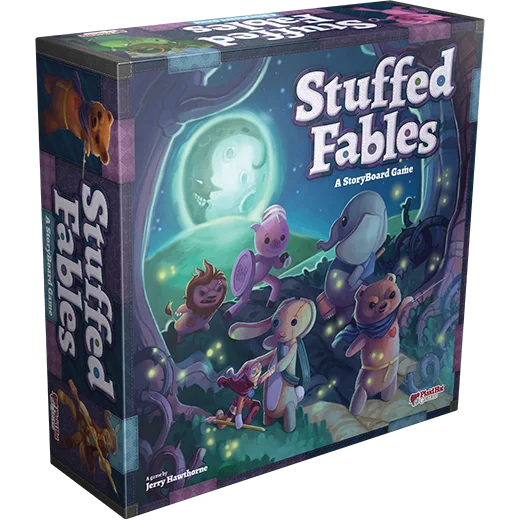
Stuffed Fables has a compelling emotional premise: toy heroes protect the child who loves them. I would consider it for a group that wants a shared adventure with a recognizable purpose. The inviting cast is useful, but it should lead to a conversation about tone and rules rather than an assumption that every younger player will enjoy it.
The adventure book serves as both story and play surface. Players control stuffed toys, draw dice, and allocate those dice to actions such as moving, fighting, and using abilities. Threats and discoveries connect the scene being read to a physical problem the group must solve.
What makes the decisions interesting
The attractive design idea is that the page has consequences. You are not merely stopping a strategy game to hear unrelated prose; the illustrated space helps frame what matters now. A group that enjoys seeing a scene become a shared task has a clear reason to choose this over a disconnected sequence of battles.
Its tradeoff is that the narrative does not administer itself. Somebody needs to understand the dice system, enemy behavior, and instructions for the current page. If one adult or experienced player handles all those systems and also chooses everybody’s actions, the others can lose the sense of being the heroes.
What you actually do with the dice
A turn begins by drawing dice from a bag. Their colors determine which options you can support: attacks, searching, and other tests do not all accept the same dice. You also handle stuffing and threat dice, so the draw can improve a toy's condition while bringing the enemies closer to acting. You are allocating an uncertain toolkit rather than selecting any action freely.
The storybook doubles as the playing surface. Movement therefore has a concrete purpose: reach a useful point, help another stuffy, or put an enemy within range. Read the current page's instructions carefully. The next page may change the immediate problem rather than simply offer another identical room.
A useful die is not always an attack die
Imagine drawing a color that supports searching while an enemy remains nearby. Searching could supply equipment that helps later, but moving and protecting a vulnerable teammate may be more urgent. An attractive roll is an opportunity, not an instruction to chase its largest immediate reward. This is an illustrative situation, not a story spoiler.
The decision becomes easier to understand when you connect it to the shared objective. Explain what a proposed action accomplishes, then let the active player choose. Children can participate meaningfully without an adult optimizing every die on their behalf. A cooperative game loses much of its appeal if one person turns everyone else's toy into another piece they control.
The threat track keeps a story moving
Threat dice give the enemy system a rhythm that does not depend on a human villain. You cannot assume the group has unlimited time to search every corner. The tension is between preparing thoroughly and allowing the situation to become more dangerous while you prepare.
The resulting adventure has a different feel from an open roleplaying session. You make tactical and narrative choices within the book's prepared structure. You do not invent unrestricted actions and ask a Game Master to adjudicate them. That makes preparation easier, while limiting how freely the group can depart from the story.
Teaching the tone as well as the rules
The toy heroes make the game approachable, but the nightmares and threats can still unsettle a sensitive child. Read the opening material yourself and judge the people at your table rather than relying only on the box's appearance. Leave time for reading, discussion, and packing away between chapters.
For the first session, demonstrate drawing dice and assigning one useful action before explaining every exception. Clarify the difference between losing stuffing and losing the whole game, and show how the current objective is tracked. The strongest fit is a group that wants to alternate listening to a story with making small, consequential decisions together.
Gameplay reference: official rulebook.
The cost of choosing this experience
For a first session, divide the jobs deliberately. One person can manage instructions while another reads dialogue. Let each player explain what their toy wants to do before discussing the most efficient answer. Nightmares and danger are part of the story, so check the content with the actual group rather than judging solely by the cuddly characters.
B3’s verdict favors a patient group that enjoys an authored journey and can share the work of keeping it moving. Start with the Stuffed Fables base game. Oh, Brother! is an expansion and should not be mistaken for the starting box. Buy the adventure because your players want its ordinary turns as well as its charming premise.
Official game information and rules →
Find the game
As an Amazon Associate, B3 earns from qualifying purchases.
Compare Stuffed Fables listings on Amazon — title search; check edition, language, contents, and seller.