Spark of Rebellion Two-Player Starter Guide: Luke, Vader, and Your First Games
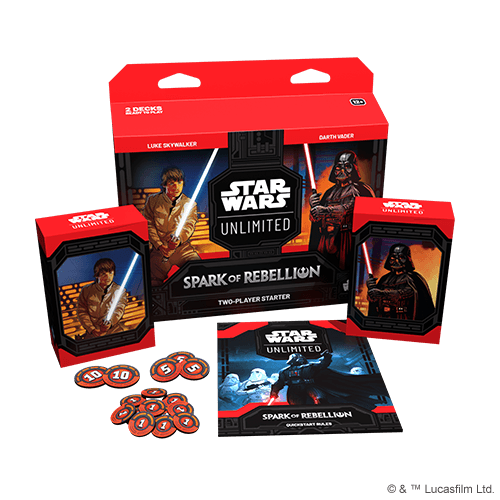
The original Luke-versus-Vader starter is still a useful idea: buy one box, give each person a complete deck, and make the first evening about playing rather than assembling a collection. The catch is that being the original product does not make it the automatic best purchase at any price. I would buy it for the pairing and the learning experience, then compare its delivered cost with the newer teaching options.
This guide covers the fixed Spark of Rebellion Two-Player Starter, not a booster display and not later Luke or Vader decks. Both characters appear in other products with different cards and plans. Here the attraction is learning pressure, protection, and the action rhythm through a familiar Rebel-versus-Empire matchup.
In this starter guide
- Who I would buy this for
- What the box supplies
- Luke’s deck: make protection change the next fight
- Vader’s deck: turn pressure into completed results
- The first two games should teach different things
- Useful rules and card checks
- Is an old starter a good upgrade purchase?
- B3’s verdict
- Still sold does not mean automatically Premier-ready
- Buying checklist and direct product link
- Where this starter fits in the wider range
- Learn the rules, then expand deliberately
Who I would buy this for
I would consider it for two people who want the original trilogy pairing, a household that intends to keep two stock decks together, or someone teaching a friend without asking them to build a deck first. There is value in replaying a fixed matchup: when the cards stay the same, you can see whether a different resource choice or attack order actually helped.
I would be less enthusiastic if the box carries a large collector premium. New players need a clear path to games, not necessarily the oldest packaging. Ask what the extra money buys you personally. If the answer is mostly that this was first, a less expensive complete setup may leave more room for sleeves and another evening of play.
What the box supplies
The package contains two fixed 50-card main decks led by Luke Skywalker and Darth Vader, their bases, damage counters, quickstart rules, two paper playmats, and two folded deckboxes. The leader and base sit outside each main deck. The original product also supplies playsets of ten starter-exclusive cards; do not expect Spark boosters to reconstruct the box's complete fixed contents.
For the first session, keep the decks separate and leave the included lists unchanged. Confirm that a secondhand purchase has both complete decks and the double-sided leaders. A cheap listing for two loose leader cards is not the starter, and a photograph of the box does not guarantee that a used offer includes the accessories.
Luke’s deck: make protection change the next fight
The supplied Luke deck combines Vigilance, Cunning, and Heroism. I would approach its protective tools as a way to preserve useful future actions, rather than as a reason to avoid combat indefinitely. A unit that survives a meaningful trade can threaten another attack next round; a protected unit left watching the game has not necessarily earned the resources invested in it.
Imagine your ready attacker can defeat an opposing unit but would die to the return hit. A Shield can change that exchange if the damage is preventable and nothing removes it first. Compare using that protection with simply developing another body. The right question is how many important future actions each line preserves, not how many tokens you can accumulate.
The original Luke's Lightsaber has a stronger entry benefit when attached to Luke himself. I would still check whether he can survive the opponent's next action before spending on the weapon. Keeping a leader alive and making one enormous target are related decisions, but they are not automatically the same good decision.

Vader’s deck: turn pressure into completed results
The supplied Vader deck combines Aggression, Command, and Villainy. I would use it to learn when damage should remove a threat and when it should advance the base race. A small damage effect becomes much more valuable when it changes a trade or finishes an enemy that would otherwise attack again.
For a simple example, a ready two-power attacker faces an enemy with three remaining HP. An available one-point damage effect could change the exchange, but using a separate action first gives the opponent an opportunity to respond. If that attacker is vulnerable, attacking immediately may bank more value than announcing a sequence you cannot complete.
Do not ignore space because the ground units are more recognizable. An enemy ship can keep damaging the base while your ground army wins fights that do not address it. I would track which arena actually caused the loss before deciding that the deck needs a larger ground finisher.
The first two games should teach different things
In game one, announce the cost of each play and the ready resources left afterward. Read new abilities aloud. When attacking a unit, calculate both sides of combat before moving damage counters; an exhausted defender still hits back. Use the written walkthrough if the distinction between an action and an entire round is unclear.
In game two, swap decks. Try to predict what the other leader wants from the next round and whether claiming initiative helps or concedes too many remaining actions. Swapping prevents a single early win from becoming an unsupported verdict about which deck is stronger.
After each game, record one card you regretted resourcing and one attack you would reorder. Those two notes are enough to make the rematch more deliberate. I would avoid changing the lists until both players can explain a repeated problem.
Useful rules and card checks
The publisher's preview illustrates ordinary unit combat with Alliance X-Wing and TIE/ln Fighter, and introduces the different roles of events and upgrades. Use those examples to recognize the card types, then use the current rules for timing and later changes. A launch-era preview is not a current event legality list.
Deployment usually checks how many resources you control; it is not a payment of that many ready resources. You can spend resources on development and still reach a deployment threshold, but playing a unit, deploying, and attacking are ordinarily separate actions. The opponent can act between them.
When learning Shields, remember that they prevent the next applicable damage event rather than providing one extra HP. A Shield can therefore be worth much more against one large hit than you might expect, while Saboteur and unpreventable damage require their own rules checks.
Is an old starter a good upgrade purchase?
For two working decks, it can be. For three particular cards, price those exact copies first. Do not compare the full starter price with just the most expensive card on your wishlist while ignoring what you already own or how much of the box will remain unused.
For a home pair, I would preserve the original lists and test changes on paper before altering one deck permanently. Upgrading only one side can change the experience for both players. A better purchase should improve the games the pair wants, not simply maximize one person's collection.
B3’s verdict
I would recommend Spark's starter when the Luke/Vader pairing is what you want and the price is sensible compared with other complete learning setups. Its greatest advantage is giving two players a repeatable starting point. Its age is a reason to check price and format fit, not a reason to dismiss the games it can still provide.
Still sold does not mean automatically Premier-ready
All three original sets rotated out of Premier when A Lawless Time released. Reprints can make individual older printings eligible, so check the exact cards and current suspended list before taking a stock starter to an event. The age of the box alone does not settle every card’s eligibility.
For casual paired play, you can keep the lists together and agree on the rules you use. Eternal and Twin Suns have their own requirements; these are not ready-made Twin Suns decks simply because older cards can be used in that format. Decide where the starter will be played before pricing competitive upgrades.
Buying checklist and direct product link
As an Amazon Associate, B3 earns from qualifying purchases.
View the Spark of Rebellion Two-Player Starter on Amazon.
An exact product listing was identifiable at this check. Seller availability, delivery, and price can change; a listing is not evidence of a continuing factory print run. Confirm the complete two-deck product, language, condition, accessories, and delivered cost before ordering.
For a hypothetical price comparison, a $30 paired starter is $15 per supplied deck. Two individual decks at $22 each cost $44 before any shipping differences. The cheaper route is useful only if its leaders and learning experience suit you. Reserve room for sleeves rather than paying for a box whose contents do not match your plans.
Where this starter fits in the wider range
Spark, Shadows, and Twilight each used a Two-Player Starter. Jump to Lightspeed introduced the individually sold Spotlight Decks. Intro Battle: Hoth is a separate guided teaching product, and 2026 Twin Suns is a separate multiplayer release. Do not group those products with a main set just because their characters share an era.
The announced Icons 2027 Edition Starter Box is another separate product, with a planned November 20, 2026 release. Its staged teaching format starts with smaller decks; it is not a relabeling of this original 50-card pairing. Compare it as an upcoming alternative rather than implying it is already on sale.
Learn the rules, then expand deliberately
Use B3’s first-game walkthrough and embedded 8:45 tutorial for setup, combat, initiative, and regroup. Read the Spark of Rebellion booster buying guide before choosing packs for this collection.
Inspect the official starter preview and its card examples. Keep the supplied decklists or photograph both lists before making changes.
Compare first-purchase options · Browse the SWU guides.
Product and rules check: October 22, 2026. Sources: official starter explanation; official set products; rotation; current rules, errata, and suspended cards. Recommendations and simplified practice situations are B3 editorial analysis, not a claim of measured matchup results or a hands-on test.