Skull Review — A Tiny Bluff with a Visible Cost
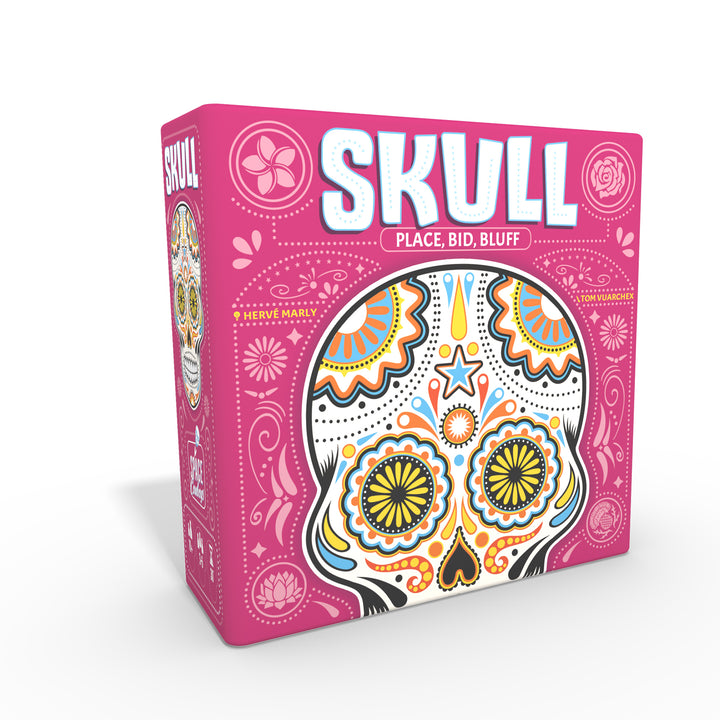
B3’s verdict
Skull is an attractive choice when a group wants bluffing without learning a large hidden-role system. B3 would choose it for players who enjoy making an uncertain claim and watching the table decide whether to believe it. The small ruleset leaves plenty of space for the people playing.
Each player has roses and a skull. Players add hidden tiles to their piles, then bid on how many tiles can be safely revealed. Roses are safe; revealing a skull causes a failed challenge and a lost tile. The bluffing problem is therefore tied to something concrete on the table.
What makes the decisions interesting
The interesting decision is whether your bid expresses confidence, pressure, or a trap. A cautious-looking pile may be safe or intentionally suspicious. Players gradually build a history of claims and reveals, giving later decisions context that did not exist in the opening round.
The limitation is that reading other people can feel uncomfortable or arbitrary to someone who wants a calculable puzzle. A confident opponent may also dominate the social rhythm. Do not assume that being short makes it a universal fit.
Place a disc or turn confidence into a bid
Each player begins with three flowers and a skull. Players add facedown discs to their own piles until somebody opens a challenge. Bidding determines who will try to reveal the promised number of flowers without encountering a skull. The challenger must deal with their own pile before choosing among other players' piles.
That last detail makes bluffing costly. If you placed your skull, an ambitious winning bid cannot simply avoid it. You may be trying to persuade somebody else to take the challenge rather than planning to win it yourself.
A safe-looking pile is a claim
Imagine a player confidently raising a bid after adding another disc. They might have built a safe pile, or be encouraging you to overbid while their skull waits. Your decision should consider what they risk by winning the auction, not just how calmly they speak. This is a hypothetical example of the bluff.
After a successful reveal, the table learns something about a pile and about the person who chose it. That information does not remain reliable forever. A player can change how they place discs once others begin treating a habit as a rule.
Losing a disc changes your future credibility
Failed challenges cost discs, reducing a player's options. Losing flowers or losing the skull produces different possibilities for later rounds, while opponents do not necessarily know exactly what remains. The physical loss makes a bluff matter beyond the immediate joke.
Explain the victory condition and loss procedure from the edition's rules before beginning. Updated editions can include additional recovery material, so do not silently mix a remembered older rule with a newer box. A short teach should still cover what happens after both success and failure.
Let the reveal be the performance
You do not need to be a loud actor to play well. A quiet placement can be as interesting as a theatrical claim. Keep the focus on bids and disc choices rather than pressure somebody to perform a personality they do not enjoy.
Choose Skull for three to six willing bluffers who want a compact contest and memorable reversals. It is less suitable for people who dislike deliberately misleading friends or being eliminated from a short game. Its small component count is a strength: very little separates the decisions from the people making them.
The cost of choosing this experience
For the teach, demonstrate one bid and a reveal, including the obligation to deal with your own pile. Explain the scoring and elimination rules before anyone stakes a challenge. A newcomer should understand what can be lost before being encouraged to make a dramatic claim.
B3 recommends the standard game for three to six willing bluffers who can enjoy a failed bid. Rotate attention and keep the teasing about the claim rather than the person. Pass if the group dislikes deception or wants extensive strategic machinery behind every decision. Skull succeeds by making a small uncertainty socially meaningful.
Official game information and rules →
Find the game
As an Amazon Associate, B3 earns from qualifying purchases.
Compare Skull listings on Amazon — title search; check edition, language, contents, and seller.