Patchwork Guide: Time, Buttons, and a Better Two-Player Puzzle

Patchwork is not just about finding a shape that fits. A patch costs buttons, occupies space, and spends time. A bargain in one of those currencies can be expensive in another. That is what makes a quiet-looking quilting game into a worthwhile two-player contest.
I would recommend it when two people want a compact puzzle with direct competition over a shared supply. Be more careful if one player dislikes spatial planning or expects the soft theme to mean the other player will never interfere with their plans.
Uwe Rosenberg’s standard game is for two players, ages 8+, with a listed time of about 30 minutes. The 2025 Revised Edition keeps the gameplay while updating the presentation. A complete older copy can still do the job.
The turn order is the first thing to learn
The player farther behind on the time track takes the next turn; with tokens together, the one on top acts. You can take consecutive turns. Choose between advancing just beyond the opponent for one button per space moved, or buying one of the next three patches clockwise from the neutral token. For a purchase, move the neutral token, pay its buttons, fit the patch without overlap, and advance the printed time cost.
When crossing an income marker, collect the button income shown on your quilt. The first player reaching an available leather patch takes that single-square piece. A first completed 7×7 area earns the seven-point bonus. Once both time tokens finish, score remaining buttons plus the bonus, minus two per uncovered square. Highest score wins; ties favor the first finisher.
That short explanation covers the main structure. Use the rulebook for setup and precise track events. Most importantly, do not replace the track with ordinary alternating turns: time is part of the game’s economy.
Read every patch in three ways
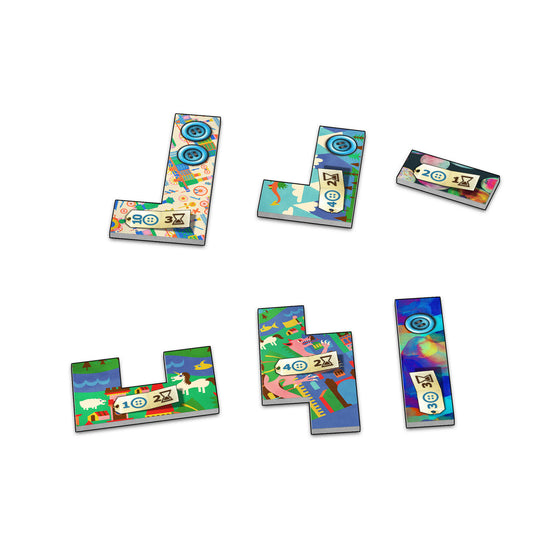
Shape: does it fit a useful space, and what gaps will it leave? A patch that covers many squares can still leave an awkward pocket you cannot conveniently repair.
Buttons: can you afford it without making your next decision miserable? A purchase that empties your supply may prevent you taking another patch you were counting on.
Time: what does the move allow the other player to do before you act again? The biggest patch available is not automatically the best use of the remaining track.
Why early income and late coverage are different questions
An income-producing purchase has more opportunities to help while income events remain ahead. Near the end, the same attraction can be mostly decorative: there may be little time for it to pay back. Look at the remaining track before valuing a patch as though the whole game were still ahead.
Likewise, covering empty space is valuable, but it is not an instruction to buy anything that physically fits. Consider the buttons spent and the alternatives lost. A purchase that improves the quilt can still damage the final position if it consumes too much of another resource.
I would compare a candidate with what happens if you advance for buttons instead. That makes the decision concrete. You are choosing between two actual futures, rather than deciding whether a patch looks attractive in isolation.
A useful first-game example
Suppose a hypothetical patch fits an awkward gap but consumes most of your money. Another is less tidy but leaves you able to make a further purchase. There is no universal answer from shape alone. Check the next three pieces that the opponent will see, your place on the time track, and how much time remains.
The important habit is considering the turn after the purchase. Patchwork’s decisions become clearer when a shape is part of a sequence rather than an isolated packing exercise. You do not need to calculate the whole game; noticing the next offer is already useful.
Common mistakes I would teach around
- Spending all your buttons for neatness. A tidy board is satisfying, but money keeps options available.
- Ignoring the second player. Your purchase changes the shared offer. Notice what the new selection lets them buy.
- Creating narrow holes without a plan. A gap is not harmless merely because the surrounding patches look efficient.
- Chasing a bonus too late. Check whether the remaining supply and time support the project before sacrificing a workable position.
For a first teach, show the two action choices and then one complete example using the time track. Let a beginner rotate a candidate patch above their board before committing. The goal is to understand the decision, not to prove they can visualize every shape instantly.
Does it work as a relaxing game?
It can, if both players enjoy thinking quietly and accept that the other person may take a useful piece. The theme and modest length make it easy to imagine as a gentle evening; the shared market keeps it competitive.
I would ask a prospective player whether fitting shapes is enjoyable before describing it as cozy. For someone who finds spatial puzzles stressful, a colorful quilt does not remove the work. Conversely, someone who enjoys a visible personal project may appreciate having a whole board they can understand at a glance.
Which version should you buy?
As an Amazon Associate I earn from qualifying purchases.
Find Patchwork Revised Edition on Amazon — this is a search, so check the actual edition, language, and box contents. The current revised box is pictured above.
Lookout says the revised printing retains the core gameplay. I would not replace a complete original copy just to obtain the newer patterns. For a new buyer, compare the actual available editions rather than assuming a themed or anniversary box is automatically the better value.
The 2024 anniversary edition included an Automa deck for solo play. Do not assume a standard box includes those extras. This guide covers the ordinary two-player game; check any solo product’s contents and instructions separately.
Verdict: a small game with three connected budgets
Patchwork earns its place through the relationship between money, time, and shape. You can understand the available actions quickly and still find that a purchase you liked has created a difficult next decision.
I would choose it for two players who enjoy weighing concrete tradeoffs and can treat an imperfect quilt as part of the challenge. I would skip it for a larger group or for someone who wants free conversation with very little attention on the board. It is approachable because the decisions are readable, not because they are empty.
Read its list context in games for a new player and cozy books and board games.
Rules-informed guide and buying assessment; no first-hand play claim. Sources: Lookout’s Revised Edition page, official two-player rules, and anniversary contents. Follow your edition’s rules for exact setup and track resolution.