Onitama Guide — The Move You Use Becomes Your Opponent’s Opportunity
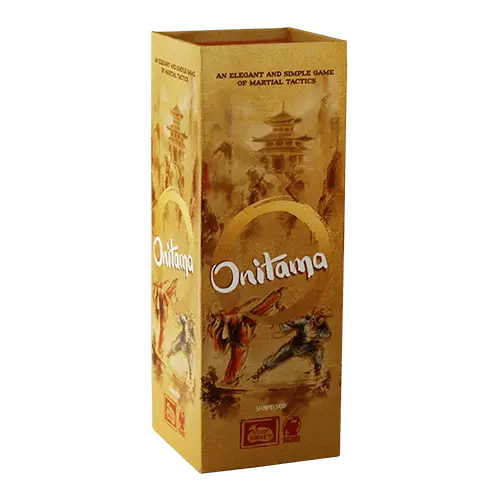
Your chosen move will not remain yours
Onitama is a two-player abstract game on a small grid. Each side has a master and students, but the movement possibilities come from cards rather than permanent piece identities. After using a card, you exchange it with the spare card, allowing movement options to circulate between players.
The immediate choice is therefore also a future gift. B3 recommends it for pairs who enjoy a short, fully visible tactical contest with a different movement vocabulary each game. It needs little thematic knowledge, but rewards careful attention to the reply you make possible.
Move one piece with one of your cards
Choose an available movement pattern and apply it to one of your pieces. Capturing the opposing master wins, as does reaching the opposing master's starting temple with your own master. The second route prevents a player from thinking only about protecting pieces.
All five movement cards are visible. You can inspect your current options, the opponent's options, and the spare that will enter the circulation. The challenge is using that information without becoming so absorbed in a perfect calculation that a short duel loses its pace.
A safe square can become unsafe
Imagine moving a student forward with a card that would later let the opponent attack your master. The move may improve your board immediately, yet the card exchange changes the next sequence. This hypothetical example shows why a move cannot be judged only by its destination.
Ask which card your opponent receives and which piece could use it. Sometimes the right move is modest because it keeps a dangerous pattern out of circulation for one more turn. Sometimes giving away the pattern is acceptable because the new position prevents its effective use.
Students create space, not just material advantage
Students can shield the master, occupy important squares, or threaten the temple route. Losing one can be a worthwhile trade if it gives the master a decisive opportunity. Counting pieces is useful, but does not replace examining the two victory routes.
Teach a capture, a temple win, and the card exchange with a sample turn. Once those are clear, a newcomer can understand what the visible patterns mean. Avoid opening with every possible tactical trick.
Choose a pace for the pair
The compact board encourages rematches and discussion. An experienced player should explain a missed threat after a game, then let the next one begin. A small card set changes the puzzle without requiring a collection of expansions.
The base game is complete for two; additional card sets and other Onitama products have their own contents. Check that a listing is the standalone game. Choose it for readable turns with difficult consequences, and more cautiously if either player finds direct captures or open-information mistakes stressful.
Product and rules reference: publisher or edition information. Examples illustrate choices and do not describe a claimed play session.
Find the game
As an Amazon Associate, B3 earns from qualifying purchases.
Compare Onitama listings on Amazon — check the edition, language, contents, and seller.