Hive Guide — Surround the Queen without Breaking Your Own Position
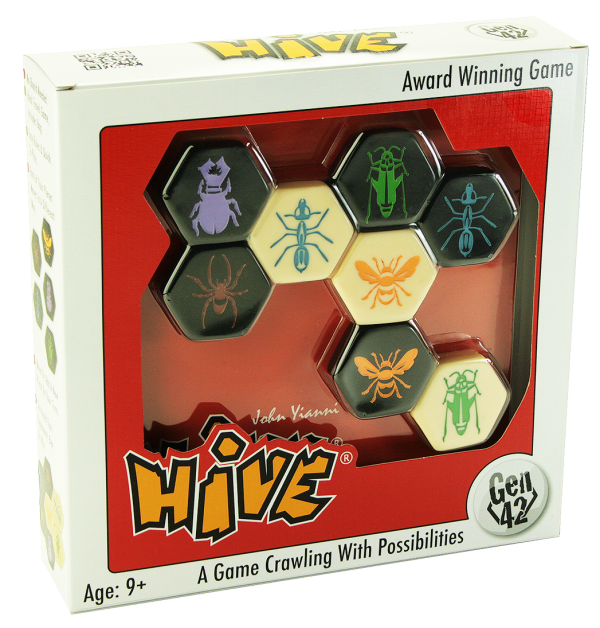
The board is made from the pieces
Hive is a two-player abstract contest in which the growing cluster of insect tiles is also the board. You place a new piece or move an existing one under its insect's movement rules, trying to surround the opposing queen. Your own pieces can contribute to surrounding your queen too.
B3 recommends it for pairs who want visible information, direct interaction, and a game that can travel without a separate board. The caveat is spatial pressure: a friendly-looking insect collection can produce a sharp contest over mobility.
Position and freedom are connected
The hive must remain connected. A piece that holds two sections together may be unable to move without breaking that structure. Sliding constraints also matter, so an apparently adjacent opening is not automatically reachable.
That is the first useful teach: demonstrate a legal slide, a blocked gap, and a piece whose removal would split the hive. Then show how the queen, ant, spider, grasshopper, and beetle differ. Their movement identities are the vocabulary from which the tactics develop.
A new piece can become a trap
Imagine placing a tile to restrict an enemy while accidentally making your own queen the connection between two groups. Your attack has improved one local position but reduced your ability to respond elsewhere. This is a hypothetical example rather than a puzzle solution.
Before committing, look at which pieces can still move next turn. A threatening tile that cannot leave its position may be less dangerous than a mobile ant with several useful destinations. Counting attackers alone misses that distinction.
There is no lucky draw to rescue a position
The available pieces and current structure are visible. That makes it possible to learn directly from mistakes, but can also make an experience gap pronounced. A first session works better with explanations and short rematches than with unexplained tactical punishments.
Do not confuse open information with an easy calculation. The cluster's shape changes legal movement, and a small shift can free or pin several pieces. Thinking one reply ahead is a useful start; a complete search of every possibility is unnecessary for an enjoyable game.
Which set should you choose?
The standard set offers large, tactile tiles. Pocket and other packages change size, appearance, and included expansion pieces, so compare contents rather than assuming every Hive product is identical. Additional insects add movement rules; they are not necessary for learning the base contest.
Choose Hive when both players enjoy an active, positional duel. Choose more cautiously if one person dislikes direct pressure on a vulnerable central piece or wants random events to soften a skill gap. Its small physical footprint hides substantial tactical depth, and a clear table surface helps make the geometry readable.
Product and rules reference: publisher or edition information. Examples illustrate choices and do not describe a claimed play session.
Find the game
As an Amazon Associate, B3 earns from qualifying purchases.
Compare Hive listings on Amazon — check the edition, language, contents, and seller.