Dune: Imperium Review: Strategy, Conflict, and Just Enough Betrayal
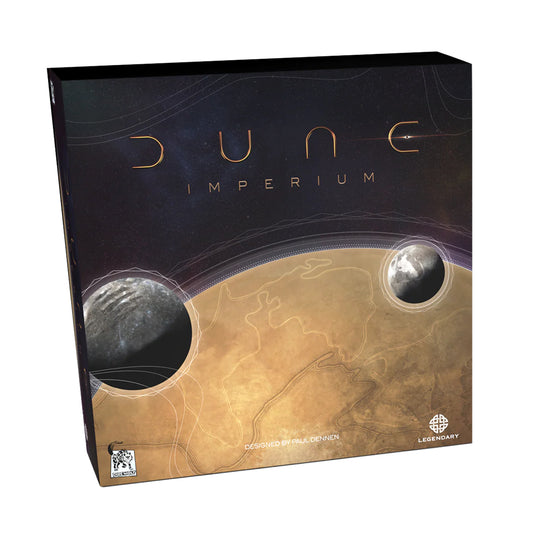
Dune: Imperium works because a card can be useful in two different ways, and using it for one job means losing the other. You build a deck while sending agents to shared board spaces, competing for influence, resources, and the conflict at the center of each round.
I would choose it for players who enjoy several interlocking pressures and can tolerate a plan changing because another player acted first. Its Dune theme supplies a strong setting, but the central pleasure is the decision structure rather than reenacting a particular scene from the novels.
Your hand is also your access to the board
On an agent turn, a played card's icons determine which spaces you can visit. The chosen space and the card can provide benefits. Later, a reveal turn uses the remaining cards for effects such as persuasion and combat strength.
An illustrative decision shows the tension. A card might let you visit an important faction space, but keeping it could help buy a stronger card during reveal. You cannot treat your hand solely as a shopping budget or solely as a movement menu.
That is the most distinctive part of the design. Improving a deck means considering where cards let you go, what they do when played, and what they offer if held back.

Worker placement gives timing a consequence
Shared spaces can be occupied before you reach them. The right move may therefore depend on acting now rather than pursuing the theoretically most efficient sequence.
This suits players who enjoy adapting to visible competition. It can frustrate someone who likes planning a complete round and carrying it out without interference. Teach that expectation explicitly: having a legal idea does not mean the opportunity will remain available.
Resources also connect actions across rounds. A purchase or visit can be useful immediately while preparing a later political or military push. Beginners should see the main routes to points before being asked to compare every space.
Conflict keeps everyone watching
Troops and combat strength matter because conflict rewards are contested, and intrigue cards can affect what seemed settled. The contest gives players a reason to observe more than their own board.
The uncertainty is managed through commitment and timing, not simply a random battle roll. You choose how much to invest while knowing opponents may have information you do not. That can produce the kind of reversal people remember.
Do not describe every unexpected result as betrayal. Much of the game is open competition with concealed possibilities. A player who wants formal alliances and negotiated promises may be looking for a different Dune game.
Theme helps without replacing the teach
The great houses and factions give familiar names to influence and access. Readers of Dune can enjoy seeing those relationships represented through competition, but newcomers need only understand what the spaces and tracks do.
Start with the goal, then an agent turn, then a reveal turn and the conflict. Explain how these pieces fit into a round before listing unusual card interactions. Keep a reference within reach and allow more time for the first play.
A long thematic introduction is less useful than showing why one card creates two competing options.
Original or Uprising?
Dune: Imperium – Uprising is a standalone version that adds its own systems, including spies and sandworms. It is not an expansion you can use only after buying the original. Expansions and compatibility should be checked by their full product names rather than the word Dune alone.
The original remains a clear way to learn the worker-placement and deck-building combination. If choosing fresh between versions, watch an actual turn demonstration of each and decide how much additional structure the group wants. A larger feature list is not automatically a better first purchase.
My verdict
I would recommend Dune: Imperium for a focused strategy night where players enjoy timing, competing priorities, and uncertain commitments. Its strength is making the same hand support several plausible plans.
I would skip it for a casual gathering mainly seeking uninterrupted conversation or a gentle first game. Buy it because the agent-and-reveal decision looks interesting to your group. That repeated tension is what will keep it returning to the table.
For a gentler engine-building comparison, read our Wingspan buying guide. Find more individual reviews in the Board Games hub.
Find the correct Dune: Imperium product
The original game and Uprising are separate standalone purchases. Rise of Ix and Immortality are expansions; check their compatibility before buying. The first three links below are Amazon searches, so confirm the edition and language in the listing.
As an Amazon Associate, B3 earns from qualifying purchases.