Dixit Review — A Good Clue Leaves More than One Plausible Picture
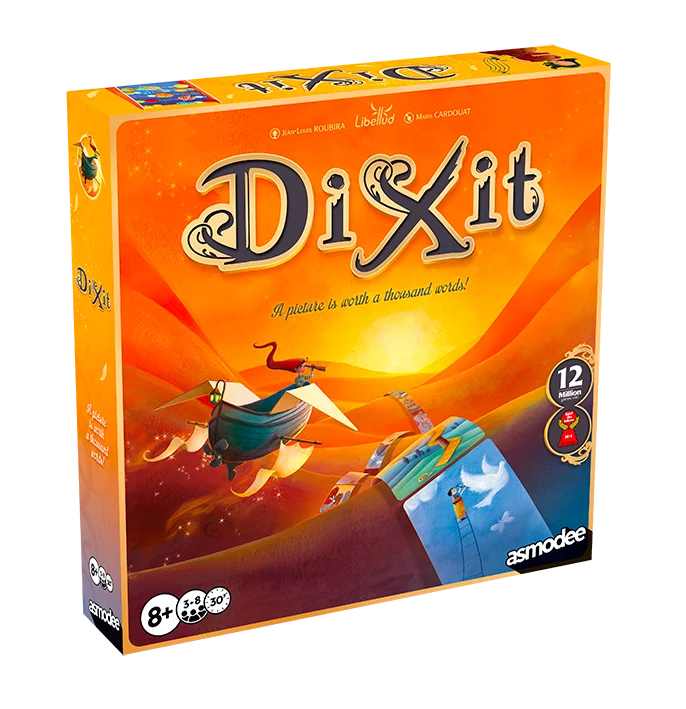
B3’s verdict
Dixit is appealing when the group wants creative associations without needing to perform a whole improvised story. B3 would choose it for players curious about how others interpret an image. A short clue can be enough; elaborate theatrical confidence is not a requirement.
The storyteller chooses a picture and gives a clue. Other players contribute pictures that might fit, then vote on the storyteller’s card. The storyteller wants some people, but not everybody, to identify it. A completely obvious clue can therefore be as unhelpful as a completely private one.
What makes the decisions interesting
The interesting decision is how much shared understanding to rely on. An association may be meaningful to you without being available to the rest of the table. The game asks you to anticipate several interpretations rather than find a single dictionary definition.
The tradeoff is that ambiguity is the activity. A player wanting precise evidence or a uniquely correct chain of logic may find the discussion arbitrary. Shared references can also exclude newcomers if the group leans too hard on private jokes.
A round turns a private association into a public choice
The storyteller selects an illustration and gives a clue. Other players submit illustrations from their own hands that could fit that clue. The cards are mixed and revealed, then players vote for the storyteller's original. The storyteller wants some people to recognize it, but not everybody.
That scoring condition explains why an obvious description is weak. A clue must be understandable without being uniquely identifying. The other players are trying to offer plausible alternatives, so choosing a convincing decoy is an active contribution rather than waiting to guess.
Describe the feeling, not just the object
Imagine an illustration containing a staircase, a bird, and a tiny doorway. A literal clue naming the doorway may make the answer trivial. A phrase about leaving home could connect several images in the reveal, leaving enough ambiguity for an interesting vote. This invented example uses no particular card solution.
The pleasure comes afterward, when people explain what they noticed. Someone may have followed color or mood while another focused on a small object. Those interpretations can be delightful even when they produce a wrong answer. A table determined to argue that one association was objectively correct can drain much of the game's charm.
Shared references are powerful and limiting
A private joke can make a clue land perfectly with one friend, which may suit the scoring. Repeatedly relying on references unknown to a newcomer can also make that person feel excluded. Vary the basis of clues so everyone gets chances to recognize an idea.
You do not have to perform elaborate poetry. A word, phrase, title, or other permitted clue can be enough. Give hesitant storytellers a moment and avoid grading their creativity. The task is to make a playable association, not prove artistic talent.
Choose the right kind of gathering
Dixit suits people who want interpretation and conversation more than a tightly controlled tactical contest. A supported smaller count has fewer competing perspectives, while a larger table creates more possibilities and reveal discussion. Follow the rules for the particular edition's count.
Start with a standalone base game that includes voting and scoring components. Many Dixit products are additional illustration decks rather than complete starting boxes. More art adds freshness, but it will not change whether the group enjoys the clue-and-decoy structure.
For a first teach, play a sample reveal and explain what happens if everybody or nobody identifies the storyteller. Once players understand that balance, the reason for the unusual clues becomes clear.
The cost of choosing this experience
I would begin with ordinary words or short phrases and explain the scoring through examples. Invite each person to describe their reasoning after the reveal without judging the association as artistically good or bad. Make sure the pictures are visible to everyone.
B3 recommends a complete Dixit base game for a group willing to enjoy surprising interpretations. Many Dixit boxes are card expansions requiring base components. Check player capacity and contents for the specific edition. Buy it for the conversation the pictures create, rather than expecting a traditional deduction mystery.
Official game information and rules →
Find the game
As an Amazon Associate, B3 earns from qualifying purchases.
Compare Dixit listings on Amazon — title search; check edition, language, contents, and seller.