Arkham Horror: The Card Game Guide — How It Plays and What to Buy in 2026
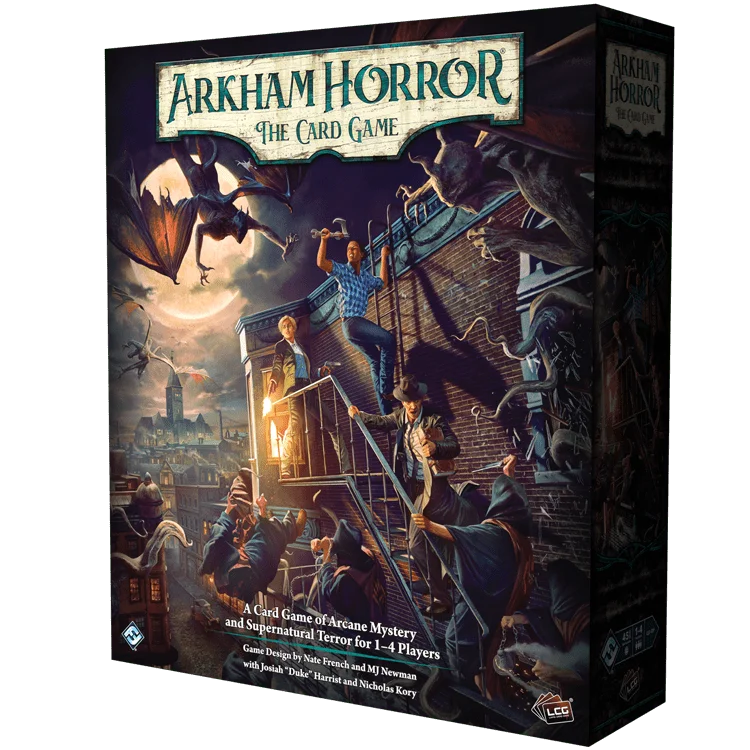
Arkham Horror: The Card Game is appealing because preparation does not make you safe. You build an investigator who ought to handle a particular problem, then a scenario asks how much of that plan you can afford to keep. The interesting decision is often whether to pursue one more useful clue while there is still a way out.
My recommendation: consider it if you want a recurring cooperative card game whose story and tactical decisions keep interrupting each other. Be more cautious if you want an easy evening of reading with occasional choices. Understanding card effects, accepting uncertainty, and deciding how to improve a deck are part of the attraction—not incidental work to get through before the fiction.
This guide uses the 2026 Chapter Two core set as the starting purchase. It supports 1–4 players, carries an age recommendation of 14+, and lists 60–120 minutes per scenario. Allow extra time for learning and setup. The introductory campaign, Brethren of Ash, contains three scenarios.
What you are actually doing
Each player controls an investigator represented by a personal deck. Locations form the space you explore. The act deck describes your progress; the agenda represents the opposing pressure. Collecting clues often advances the investigation, but surviving enemies and encounter effects consumes the attention you need to make that progress.
That creates a useful tension: survival is necessary, but a group that only protects itself can still run out of time. I would introduce the game by asking everyone to watch both the immediate danger and the actual objective. A beautifully equipped investigator who never contributes to the investigation may have solved the wrong problem.
A turn, explained without a rules lecture
In the investigator phase, a normal turn gives you three actions. Common choices include moving, investigating, fighting, evading, playing a card, drawing a card, or gaining a resource. Card abilities can modify what is possible. A skill test combines your relevant skill and committed card icons with a chaos-token result; compare the final value with the difficulty and apply the effect.
Here is an invented example rather than a scene from the campaign. You are one location away from a clue you want. Moving spends an action. Investigating might spend another. If the test fails, your last action becomes a real question: attempt it again, prepare a useful card, or reposition for next round? You cannot evaluate the attempt only by its chance of success; you must consider what failure would leave you able to do.
The rest of the round gives the game its teeth: enemies and the encounter system act, while upkeep refreshes the investigators. Read the core rulebook for the exact sequence, engagement rules, attacks of opportunity, and scenario exceptions. This outline is a way to understand the decisions, not a replacement for those rules.
Why the chaos bag is more than a coin flip
I would not sell this to someone who needs a good plan to guarantee a good result. A margin above a test's difficulty is protection against some outcomes, not a promise. The strategic question is how much protection a particular attempt deserves.
Do not spend every useful card making an unimportant test as safe as possible. Save attention for attempts that determine whether another investigator can act, whether a threat remains, or whether the group can finish an objective before pressure increases. Conversely, repeatedly attempting an important test with poor odds can be more expensive than committing properly once.
The practical lesson is to budget for a bad outcome. Before taking a risk, ask what the next action would be if it failed. If there is no acceptable answer, the risk is larger than its difficulty number suggests.
Choose complementary jobs before choosing clever combos
The five classes provide different starting tendencies: Guardians protect and fight, Seekers investigate, Rogues emphasize movement and resources, Mystics use flexible but risky spells, and Survivors recover from adversity. A class is a starting point, not a guarantee that every deck fills the same role.
For a first pair of investigators, I would discuss three jobs: who reliably gets clues, who handles enemies, and how each survives when separated. You do not need to divide these equally. You need a believable answer for all three. Use the supplied investigator decks for the first scenario rather than postponing play until you understand every possible combination.
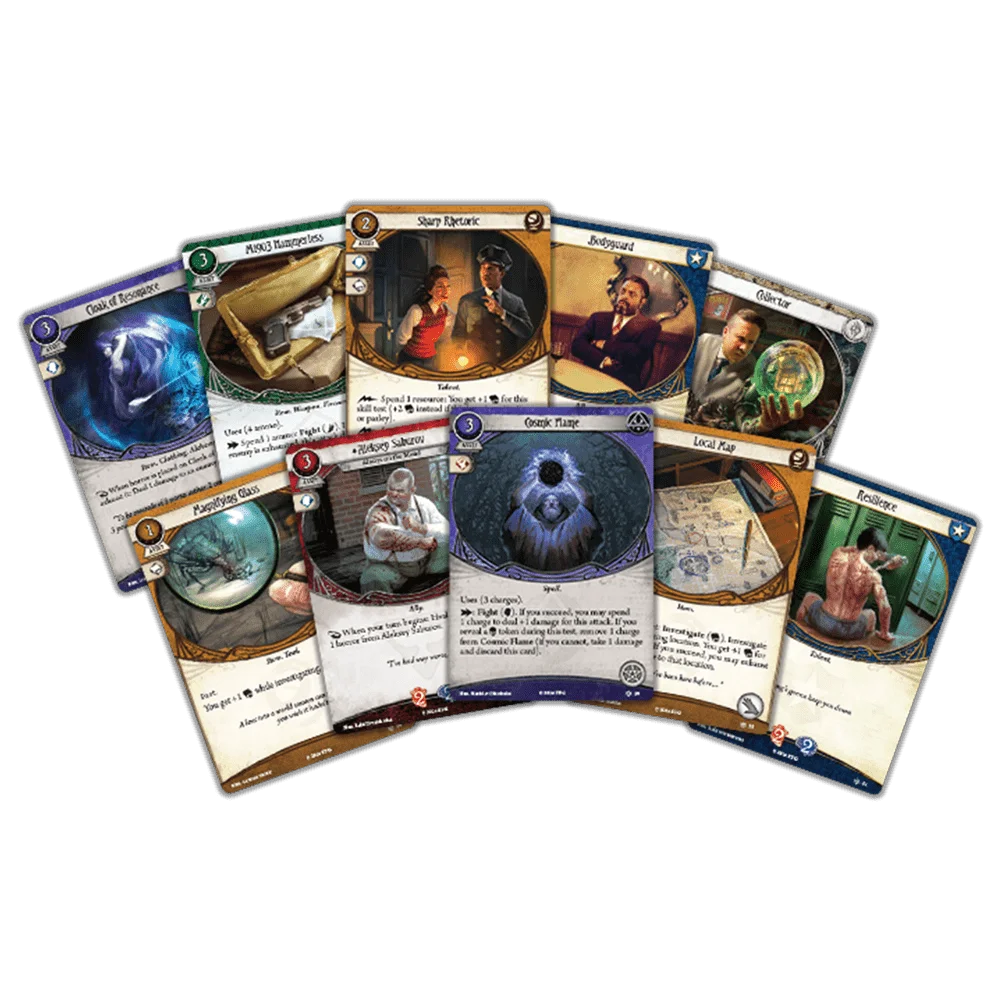
After playing, diagnose a specific problem. Did an expensive hand leave you unable to pay for useful cards? Did you have no reliable enemy answer when your partner was elsewhere? Improve that weakness before adding an elaborate combo. A deck that consistently does its intended job teaches more than a collection of individually exciting cards.
Campaigns: consequences, upgrades, and realistic commitment
Scenario resolutions and campaign instructions determine what carries forward, and experience lets you improve a deck. Follow the actual resolution instead of assuming that defeat means you must restart. Outcomes can affect what happens next; a campaign is not simply a ladder of perfect wins.
The main scheduling commitment is continuity. Before buying a larger campaign, finish the core introduction with a group that can realistically return. Keep investigator decks together, record the campaign state, and write a brief reminder of the last session. An efficient return is more valuable than an exhaustive account nobody wants to read.
Replaying can reveal different investigator approaches and decisions, but it cannot restore every surprise. I would evaluate the core as an introduction to a system you may want to revisit, not as an endless supply of unseen story. If you dislike the procedures after the introductory campaign, more scenarios are unlikely to remove them.
Solo, two players, or a full table?
Two players would be my default recommendation. It gives you someone to discuss a plan with and makes it practical to divide responsibilities. That is an editorial judgment about coordination and scheduling, not a claim that the other supported counts are inferior.
Solo: one investigator keeps the table easier to manage but puts more responsibility into one deck. Controlling two investigators offers complementary roles at the cost of remembering two hands and more effects. Choose based on the amount of administration you enjoy; two-handed play is not automatically the more relaxing option.
Three or four: more people can share the investigation, but the conversation and card effects need room. Let each player propose their own turn before the experienced player starts optimizing it. Cooperation becomes dull when one person makes everyone else's decisions.
The 2026 core versus the older Revised Core
The 2026 box is a new entry point, not a second edition that discards the older game. It replaces the 2021 Revised Core as the evergreen starting box. Earlier player cards remain usable within the appropriate play environment, but new Chapter Two scenarios draw on the new core's encounter sets. An older core is therefore not an automatic substitute for every future product.
If you already own a working older collection, there is no reason to throw it away. Check what a particular scenario requires and distinguish casual Legacy play from the supported card pools for other environments. Do not buy a replacement core merely because the word “new” appears on a listing.
What to buy first—and when to stop
As an Amazon Associate I earn from qualifying purchases.
Check the Arkham Horror: The Card Game 2026 core set on Amazon. Match the 2026 box pictured above and product code AHC100; check language, seller, and included contents.
- Start with that core only. Learn the supplied decks and introductory campaign before planning a collection.
- Decide what you want more of. Additional story and additional player-card choices solve different wants. Read an expansion's contents and required core before buying it.
- Check older product formats carefully. A single old Mythos pack may be only one part of a campaign. A bundle is not automatically complete because it contains several boxes.
- Set a stopping point. Finish the campaign you own before browsing for the next one. The best purchase is the one your group will actually play.
Sleeves and storage can wait until you know you enjoy the system. This is already a game with a tempting collection around it; the guide's buying advice should make starting manageable, not make a newcomer feel behind.
My verdict
Arkham's strongest promise is a character you shape facing a situation you cannot completely control. That is an excellent fit for someone who enjoys revising a plan under pressure and then thinking about how the next deck could work better.
I would pass if your group resents rules lookups, dislikes setbacks carrying meaning, or wants freeform solutions beyond the actions and cards the game provides. For the right players, the card system is what makes the investigation compelling. For the wrong players, it will keep getting between them and the story.
For a smaller first step, use our narrative-game starting guide; for the specific two-person decision, see horror games for two. Browse the individual game finder for the wider review collection.
Editorial scope: this is a rules-informed guide and buying assessment, not a claim of first-hand completion of Brethren of Ash. Sources checked October 2026: current core contents, official beginner and deckbuilding introduction, Chapter Two and compatibility, and rules update and Grimoire link. Use the core rulebook and current Grimoire for complete rules.