The Terraformers Review — The Future Is Also an Infrastructure Problem
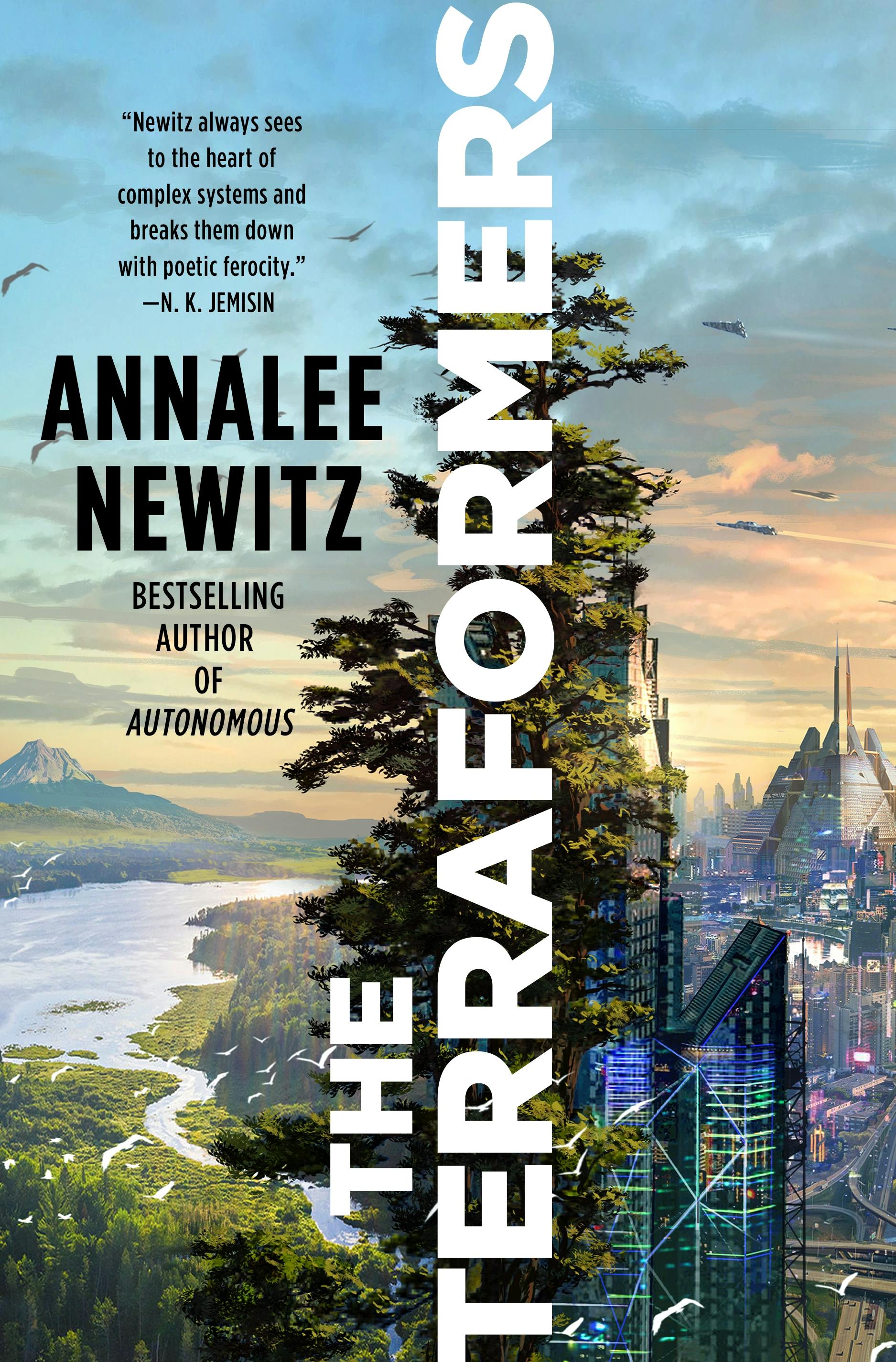
The Terraformers treats building a future as maintenance, negotiation, and collective work. Annalee Newitz follows the development of Sask-E across a vast span of time, connecting ecological care to ownership and the definition of a person. Its most distinctive idea is that a transportation plan can be as politically consequential as a battle.
Sask-E is a product with people inside it
The planet’s corporate owners want a carefully manufactured environment. Destry’s Environmental Rescue Team works within that project, managing ecosystems and protecting the developing world. The premise quickly raises a problem: the beings doing the work may have interests incompatible with the property owner’s intentions.
That makes terraforming more than changing atmospheric conditions. A constructed landscape is already a network of inhabitants, labor, and obligations. Calling it a product does not make those relationships disappear.
Destry’s discovery of a hidden community in a volcano sharpens that conflict. The question is not simply whether an unexpected city disrupts the plan. It is whether the plan has the right to decide that its residents should not exist.
Destry gives environmental work a personal center
Her responsibilities involve intervention and care, rather than passive admiration of an untouched wilderness. That is a useful distinction in a novel about a deliberately engineered planet. The environment is neither purely natural nor therefore disposable.
The work brings her into contact with people whose intelligence and embodiment challenge familiar categories. The novel asks readers to take those beings’ interests seriously without requiring them to resemble a conventional human protagonist.
I find that approach more persuasive than a distant claim that future society has solved prejudice. Conflicts over recognition show where its supposedly enlightened arrangements still fail.
The time jumps change what a story follows
The novel moves across thousands of years, with later sections following people shaped by earlier decisions. Destry does not simply remain the unchanged center of one continuous personal adventure.
That scale allows infrastructure and institutions to become forms of continuity. A choice can persist through a transit system, a legal arrangement, or an environment after the person who made it is gone.
It also creates emotional distance. Readers invested in the initial cast may resist moving away from it, even when the broader design makes sense. This is a significant part of the reading decision: choose it for a planet’s evolving society rather than expect one hero’s compact arc.
Misha’s transit problem makes politics tangible
The later work around planetary transportation gives the novel a refreshingly specific subject. Routes, access, and the organization of shared systems determine who can participate in the world being built.
Sulfur and the volcano community complicate assumptions about whose expertise counts. The people asked to accommodate a plan are also capable of questioning and redesigning it.
This is the book’s strongest kind of conflict. A policy stops being abstract when it determines whether people can travel, maintain relationships, or remain in their homes. The technical and political questions become the same question viewed from different positions.
The optimism is about cooperation, not an easy setting
Corporate control and exploitation remain serious obstacles. The novel’s constructive quality comes from the possibility that people can organize alternatives and build systems worth maintaining.
That gives it a different flavor from science fiction where every institution is doomed and every reform conceals another trap. Cooperation is allowed to be difficult without being pointless.
The downside is that the social argument can become more prominent than individual drama. Readers who prefer political questions to emerge quietly through a tightly focused plot may find the book’s attention to structures less subtle than they want. Those interested in infrastructure and ecological labor have a stronger reason to appreciate that focus.
B3’s verdict
The Terraformers is a strong choice for readers who want science fiction about the practical arrangements that make a society livable. Sask-E’s corporate purpose, the hidden volcano city, and the transit-system debates give its ideas concrete form. Its long time scale and changing cast are the main barriers. Read it for a future where care, access, and collective decisions are major events—not scenery behind a more conventional adventure.
Find the book
As an Amazon Associate I earn from qualifying purchases.