The Spear Cuts Through Water Review — A Mythic Journey That Asks You to Follow Its Form
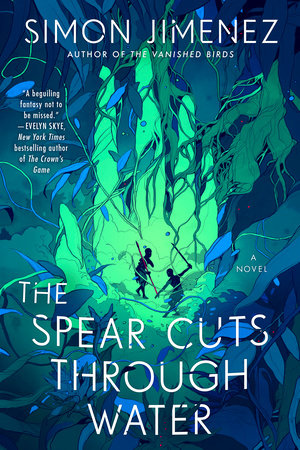
The Spear Cuts Through Water tells a recognizable quest through a deliberately unusual form. Simon Jimenez follows Jun and Keema across a land ruled by the Moon Throne, while memory, theater, and shifting voices make the telling part of the experience. Its originality is substantial, but the reader has to enjoy that form for the journey to land.
A five-day journey supplies the center
Jun and Keema help an ancient god escape captivity and cross a threatened country. That immediate purpose provides an anchor while the narration moves through other frames and perspectives.
The clarity of the central task matters. Without people traveling toward a concrete goal, the layers could feel like pure formal display. The journey gives the reader something to return to whenever the narrative changes how it addresses us.
The Moon Throne’s power also makes the escape political. The god’s movement is a challenge to an existing order, not merely an extraordinary traveler’s private journey. The landscape and its inhabitants have reasons to react.
The theater makes storytelling visible
A performance in the Inverted Theater places the adventure inside another act of witnessing. The book also invokes inherited stories and family memory, so the narrative asks who receives a story as well as who originally lives it.
Second-person passages draw the reader toward that act of reception. Other voices briefly open lives beyond the central pair. The effect is to make the world feel inhabited by people whose experience exceeds their role as scenery in a hero’s quest.
That is the structural feature I find most interesting. A journey can be grand while still remembering that its background characters have their own accounts of what happened. The form gives those accounts room.
The shifts ask for attention
The book does not hold one stable narrative distance throughout. It moves between frames, moments, and voices, sometimes asking the reader to understand an unfamiliar address before its full relationship to the story becomes clear.
That can feel intimate and expansive. It can also interrupt momentum for someone chiefly interested in finding out what happens next. Neither reaction is a failure to understand fantasy; it is a difference in what kind of reading experience feels rewarding.
I would sample the opening at a time when you can give it uninterrupted attention. This is a less comfortable choice for readers trying to read a few distracted pages between other tasks. Its form becomes easier to follow when the recurring frames remain fresh in memory.
Jun and Keema keep the scale human
The central pair bring different histories and vulnerabilities into the same journey. Their developing connection makes the quest more than a confrontation between a god and a dynasty.
The love story is important because it gives mythic events a close emotional consequence. Freedom and belonging mean something specific to these people, even while the narration places them within a much larger account.
The novel’s bodily violence and cruelty prevent the mythic beauty from becoming a gentle fairy tale. Readers attracted by lyrical prose should still expect an often harsh world. The contrast is part of the effect: tenderness exists within danger rather than replacing it.
The form and the themes support each other
Legacy, identity, and the preservation of stories are not merely subjects mentioned in dialogue. They are enacted through the way the novel lets different people tell, remember, and witness events.
That relationship gives the experimentation purpose. The book’s style asks readers to participate in assembling an account, just as its characters struggle with what their histories mean.
The limitation is equally clear. If the layered telling keeps you too far from Jun and Keema, the ambition alone may not make the experience satisfying. A more conventional quest would be easier to recommend broadly, but it would lose the quality that makes this book distinctive.
B3’s verdict
The Spear Cuts Through Water is a strong choice for readers who want a mythic journey whose narration carries as much meaning as its events. Jun and Keema provide an emotional center, while the theater and shifting voices widen the story’s reach. Its demands are concentration, tolerance for formal change, and readiness for severe violence. Choose it for the pleasure of following how a story is carried between people, rather than expecting a familiar quest delivered in a familiar way.
Find the book
As an Amazon Associate I earn from qualifying purchases.