Blades in the Dark Review — Heists That Keep Their Consequences
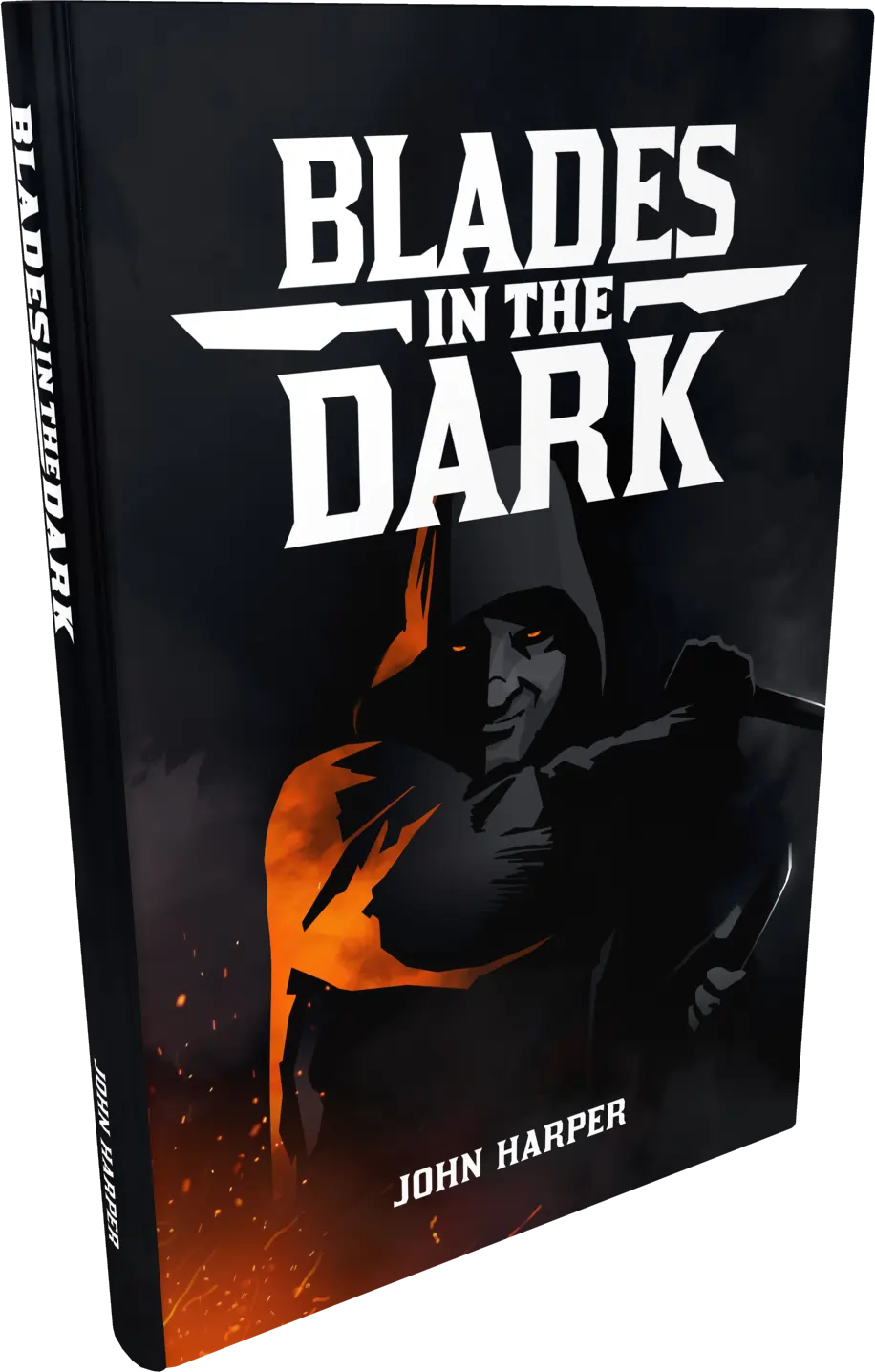
Blades in the Dark makes a heist part of an ongoing criminal life. A successful score brings money and reputation, but it also creates heat, obligations, and enemies who remain in Doskvol next session. John Harper’s game is strongest when a group wants those consequences to generate the campaign instead of waiting for a predetermined plot.
Doskvol keeps the trouble close
The haunted industrial city is protected from a dangerous outside world, making it difficult for a crew to escape every consequence simply by moving away. Criminal factions, authorities, and supernatural forces share a crowded environment.
That is a useful setting for a campaign about reputation. A person robbed today can become the contact needed tomorrow. An ally can help while expecting a favor that puts the crew in another conflict.
The book provides factions and districts with enough hooks to begin building that network. It is not a street-by-street simulation; its value lies in creating pressures that respond to the crew’s actions.
The crew is a second character sheet
Players choose a shared organization, such as a crew focused on theft, smuggling, assassination, or another criminal enterprise. It has development, relationships, and ambitions alongside the individual scoundrels.
That gives cooperation a concrete reason. A score can advance the enterprise even when it does not directly satisfy every character’s personal desire. Choosing the crew’s identity is therefore a major campaign decision, not a box to fill after character creation.
I would begin by discussing the kind of trouble the players want. A smuggling campaign and a violent turf campaign can use the same city while creating very different evenings.
Engagement and flashbacks reduce speculative planning
The group establishes a plan and its key detail, then uses engagement to determine the opening situation. Flashbacks can later reveal preparation relevant to an obstacle encountered during the score.
This is one of the system’s best practical features. Players do not have to spend an hour anticipating every guard arrangement before entering the interesting scene. Preparation becomes visible when it matters.
A flashback cannot simply undo an established present event. It supplies earlier action, with appropriate costs or resolution, rather than permission to declare that nothing difficult ever happened. Understanding that limit preserves the heist’s tension.
Position and effect make risk explicit
Before an action roll, position describes how dangerous the attempt is, while effect describes how much it can achieve. The distinction lets the group discuss a risky action more precisely than a single difficulty number.
A desperate maneuver with limited effect may be worth changing before rolling. Better tools, help, a setup action, or accepting more risk can alter the situation. That conversation is where much of the tactical decision-making lives.
It also creates a learning burden. Players and the GM need practice distinguishing severity from effectiveness. Groups wanting rules to settle every case without discussion may find the judgment involved tiring.
Stress gives players influence over consequences
Stress supports pushing oneself, teamwork, flashbacks, and resistance. Resistance lets a player reduce or avoid a consequence according to the situation, with the roll determining its stress cost.
That makes scoundrels capable without making them safe. They can insist on a better outcome now while moving toward trauma and the limits of continued pressure. The resource connects competence to vulnerability.
The GM should state consequences clearly enough for resistance to be a meaningful decision. A player cannot evaluate the cost of accepting a result that remains vaguely described.
Downtime turns the aftermath into play
Recovery, vice, projects, heat reduction, and crew business give the campaign a rhythm between scores. Entanglements and faction reactions make completed jobs matter beyond their immediate rewards.
This is where the game distinguishes itself from a generic heist generator. The crew’s life changes because of what it did. Downtime also gives individual ambitions somewhere to develop without requiring every score to serve one character’s backstory.
The phase structure takes learning. Moving into it from a game with continuous exploration can initially feel formal, though the structure becomes useful once everyone understands what each phase contributes.
B3’s verdict
Blades is an excellent fit for groups wanting decisive criminal action and a city that remembers it. The crew sheet, flashbacks, position and effect, stress, and downtime form a coherent campaign engine. Its main limitations are the initial vocabulary and reliance on shared judgment. Choose it for ambitious scores with consequences; choose a different system if exact map positioning and exhaustive advance planning are the central pleasures you want.
Where to start: rules, editions & buying options
Begin with John Harper’s Blades in the Dark core rulebook for the crew, scores, and downtime described here. Check that a listing is the complete game rather than an adventure, accessory, or supplement. Use the publisher page to confirm the format and included PDF.
Find the book
As an Amazon Associate I earn from qualifying purchases.